Recognize that the expression \$64x^2 - 81\( is a difference of two squares because it can be written as \)(8x)^2 - 9^2$.
Recall the difference of squares formula: \(a^2 - b^2 = (a - b)(a + b)\).
Identify \(a = 8x\) and \(b = 9\) from the expression.
Apply the formula by substituting \(a\) and \(b\): \((8x - 9)(8x + 9)\).
Write the factored form of the expression as \((8x - 9)(8x + 9)\).
Verified video answer for a similar problem:
This video solution was recommended by our tutors as helpful for the problem above
Video duration:
1m
Play a video:
0 Comments
Key Concepts
Here are the essential concepts you must grasp in order to answer the question correctly.
Difference of Squares
The difference of squares is a specific algebraic expression of the form a² - b², which can be factored into (a - b)(a + b). Recognizing this pattern allows for straightforward factoring of expressions where two perfect squares are subtracted.
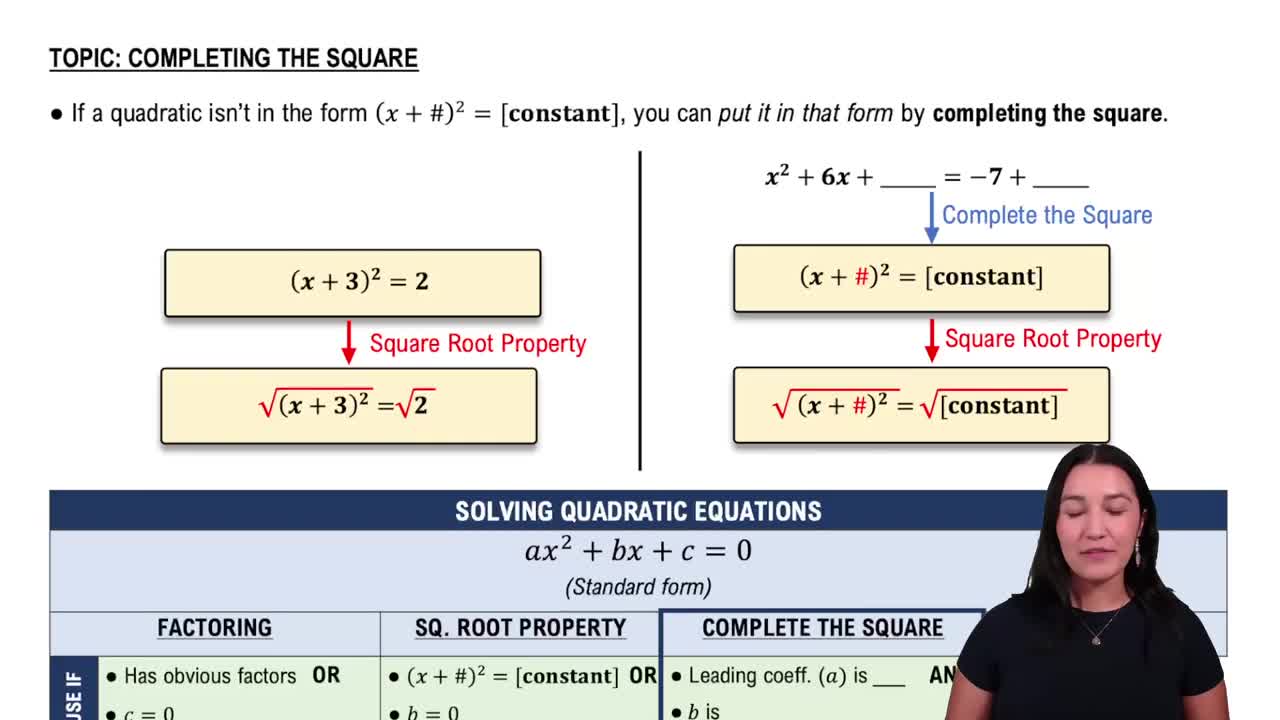
Solving Quadratic Equations by Completing the Square
Identifying Perfect Squares
To factor using the difference of squares, each term must be a perfect square. This means the terms can be expressed as the square of a number or variable, such as 64x² = (8x)² and 81 = 9², enabling the use of the difference of squares formula.
Solving Quadratic Equations by Completing the Square
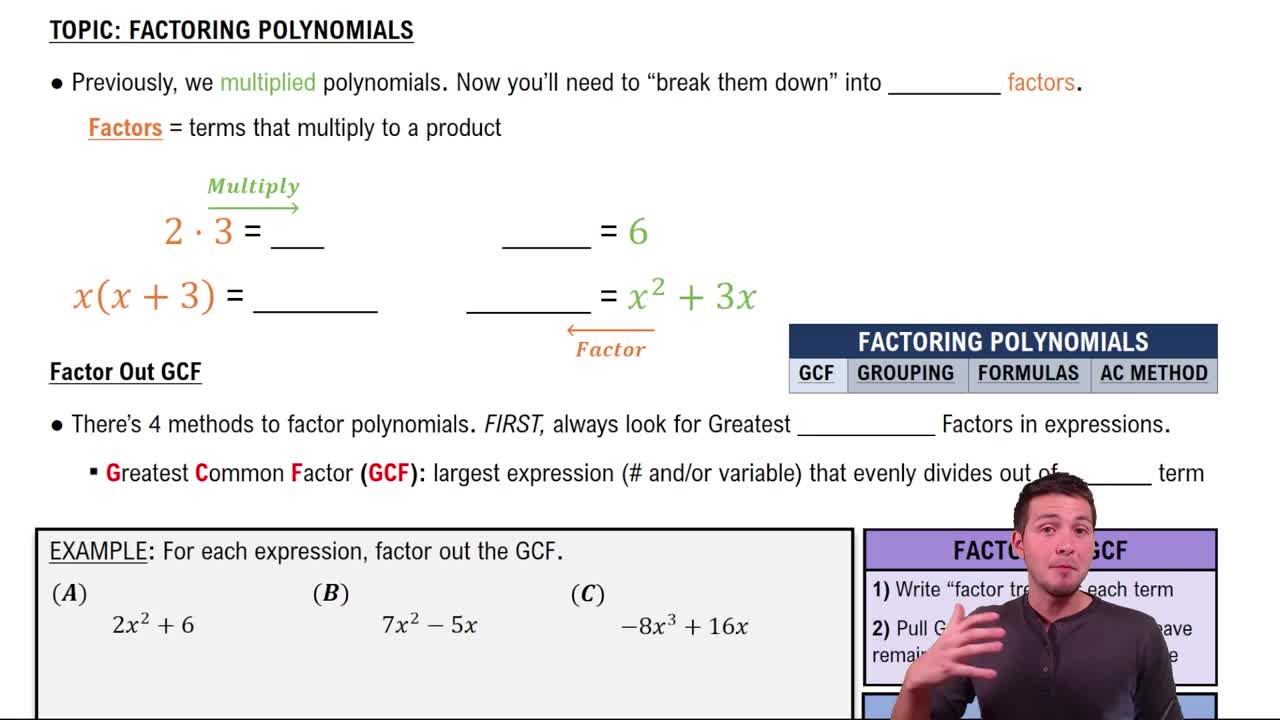
Factoring Polynomials
Factoring polynomials involves rewriting an expression as a product of simpler expressions. Understanding how to factor special forms like the difference of squares is essential for simplifying expressions and solving equations in algebra.