Multiply or divide as indicated. [(x^2-5x-24)/(x^2-x-12)]/[(x^2-10x+16)/(x^2+x-6)]
Verified step by step guidance
1
Rewrite the division of fractions as multiplication by the reciprocal. This means the problem becomes: [(x^2 - 5x - 24) / (x^2 - x - 12)] * [(x^2 + x - 6) / (x^2 - 10x + 16)].
Factorize each quadratic expression in the numerators and denominators. For example, factorize x^2 - 5x - 24 into (x - 8)(x + 3), x^2 - x - 12 into (x - 4)(x + 3), x^2 + x - 6 into (x - 2)(x + 3), and x^2 - 10x + 16 into (x - 8)(x - 2).
Substitute the factored forms back into the expression. The problem now looks like: [(x - 8)(x + 3) / (x - 4)(x + 3)] * [(x - 2)(x + 3) / (x - 8)(x - 2)].
Simplify the expression by canceling out common factors in the numerators and denominators. For instance, cancel (x + 3), (x - 8), and (x - 2) where applicable.
After canceling, multiply the remaining terms in the numerators and denominators to get the simplified expression. Ensure no further simplifications are possible.
Verified video answer for a similar problem:
This video solution was recommended by our tutors as helpful for the problem above
Video duration:
4m
Play a video:
0 Comments
Key Concepts
Here are the essential concepts you must grasp in order to answer the question correctly.
Factoring Polynomials
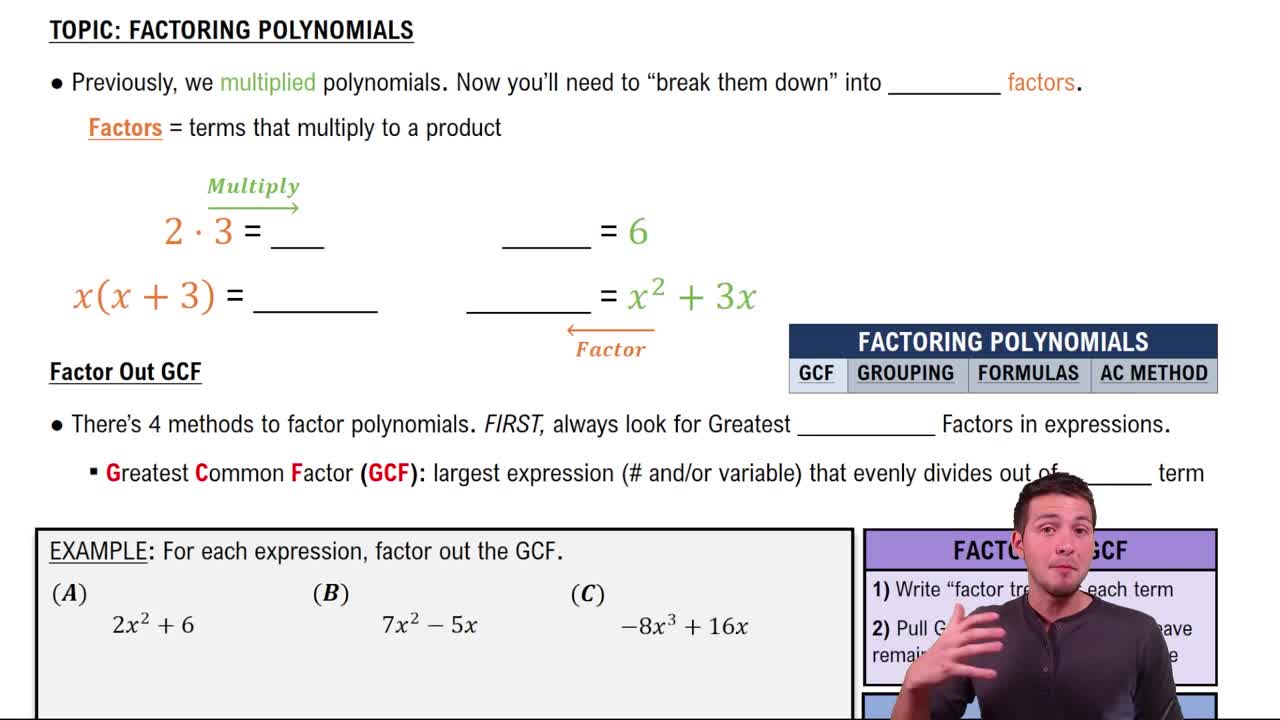
Factoring polynomials involves rewriting a polynomial expression as a product of its factors. This is essential for simplifying rational expressions, as it allows for the cancellation of common terms. For example, the polynomial x^2 - 5x - 24 can be factored into (x - 8)(x + 3), making it easier to work with in division or multiplication.
A rational expression is a fraction where both the numerator and the denominator are polynomials. Understanding how to manipulate these expressions, including multiplying and dividing them, is crucial in algebra. When dividing rational expressions, one can multiply by the reciprocal of the divisor, which simplifies the process of finding the result.
Simplifying complex fractions involves reducing fractions that contain other fractions in their numerators or denominators. This process often requires finding a common denominator and can include factoring and canceling terms. Mastery of this concept is vital for solving problems that involve multiple layers of fractions, as seen in the given question.

 4:24 minutes
 Verified step by step guidance
 07:30
07:30