In Exercises 93–102, factor and simplify each algebraic expression. (x+5)−1/2−(x+5)−3/2
Verified step by step guidance
1
Rewrite the expression using a common base. Both terms involve the base (x + 5) raised to different exponents. Let’s rewrite the expression as: (x + 5)^(-1/2) - (x + 5)^(-3/2).
Factor out the smallest power of (x + 5) from both terms. The smallest power here is (x + 5)^(-3/2). Factoring this out gives: (x + 5)^(-3/2) * [(x + 5)^(1) - 1].
Simplify the term inside the brackets. The expression becomes: (x + 5)^(-3/2) * [(x + 5) - 1].
Combine the terms inside the brackets. Simplify (x + 5) - 1 to get x + 4. The expression now becomes: (x + 5)^(-3/2) * (x + 4).
Express the final result in simplified form. The factored and simplified expression is: (x + 4) / (x + 5)^(3/2).
Verified video answer for a similar problem:
This video solution was recommended by our tutors as helpful for the problem above
Video duration:
3m
Play a video:
0 Comments
Key Concepts
Here are the essential concepts you must grasp in order to answer the question correctly.
Exponents and Negative Exponents
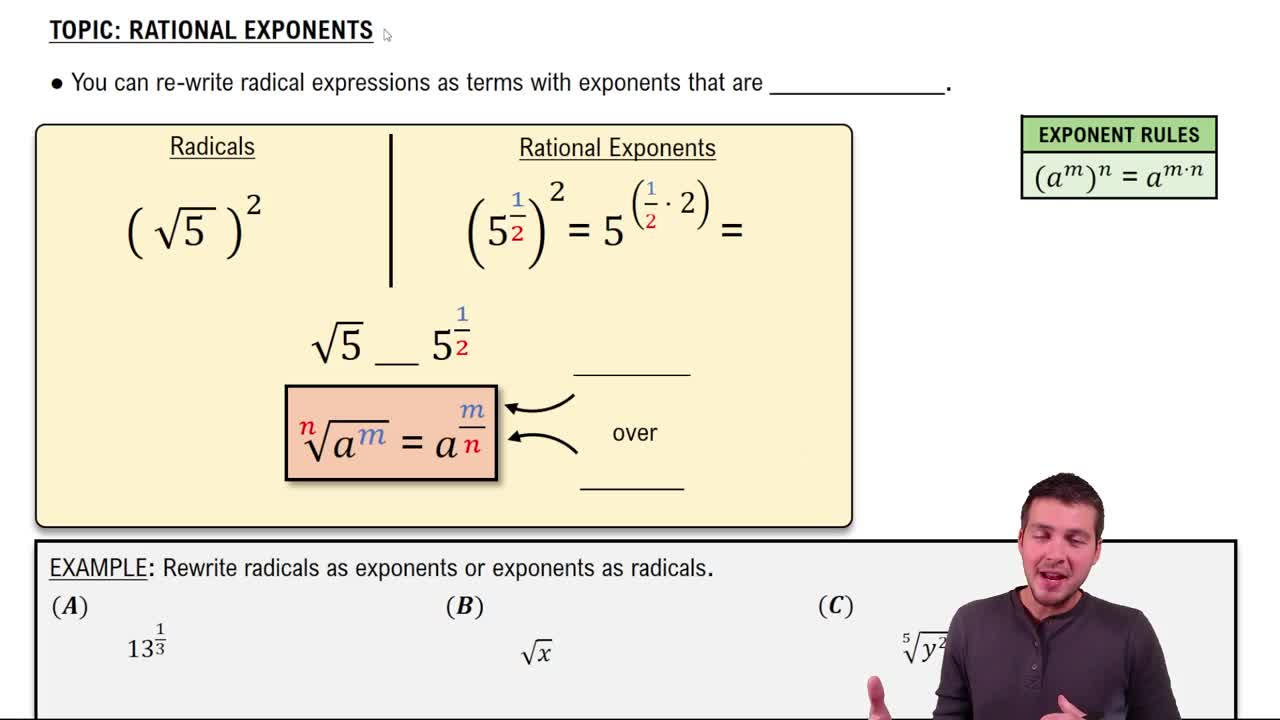
Exponents represent repeated multiplication of a base number. A negative exponent indicates the reciprocal of the base raised to the absolute value of the exponent. For example, a^(-n) = 1/(a^n). Understanding how to manipulate negative exponents is crucial for simplifying expressions like (x+5)^(-1/2) and (x+5)^(-3/2).
Factoring involves rewriting an expression as a product of its factors. This process is essential for simplifying complex algebraic expressions. In the given expression, recognizing common factors can help in reducing the terms effectively, making it easier to simplify the overall expression.
Simplifying algebraic fractions involves reducing the fraction to its simplest form by canceling common factors in the numerator and denominator. This process often requires factoring and understanding the properties of exponents. In the context of the given expression, simplifying will lead to a clearer and more manageable form.

 3:05 minutes
 Verified step by step guidance
 04:06
04:06