Multiply or divide, as indicated. ac + ad + bc + bd/a2 - b2 * a3 - b3/2a2 + 2ab + 2b2
Verified step by step guidance
1
First, rewrite the entire expression clearly as a multiplication and division problem: \[ \frac{ac + ad + bc + bd}{a^2 - b^2} \times \frac{a^3 - b^3}{2a^2 + 2ab + 2b^2} \].
Next, factor each polynomial where possible:
- Factor the numerator of the first fraction by grouping: \(ac + ad + bc + bd = (a + b)(c + d)\).
- Factor the denominator of the first fraction as a difference of squares: \(a^2 - b^2 = (a - b)(a + b)\).
Then, factor the numerator of the second fraction, which is a difference of cubes: \(a^3 - b^3 = (a - b)(a^2 + ab + b^2)\).
Also, factor the denominator of the second fraction by factoring out the common factor 2: \(2a^2 + 2ab + 2b^2 = 2(a^2 + ab + b^2)\).
Now, rewrite the entire expression with all factored forms and look for common factors in numerators and denominators to simplify the expression by canceling out those common factors.
Verified video answer for a similar problem:
This video solution was recommended by our tutors as helpful for the problem above
Video duration:
8m
Play a video:
0 Comments
Key Concepts
Here are the essential concepts you must grasp in order to answer the question correctly.
Polynomial Multiplication and Distribution
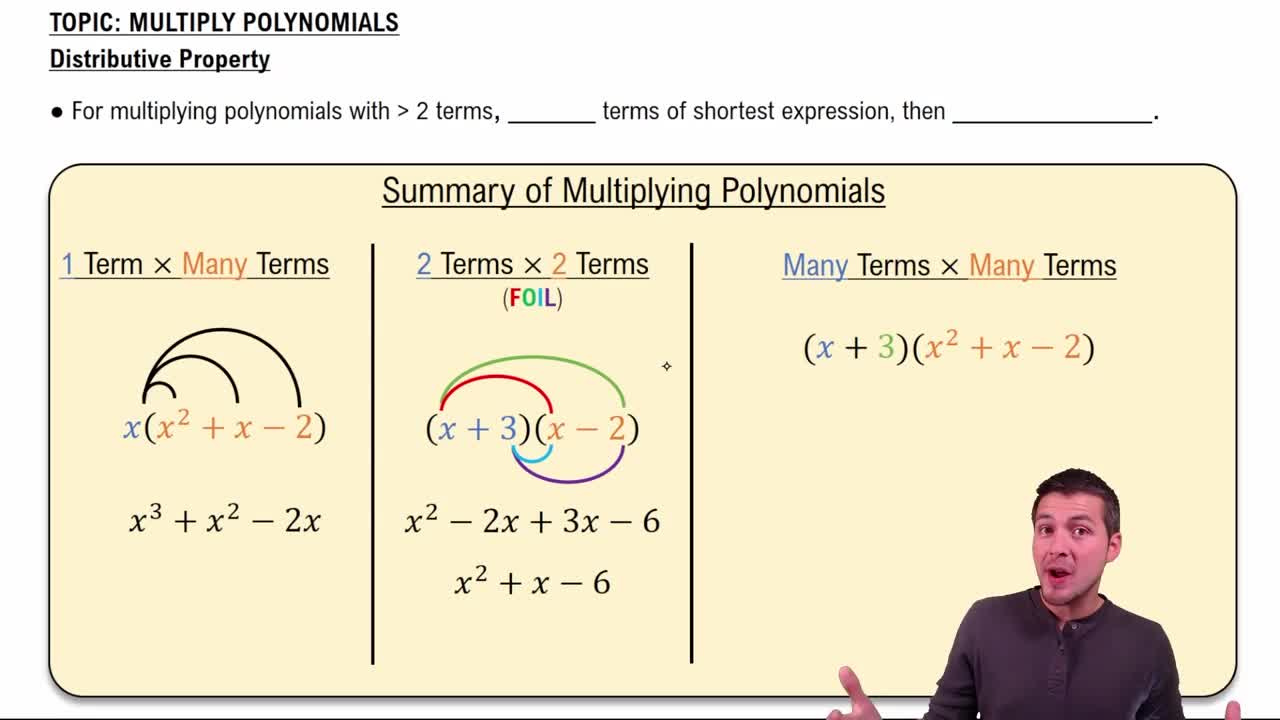
Polynomial multiplication involves applying the distributive property to multiply each term in one polynomial by every term in the other. This process expands expressions like (ac + ad + bc + bd) by combining like terms and simplifying the result.
Multiply Polynomials Using the Distributive Property
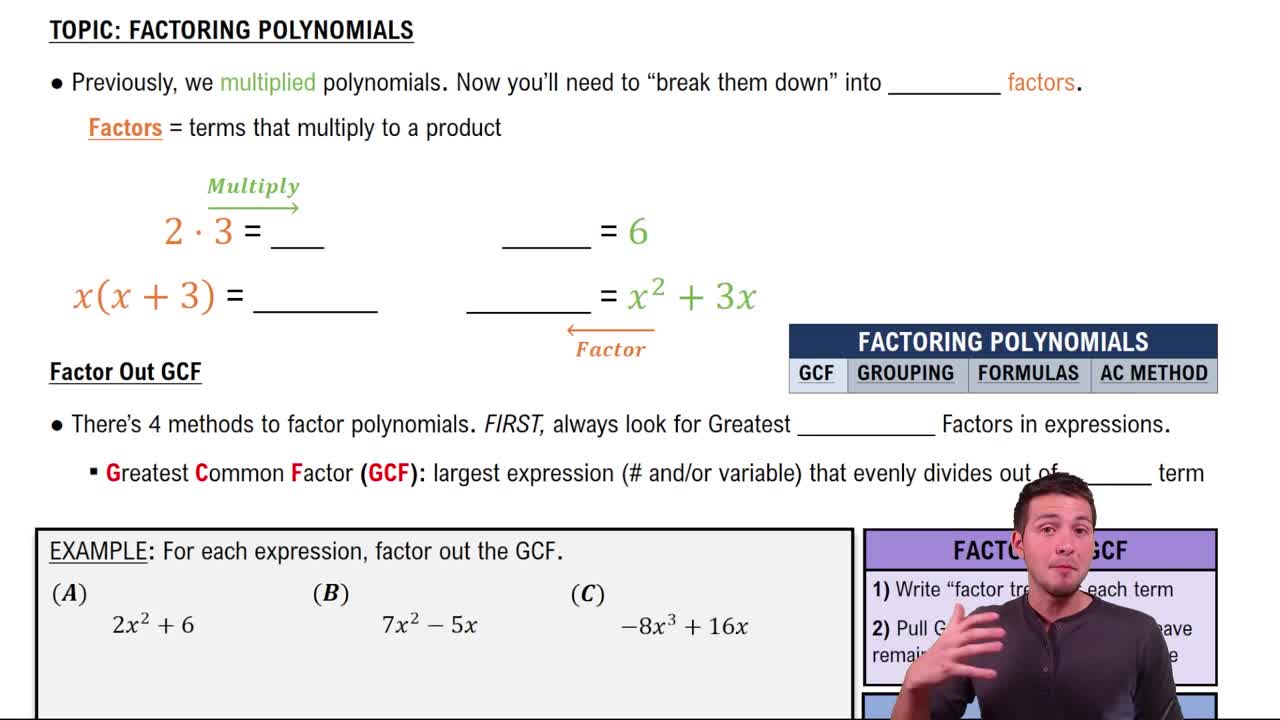
Factoring Polynomials
Factoring is rewriting a polynomial as a product of its factors. Recognizing patterns such as difference of squares (a^2 - b^2) or factoring out common terms helps simplify expressions and is essential before performing division or multiplication.
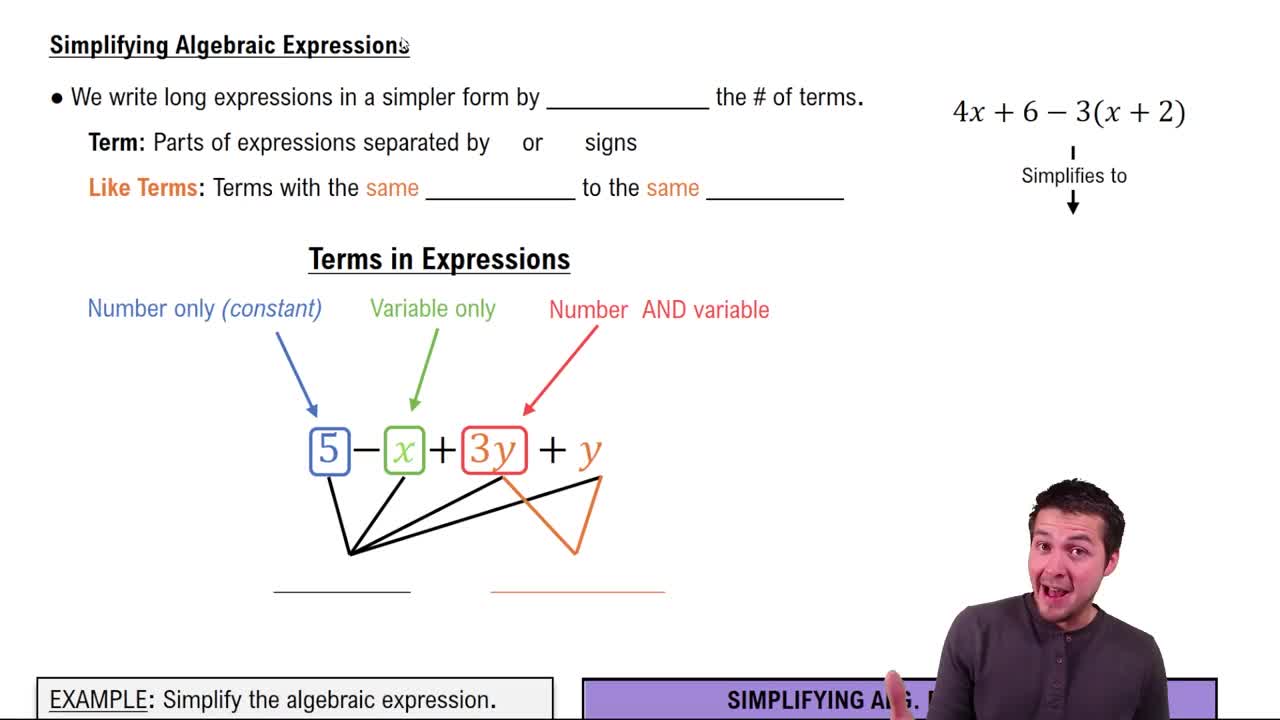
Simplifying rational expressions involves factoring numerators and denominators, canceling common factors, and reducing the expression to its simplest form. This is crucial when dividing or multiplying complex fractions to avoid errors and obtain the correct simplified result.

 8:08 minutes
 Verified step by step guidance
 04:15
04:15