In Exercises 9 - 16, find the following matrices: d. - 3A + 2B
Verified step by step guidance
1
Step 1: Identify the matrices A and B from the problem. Matrix A is \( \begin{bmatrix} 1 & 3 \\ 3 & 4 \\ 5 & 6 \end{bmatrix} \) and matrix B is \( \begin{bmatrix} 2 & -1 \\ 3 & -2 \\ 0 & 1 \end{bmatrix} \).
Step 2: Multiply matrix A by -3. This means multiplying each element of matrix A by -3, resulting in a new matrix \( -3A \).
Step 3: Multiply matrix B by 2. This means multiplying each element of matrix B by 2, resulting in a new matrix \( 2B \).
Step 4: Add the two resulting matrices from Step 2 and Step 3 element-wise. That is, add corresponding elements from \( -3A \) and \( 2B \) to get the matrix \( -3A + 2B \).
Step 5: Verify that the resulting matrix has the same dimensions as the original matrices (3 rows and 2 columns) and write the final matrix as the answer.
Verified video answer for a similar problem:
This video solution was recommended by our tutors as helpful for the problem above
Video duration:
4m
Play a video:
0 Comments
Key Concepts
Here are the essential concepts you must grasp in order to answer the question correctly.
Matrix Addition and Scalar Multiplication
Matrix addition involves adding corresponding elements of two matrices of the same dimensions. Scalar multiplication means multiplying every element of a matrix by a constant. Both operations are fundamental for combining matrices as in the expression -3A + 2B.
For matrix addition or subtraction, the matrices must have the same dimensions (same number of rows and columns). Here, matrices A and B are both 3x2, so operations like -3A + 2B are valid and can be performed element-wise.
When evaluating expressions like -3A + 2B, scalar multiplication is performed first on each matrix, followed by matrix addition. This ensures correct calculation by applying multiplication before addition, similar to arithmetic order of operations.

 4:58 minutes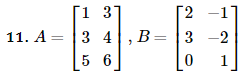
 Verified step by step guidance
 03:42
03:42