In Exercises 1–34, solve each rational equation. If an equation has no solution, so state.8/x²−9 + 4/x+3 = 2/x−3
Verified step by step guidance
1
Identify the least common denominator (LCD) for the rational expressions. The denominators are \(x^2 - 9\), \(x + 3\), and \(x - 3\). Notice that \(x^2 - 9\) can be factored as \((x + 3)(x - 3)\).
Multiply every term in the equation by the LCD, \((x + 3)(x - 3)\), to eliminate the denominators.
Simplify each term after multiplying by the LCD. This should result in a polynomial equation without fractions.
Solve the resulting polynomial equation. This may involve expanding, combining like terms, and factoring.
Check the solutions in the original equation to ensure they do not make any denominator zero, as these would be extraneous solutions.
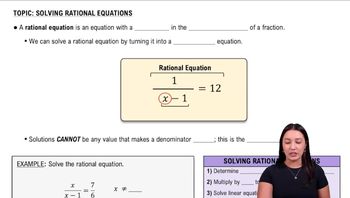
Verified video answer for a similar problem:
This video solution was recommended by our tutors as helpful for the problem above
Video duration:
5m
Play a video:
0 Comments
Key Concepts
Here are the essential concepts you must grasp in order to answer the question correctly.
Rational Equations
Rational equations are equations that involve fractions with polynomials in the numerator and denominator. To solve these equations, one typically finds a common denominator to eliminate the fractions, allowing for easier manipulation and simplification. Understanding how to work with rational expressions is crucial for solving these types of equations.
Finding a common denominator is essential when adding or subtracting fractions. In the context of rational equations, it allows us to combine terms and simplify the equation. The least common denominator (LCD) is often used to ensure all fractions can be expressed with the same denominator, facilitating the elimination of fractions from the equation.
When solving rational equations, it is important to check for extraneous solutions, which are solutions that do not satisfy the original equation. This can occur when both sides of the equation are manipulated, particularly when multiplying by a variable expression that could be zero. Verifying solutions against the original equation ensures that only valid solutions are accepted.

 5:29 minutes
 Verified step by step guidance
 05:56
05:56