In Exercises 1–30, factor each trinomial, or state that the trinomial is prime. Check each factorization using FOIL multiplication.y² − 12y + 20
Verified step by step guidance
1
Identify the trinomial: \( y^2 - 12y + 20 \).
Look for two numbers that multiply to the constant term, 20, and add up to the linear coefficient, -12.
Consider the pairs of factors of 20: (1, 20), (2, 10), (4, 5).
Check which pair of factors adds up to -12. Since both numbers need to be negative to add up to -12, consider (-2, -10).
Rewrite the trinomial as \((y - 2)(y - 10)\) and use the FOIL method to verify the factorization.
Verified video answer for a similar problem:
This video solution was recommended by our tutors as helpful for the problem above
Video duration:
5m
Play a video:
0 Comments
Key Concepts
Here are the essential concepts you must grasp in order to answer the question correctly.
Factoring Trinomials
Factoring trinomials involves rewriting a quadratic expression in the form ax² + bx + c as a product of two binomials. The goal is to find two numbers that multiply to 'c' and add to 'b'. In this case, we look for factors of 20 that sum to -12, which helps us express the trinomial in a simpler form.
A trinomial is considered prime if it cannot be factored into the product of two binomials with real coefficients. This occurs when there are no two numbers that satisfy the conditions for factoring. Recognizing a prime trinomial is essential for determining whether further factorization is possible.
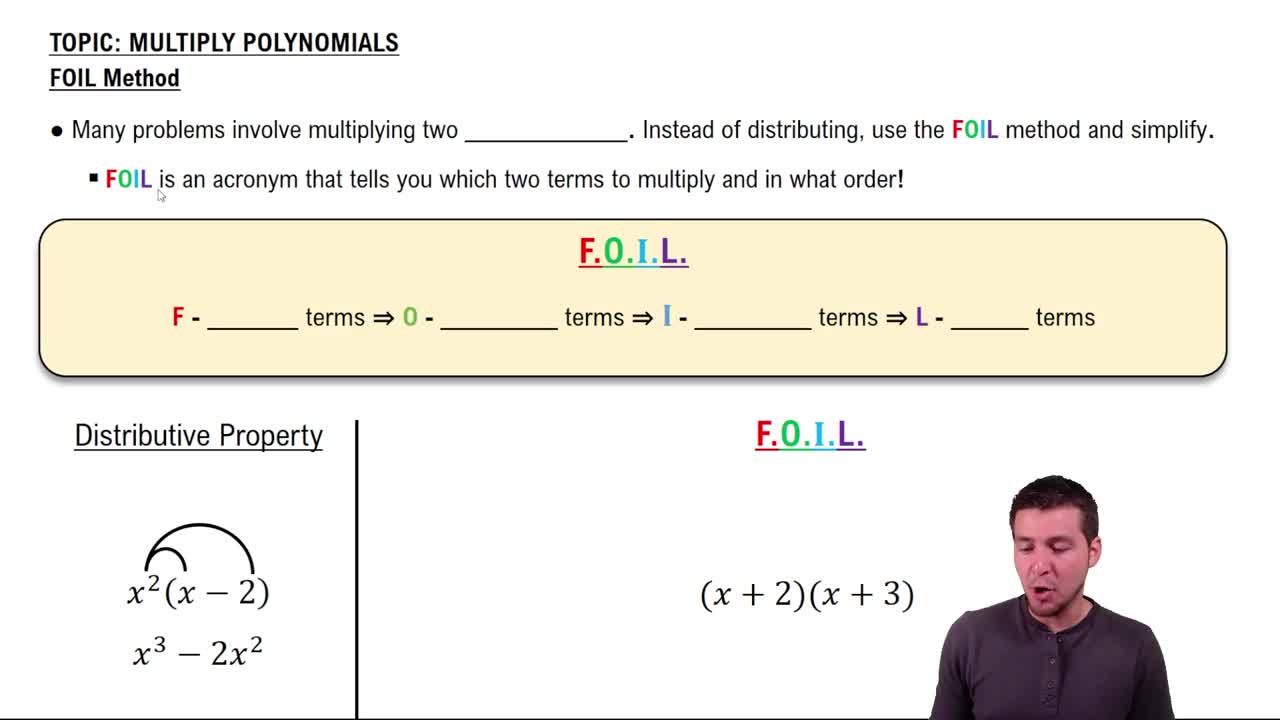
The FOIL method is a technique used to multiply two binomials, standing for First, Outside, Inside, Last. This method ensures that all terms are accounted for when expanding the product. After factoring a trinomial, using FOIL to check the factorization confirms the accuracy of the result by returning to the original expression.

 5:23 minutes
 Verified step by step guidance
 6:29
6:29