Insert ∈ or ∉ in each blank to make the resulting statement true. 13 _____ {3, 5, 12, 14}
Verified step by step guidance
1
Understand the problem: We need to determine whether the number 13 is an element of the set \{3, 5, 12, 14\}. The symbol \( \in \) means "is an element of," and \( \notin \) means "is not an element of."
Look at the set \{3, 5, 12, 14\} and check if 13 is listed among these elements.
Since 13 is not listed in the set, it means 13 is not an element of the set.
Therefore, the correct symbol to use in the blank is \( \notin \), which reads as "13 \(\notin\) \{3, 5, 12, 14\}."
This statement means "13 is not an element of the set \{3, 5, 12, 14\}," which is true.
Verified video answer for a similar problem:
This video solution was recommended by our tutors as helpful for the problem above
Video duration:
47s
Play a video:
0 Comments
Key Concepts
Here are the essential concepts you must grasp in order to answer the question correctly.
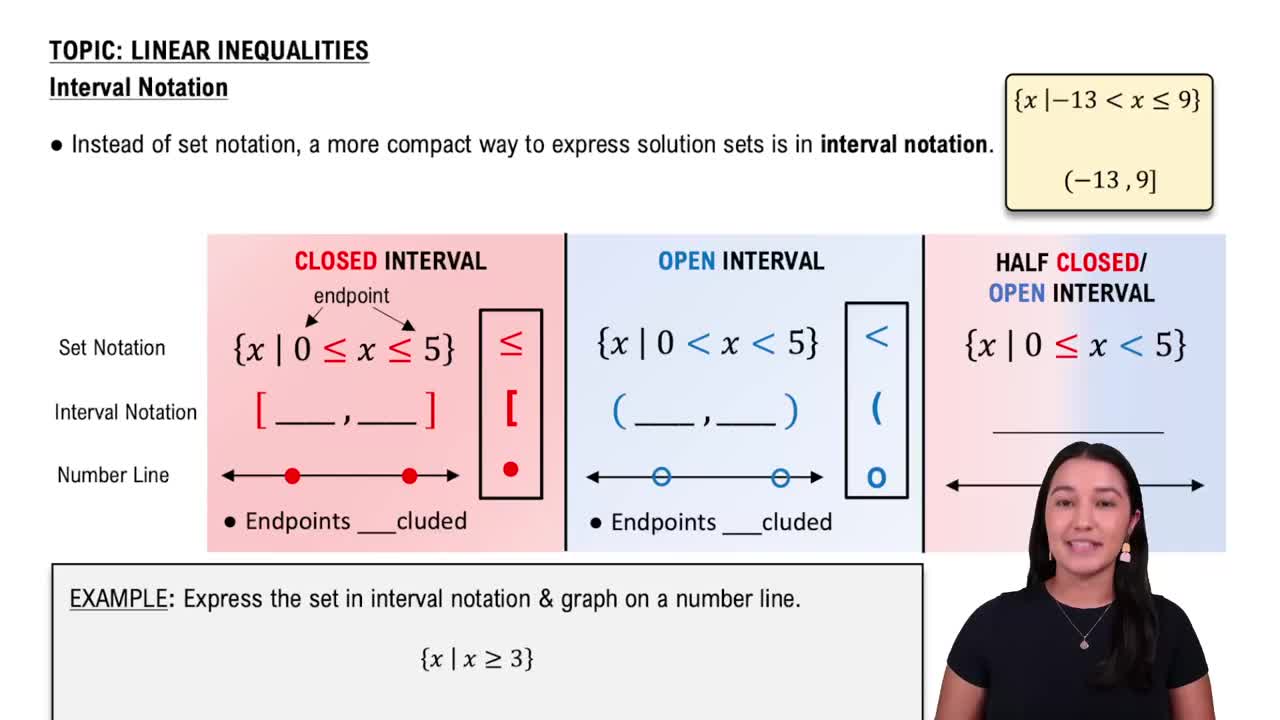
Set Membership (Element of a Set)
Set membership refers to whether a specific element belongs to a given set. The symbol '∈' denotes that an element is a member of the set, meaning it is included among the set's listed elements.
Set notation uses curly braces {} to list elements, and symbols like '∈' (element of) and '∉' (not an element of) to express membership. Understanding these symbols is essential to correctly interpret and write statements about sets.
To determine if an element belongs to a set, compare the element to each member of the set. If the element matches any member, use '∈'; if not, use '∉'. This evaluation is fundamental in set theory and problem-solving.

 0:47 minutes
 Verified step by step guidance
 05:25
05:25