Identify the problem as a division of two fractions: \(\frac{12}{13} \div \left(-\frac{4}{3}\right)\).
Recall that dividing by a fraction is the same as multiplying by its reciprocal. So rewrite the expression as \(\frac{12}{13} \times \left(-\frac{3}{4}\right)\).
Multiply the numerators together and the denominators together: numerator = \(12 \times (-3)\), denominator = \(13 \times 4\).
Write the product as a single fraction: \(\frac{12 \times (-3)}{13 \times 4}\).
Simplify the fraction by reducing common factors if possible, and express the final answer in simplest form.
Verified video answer for a similar problem:
This video solution was recommended by our tutors as helpful for the problem above
Video duration:
2m
Play a video:
0 Comments
Key Concepts
Here are the essential concepts you must grasp in order to answer the question correctly.
Dividing Fractions
Dividing fractions involves multiplying the first fraction by the reciprocal of the second. The reciprocal of a fraction is obtained by swapping its numerator and denominator. For example, dividing by 4/3 is the same as multiplying by 3/4.
To multiply fractions, multiply the numerators together and the denominators together. Simplify the resulting fraction if possible. This operation is straightforward and is used after converting division into multiplication by the reciprocal.
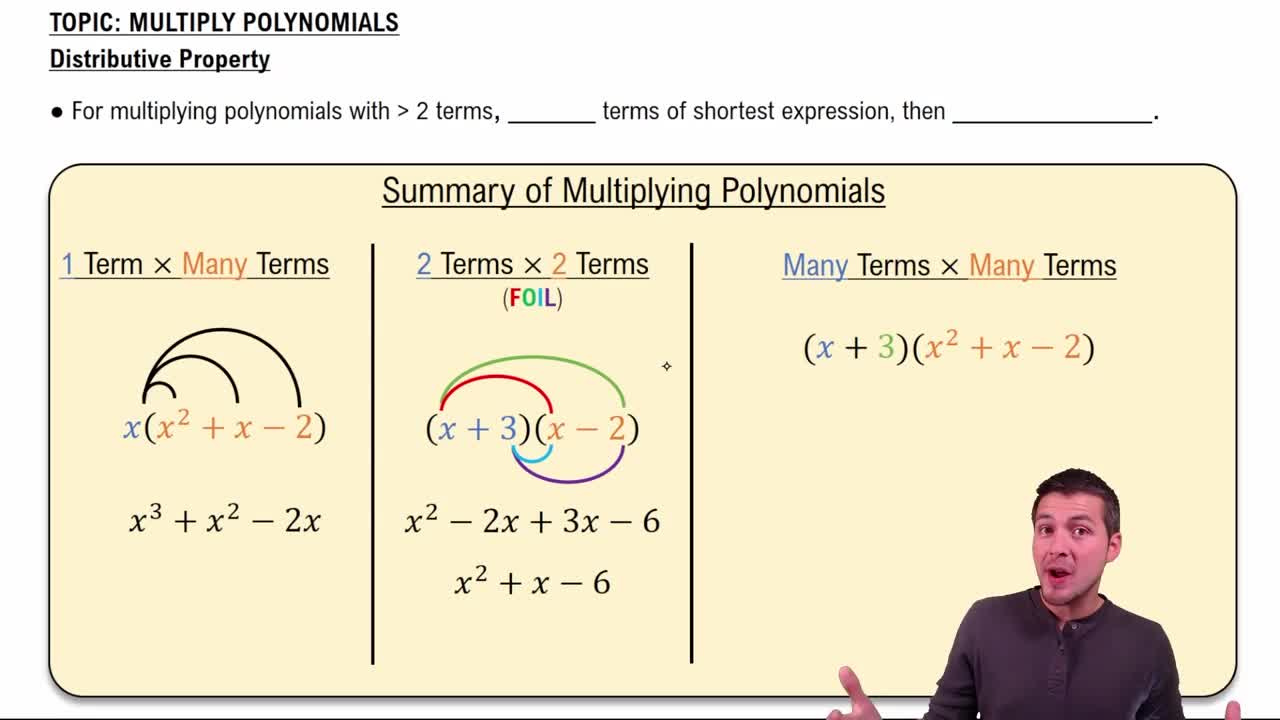
Multiply Polynomials Using the Distributive Property
Simplifying Fractions
Simplifying fractions means reducing them to their lowest terms by dividing numerator and denominator by their greatest common divisor (GCD). This makes the fraction easier to understand and work with, and is often the final step in fraction operations.

 2:36 minutes
 Verified step by step guidance
 04:22
04:22