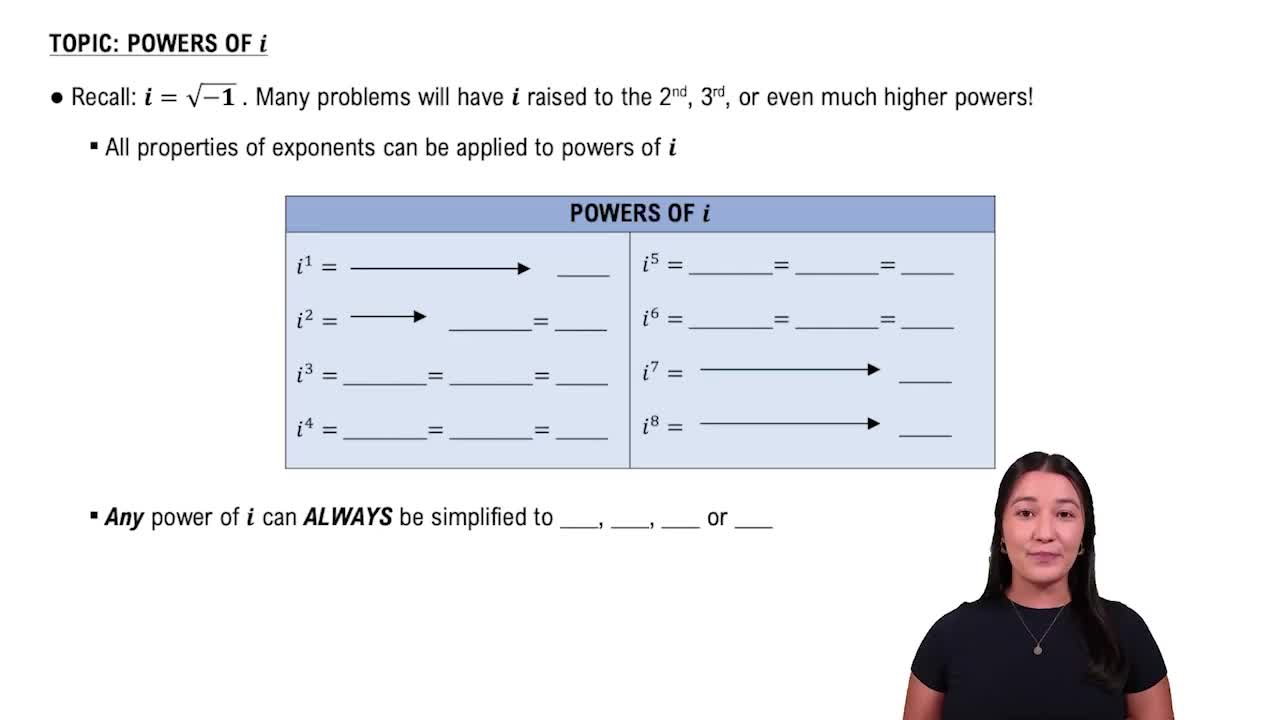
Recall that the imaginary unit \( i \) has the property \( i^2 = -1 \), and powers of \( i \) cycle every 4 steps: \( i^1 = i \), \( i^2 = -1 \), \( i^3 = -i \), \( i^4 = 1 \), and then the pattern repeats.
To simplify \( i^{-27} \), first express the negative exponent as the reciprocal: \( i^{-27} = \frac{1}{i^{27}} \).
Next, find the remainder when 27 is divided by 4 to use the cyclic pattern. Calculate \( 27 \mod 4 \) to determine the equivalent positive power of \( i \).
Use the remainder from the previous step to rewrite \( i^{27} \) as one of \( i^0, i^1, i^2, \) or \( i^3 \), based on the cycle.
Finally, substitute this value back into \( \frac{1}{i^{27}} \) and simplify the expression, possibly by multiplying numerator and denominator by the conjugate if needed to remove \( i \) from the denominator.
Verified video answer for a similar problem:
This video solution was recommended by our tutors as helpful for the problem above
Video duration:
2m
Play a video:
0 Comments
Key Concepts
Here are the essential concepts you must grasp in order to answer the question correctly.
Imaginary Unit i and its Powers
The imaginary unit i is defined as the square root of -1, with the property i² = -1. Powers of i cycle every four steps: i¹ = i, i² = -1, i³ = -i, and i⁴ = 1, then the pattern repeats. Understanding this cyclical behavior is essential for simplifying powers of i.
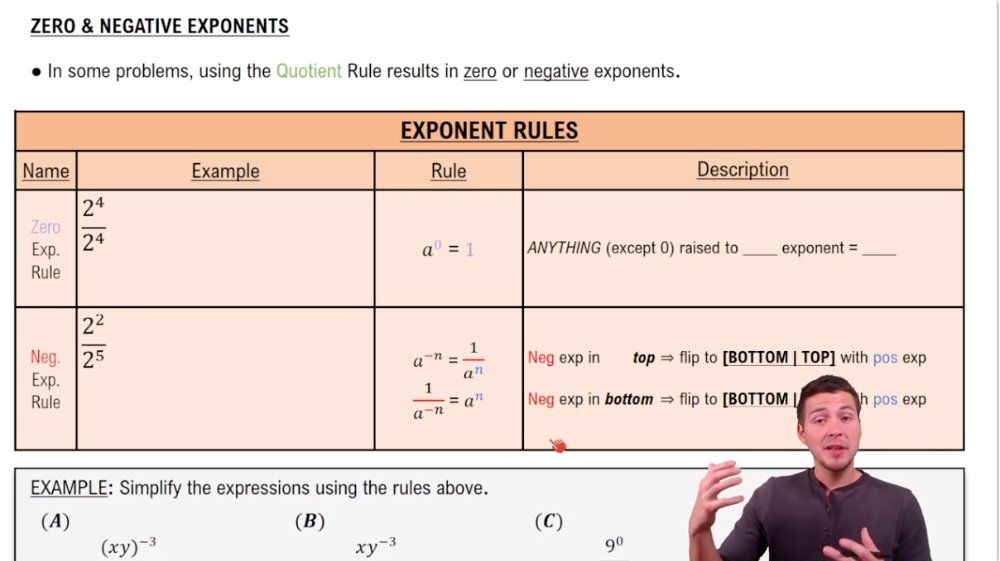
A negative exponent indicates the reciprocal of the base raised to the corresponding positive exponent. For example, i⁻ⁿ = 1 / iⁿ. Simplifying expressions with negative exponents often involves rewriting them as positive powers to apply known properties.
Since powers of i repeat every 4, reducing the exponent modulo 4 simplifies calculations. For instance, to simplify i⁻²⁷, find the remainder when 27 is divided by 4, then use this to determine the equivalent power within the cycle. This technique streamlines working with large exponents.

 2:39 minutes
 Verified step by step guidance
 04:10
04:10