Use the change-of-base theorem to find an approximation to four decimal places for each logarithm. log8 0.59
Verified step by step guidance
1
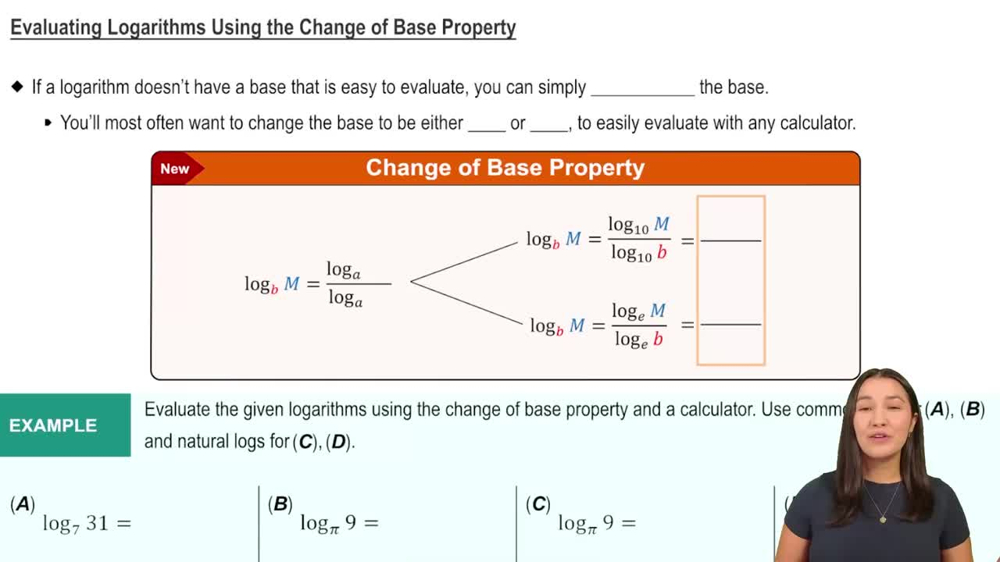
Recall the change-of-base formula for logarithms: \(\log_a b = \frac{\log_c b}{\log_c a}\), where \(c\) is any positive number (commonly 10 or \(e\)).
Apply the change-of-base formula to \(\log_8 0.59\) by choosing base 10 (common logarithm): \(\log_8 0.59 = \frac{\log_{10} 0.59}{\log_{10} 8}\).
Use a calculator to find the values of \(\log_{10} 0.59\) and \(\log_{10} 8\) separately (do not calculate the final division yet).
Divide the value of \(\log_{10} 0.59\) by the value of \(\log_{10} 8\) to get the approximate value of \(\log_8 0.59\).
Round the result to four decimal places to complete the approximation.
Verified video answer for a similar problem:
This video solution was recommended by our tutors as helpful for the problem above
Video duration:
2m
Play a video:
0 Comments
Key Concepts
Here are the essential concepts you must grasp in order to answer the question correctly.
Change-of-Base Theorem
The change-of-base theorem allows you to rewrite logarithms with any base into a quotient of logarithms with a new base, typically base 10 or e. It states that log_b(a) = log_c(a) / log_c(b), where c is the new base. This is useful for calculating logarithms on calculators that only have log or ln functions.
Logarithms are the inverse operations of exponentiation and follow specific properties such as log_b(xy) = log_b(x) + log_b(y) and log_b(x^r) = r log_b(x). Understanding these properties helps simplify expressions and solve logarithmic equations effectively.
When calculating logarithms, results often come as decimal numbers that need to be approximated to a certain number of decimal places. Rounding to four decimal places means adjusting the number so that only four digits appear after the decimal point, ensuring precision and clarity in answers.

 2:24 minutes
 Verified step by step guidance
 5:36
5:36