Add or subtract as indicated. (4x−10)/(x−2) − (x−4)/(x−2)
Verified step by step guidance
1
Identify that both rational expressions have the same denominator, which is \(x - 2\).
Since the denominators are the same, combine the numerators by subtracting: \((4x - 10) - (x - 4)\).
Distribute the subtraction across the second numerator: \$4x - 10 - x + 4$.
Combine like terms in the numerator: \((4x - x) + (-10 + 4)\).
Write the simplified numerator over the common denominator: \(\frac{3x - 6}{x - 2}\).
Verified video answer for a similar problem:
This video solution was recommended by our tutors as helpful for the problem above
Video duration:
2m
Play a video:
0 Comments
Key Concepts
Here are the essential concepts you must grasp in order to answer the question correctly.
Like Denominators in Rational Expressions
When adding or subtracting rational expressions, the denominators must be the same. If the denominators are identical, you can combine the numerators directly while keeping the denominator unchanged. This simplifies the process and avoids the need for finding a common denominator.
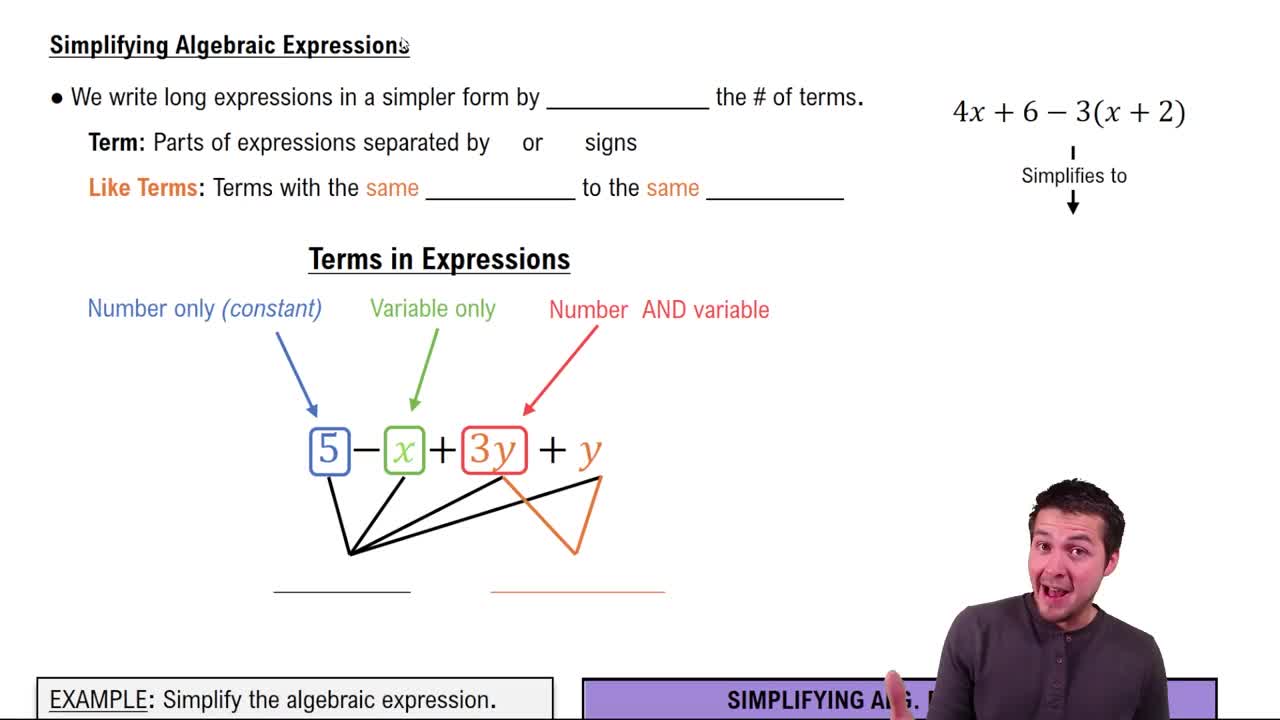
After confirming the denominators are the same, subtract or add the numerators as indicated. This involves combining like terms carefully to simplify the resulting expression. Proper handling of subtraction signs is crucial to avoid errors.
Once the numerators are combined, simplify the resulting rational expression by factoring and reducing common factors if possible. Simplification makes the expression easier to interpret and use in further calculations.

 2:39 minutes
 Verified step by step guidance
 02:58
02:58