Find the domain of each function. g(x) = √(x −2) /(x-5)
Verified step by step guidance
1
Step 1: Recall that the domain of a function is the set of all input values (x-values) for which the function is defined. For this function, g(x) = √(x − 2)/(x − 5), we need to consider two restrictions: (1) the square root must have a non-negative argument, and (2) the denominator cannot be zero.
Step 2: Start by addressing the square root restriction. The expression inside the square root, x − 2, must be greater than or equal to zero. Solve the inequality x − 2 ≥ 0 to find the values of x that satisfy this condition.
Step 3: Next, address the denominator restriction. The denominator, x − 5, cannot be equal to zero because division by zero is undefined. Solve the equation x − 5 = 0 to find the value of x that must be excluded from the domain.
Step 4: Combine the results from Step 2 and Step 3. The domain will include all x-values that satisfy the inequality x − 2 ≥ 0, except for the value of x that makes the denominator zero.
Step 5: Express the domain in interval notation, taking into account both the square root restriction and the excluded value from the denominator. Ensure the intervals are clearly defined and exclude the problematic value.
Verified video answer for a similar problem:
This video solution was recommended by our tutors as helpful for the problem above
Video duration:
3m
Play a video:
0 Comments
Key Concepts
Here are the essential concepts you must grasp in order to answer the question correctly.
Domain of a Function
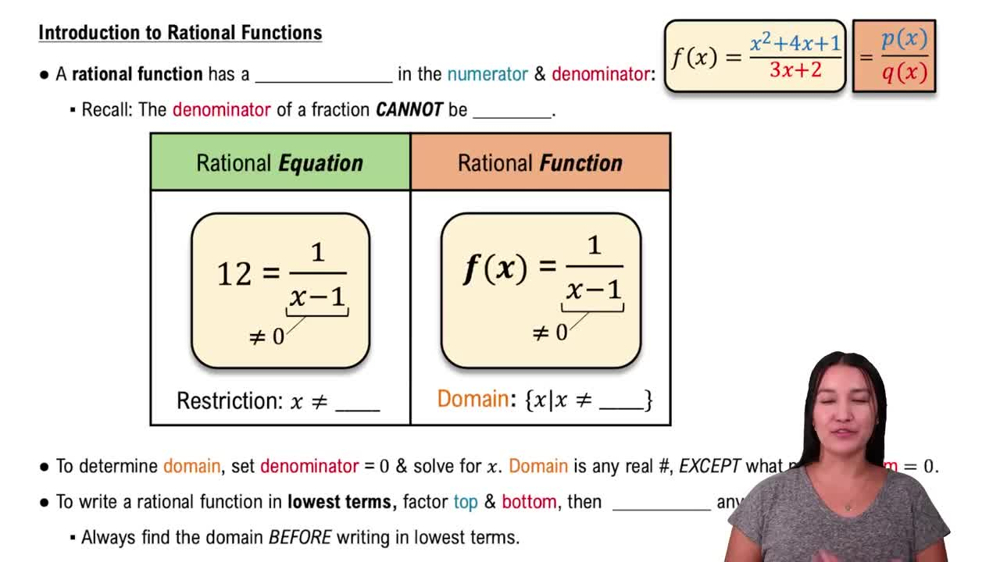
The domain of a function refers to the set of all possible input values (x-values) for which the function is defined. For rational and radical functions, the domain is restricted by values that would make the denominator zero or the expression under a square root negative. Understanding the domain is crucial for determining where the function can be evaluated without resulting in undefined or imaginary values.
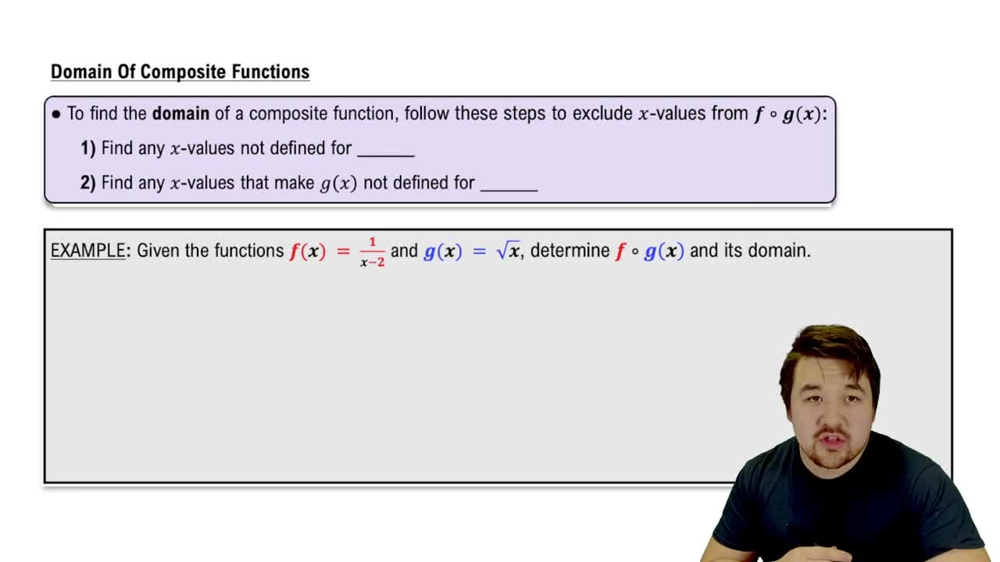
A square root function, denoted as √(x), is defined only for non-negative values of x. This means that the expression inside the square root must be greater than or equal to zero. In the context of the given function g(x), the condition x - 2 ≥ 0 must be satisfied, which directly influences the domain of the function.
A rational function is a function that can be expressed as the ratio of two polynomials. In the case of g(x), the denominator (x - 5) cannot be zero, as this would make the function undefined. Therefore, identifying values that make the denominator zero is essential for determining the domain, as these values must be excluded from the set of possible inputs.

 3:49 minutes
 Verified step by step guidance
 3:51
3:51