College Algebra
My Course
Learn
Exam Prep
AI Tutor
Study Guides
Textbook Solutions
Flashcards
Explore
My Course
Learn
Exam Prep
AI Tutor
Study Guides
Textbook Solutions
Flashcards
Explore
Back
Radical Expressions definitions
You can tap to flip the card.
Square Root
You can tap to
flip the card.
👆
Square Root
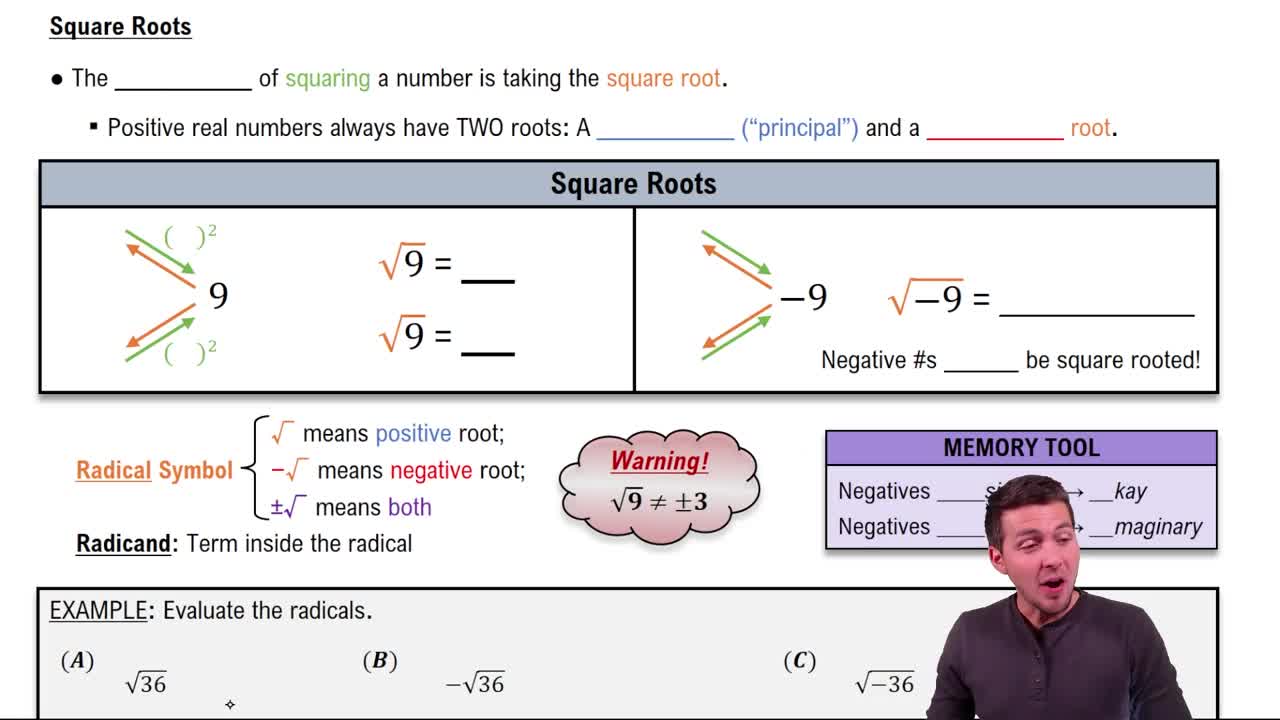
A value that, when multiplied by itself, results in the original number; positive numbers have both positive and negative forms.
Track progress
Control buttons has been changed to "navigation" mode.
1/15
Related practice
Recommended videos
Guided course
05:49
Square Roots
Patrick
3224
views
58
rank
2
comments
Guided course
06:56
Nth Roots
Patrick
2126
views
104
rank
1
comments
Terms in this set (15)
Hide definitions
Square Root
A value that, when multiplied by itself, results in the original number; positive numbers have both positive and negative forms.
Principal Root
The nonnegative solution indicated by the radical symbol alone, representing the main square root of a number.
Radical Symbol
A notation used to indicate the root of a number, with the index sometimes shown at its upper left.
Negative Root
The solution to a root that is the negative counterpart of the principal root, shown by a minus sign before the radical.
Cube Root
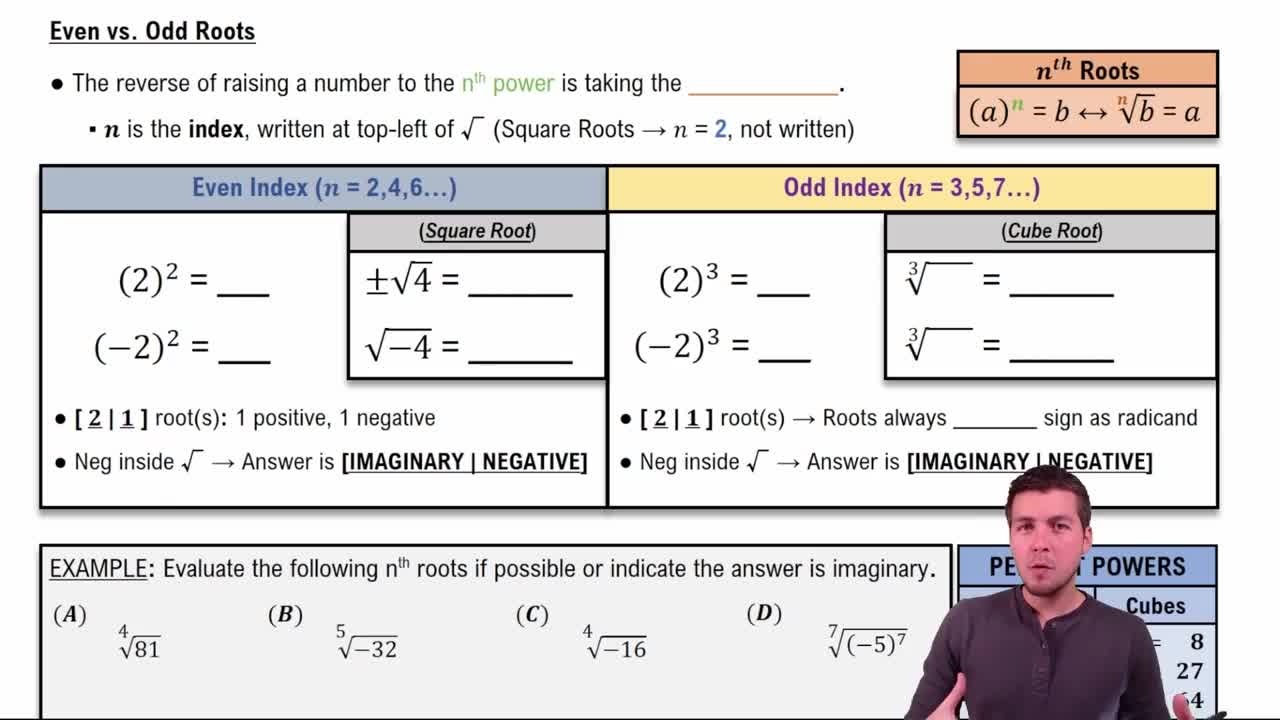
A value that, when used three times in multiplication, gives the original number; always matches the sign of the original number.
Nth Root
A value that, when raised to the nth power, equals the original number; generalizes square and cube roots.
Index
The small number written at the upper left of the radical symbol, indicating which root is being taken.
Radicand
The number or expression inside the radical symbol whose root is being evaluated.
Imaginary Number
A result that occurs when taking an even root of a negative number, since no real number squared gives a negative.
Perfect Square
A number that is the product of an integer multiplied by itself, such as 9 or 36.
Perfect Cube
A number that is the product of an integer used three times in multiplication, such as 8 or 27.
Even Index
A root with an index that is an even number, resulting in two real roots for positive radicands and imaginary results for negatives.
Odd Index
A root with an index that is an odd number, always yielding one real root that matches the sign of the radicand.
Exponent
A number indicating how many times a base is multiplied by itself; roots are the inverse operation.
Plus-Minus Notation
A shorthand indicating both the positive and negative roots, written as ± before the radical symbol.