Skip to main content
College Algebra
My Course
Learn
Exam Prep
AI Tutor
Study Guides
Textbook Solutions
Flashcards
Explore
Try the app
My Course
Learn
Exam Prep
AI Tutor
Study Guides
Textbook Solutions
Flashcards
Explore
Try the app
Back
Understanding Polynomial Functions definitions
3 students found this helpful
You can tap to flip the card.
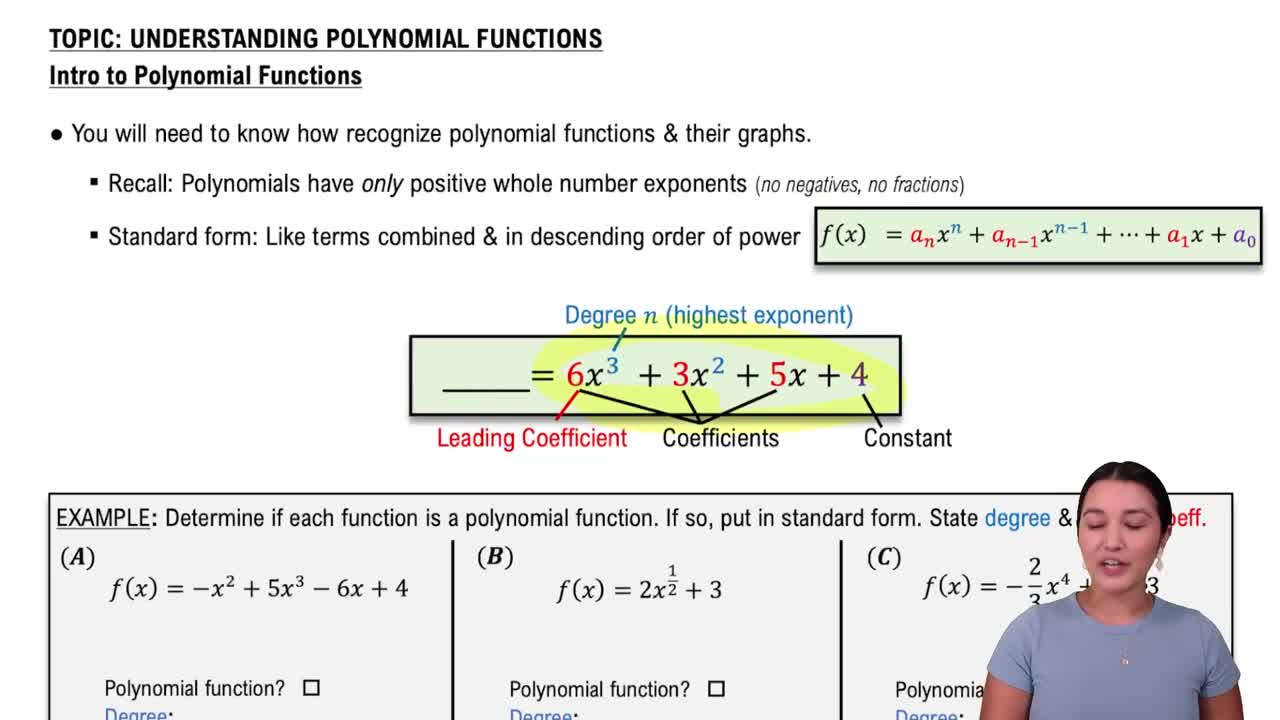
Polynomial Function
You can tap to flip the card.
👆
Polynomial Function
An expression with positive whole number exponents, written in standard form, whose graph is always smooth and continuous.
Track progress
Control buttons has been changed to "navigation" mode.
1/15
Related flashcards
Related practice
Recommended videos
Understanding Polynomial Functions quiz #1
Understanding Polynomial Functions
10 Terms
Understanding Polynomial Functions
4. Polynomial Functions
3 problems
Topic
Callie
Graphing Polynomial Functions
4. Polynomial Functions
6 problems
Topic
Justin
4. Polynomial Functions
5 topics
11 problems
Chapter
Callie
06:04
Introduction to Polynomial Functions
3884
views
124
rank
02:44
Maximum Turning Points of a Polynomial Function
1840
views
41
rank
03:42
Finding Zeros & Their Multiplicity
2786
views
60
rank
Terms in this set (15)
Hide definitions
Polynomial Function
An expression with positive whole number exponents, written in standard form, whose graph is always smooth and continuous.
Standard Form
A way of writing expressions with terms in descending order of exponents, combining like terms, and showing the leading coefficient first.
Exponent
A positive whole number indicating how many times a variable is multiplied by itself in a term.
Leading Coefficient
The coefficient attached to the term with the highest exponent when the expression is in standard form.
Degree
The highest exponent present in a polynomial, which determines the function's end behavior and maximum turning points.
End Behavior
The direction the graph moves as x approaches positive or negative infinity, determined by the leading coefficient and degree.
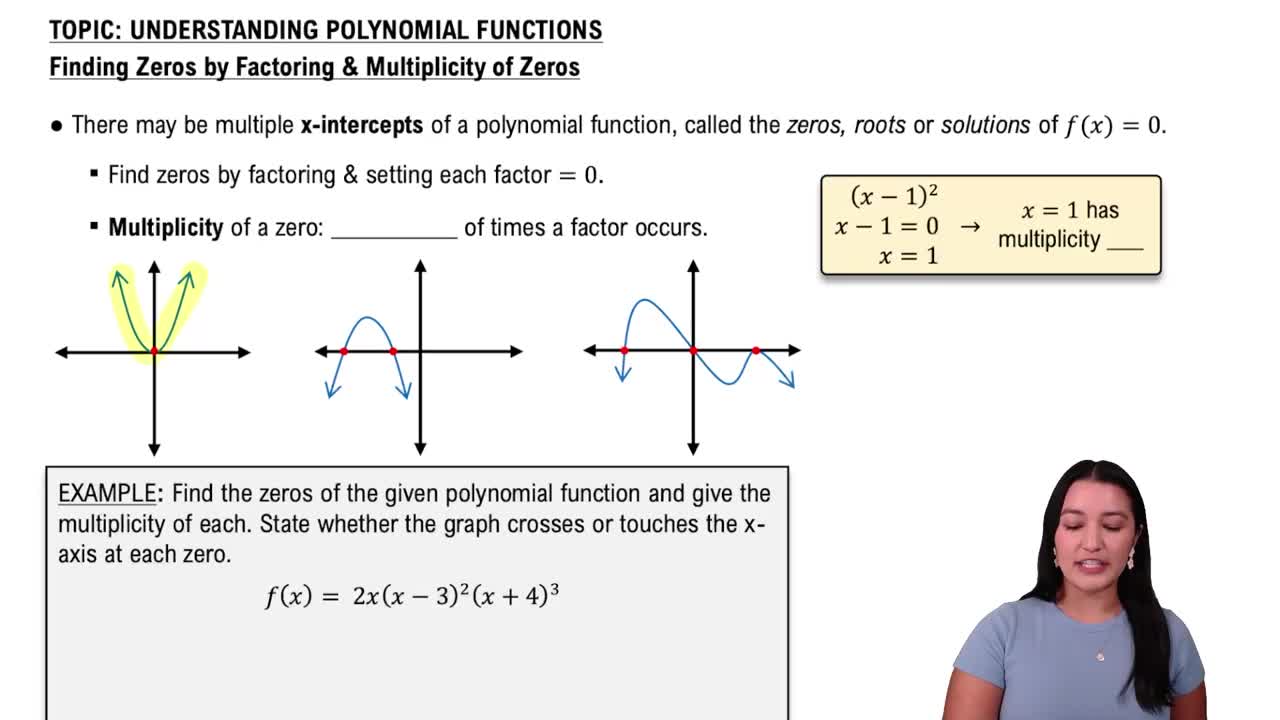
Zero
A value of x where the function equals zero, corresponding to an x-intercept on the graph.
Multiplicity
The number of times a particular factor appears, affecting whether the graph crosses or bounces at a zero.
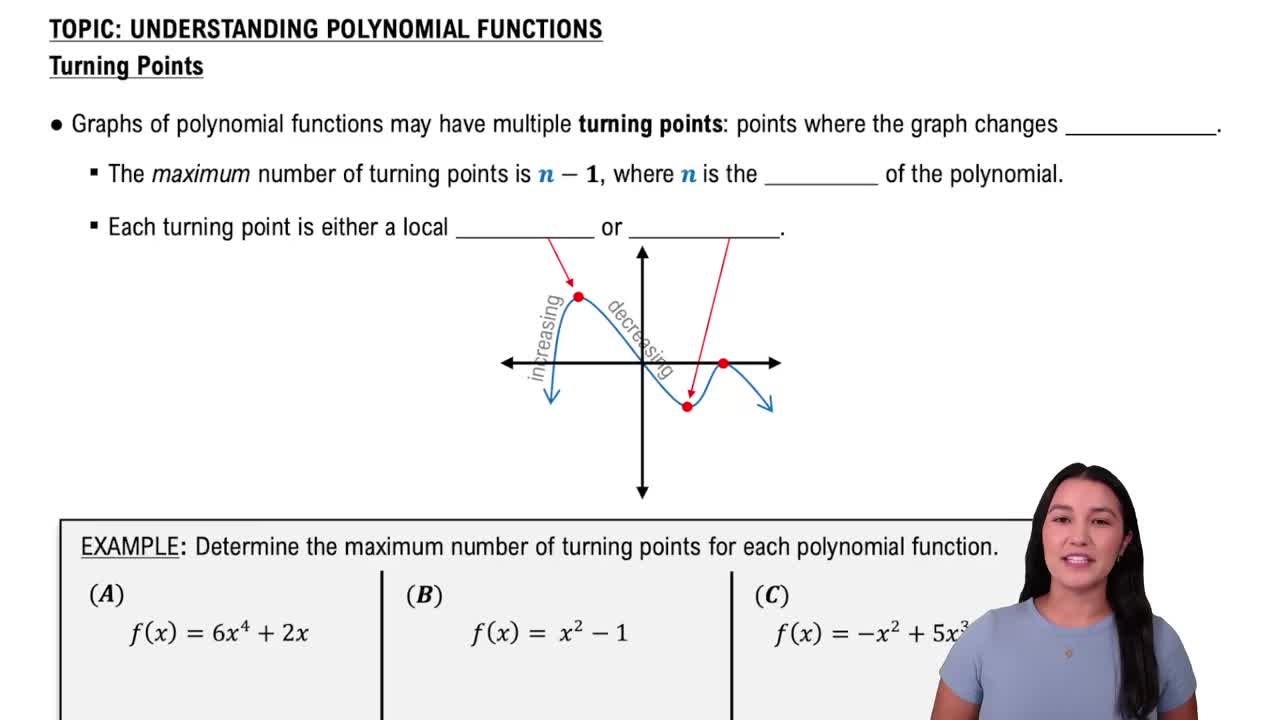
Turning Point
A location on the graph where the function changes direction from increasing to decreasing or vice versa.
Local Maximum
A point on the graph higher than all nearby points, representing the top of a hill.
Local Minimum
A point on the graph lower than all nearby points, representing the bottom of a valley.
X-Intercept
A point where the graph crosses or touches the x-axis, found by setting the function equal to zero.
Continuous Graph
A graph with no breaks or gaps, characteristic of all polynomial functions.
Smooth Curve
A graph with no sharp corners, always present in polynomial functions.
Domain
The set of all real numbers for which the function is defined, always from negative infinity to infinity for polynomials.
 BackBack

 06:04
06:04