Ch. 1 - Equations and Inequalities
Blitzer - College Algebra 8th Edition
Blitzer8th EditionCollege AlgebraISBN: 9780136970514Not the one you use?Change textbook
Chapter 2, Problem 2

Graph each equation in Exercises 1–4. Let x= -3, -2. -1, 0, 1, 2 and 3. y = x^2-3

Verified step by step guidance
1
Step 1: Understand the problem. The equation y = x^2 - 3 is a quadratic equation, which represents a parabola. We are tasked with graphing this equation by calculating the y-values for specific x-values: -3, -2, -1, 0, 1, 2, and 3.
Step 2: Substitute each x-value into the equation y = x^2 - 3 to calculate the corresponding y-value. For example, when x = -3, substitute -3 into the equation to find y: y = (-3)^2 - 3.
Step 3: Repeat the substitution process for all the given x-values (-3, -2, -1, 0, 1, 2, 3). For each x-value, calculate y by squaring the x-value and then subtracting 3. Record the resulting (x, y) pairs.
Step 4: Plot the calculated (x, y) points on a coordinate plane. For example, if one of the points is (-3, 6), plot this point by moving 3 units to the left on the x-axis and 6 units up on the y-axis.
Step 5: Connect the plotted points with a smooth curve to form the parabola. Ensure the curve opens upwards (since the coefficient of x^2 is positive) and has its vertex at the lowest point of the graph.

Verified video answer for a similar problem:

This video solution was recommended by our tutors as helpful for the problem above.
Video duration:
3m
Was this helpful?

Key Concepts

Here are the essential concepts you must grasp in order to answer the question correctly.

Quadratic Functions

A quadratic function is a polynomial function of degree two, typically expressed in the form y = ax^2 + bx + c. The graph of a quadratic function is a parabola, which can open upwards or downwards depending on the sign of the coefficient 'a'. Understanding the shape and properties of parabolas is essential for graphing quadratic equations.
Recommended video:
06:36
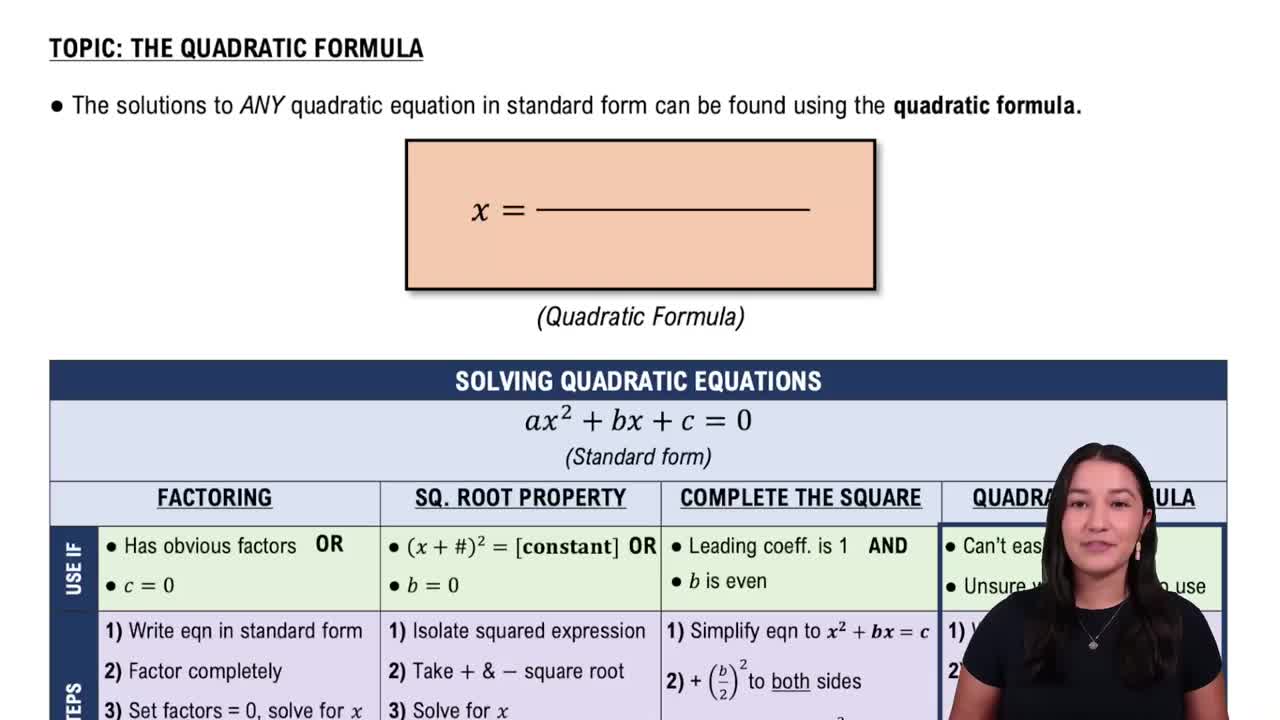
Solving Quadratic Equations Using The Quadratic Formula

Evaluating Functions

Evaluating a function involves substituting specific values for the variable(s) in the function's equation. In this case, substituting the given x-values (-3, -2, -1, 0, 1, 2, 3) into the equation y = x^2 - 3 allows us to calculate the corresponding y-values. This process is crucial for plotting points on the graph.
Recommended video:
4:26
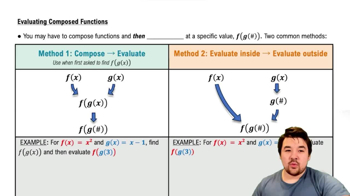
Evaluating Composed Functions

Graphing Points

Graphing points involves plotting the calculated (x, y) pairs on a coordinate plane. Each point represents a solution to the equation, and connecting these points helps visualize the function's behavior. Understanding how to accurately plot points and interpret the resulting graph is vital for analyzing the function's characteristics.
Recommended video:
Guided course
04:29
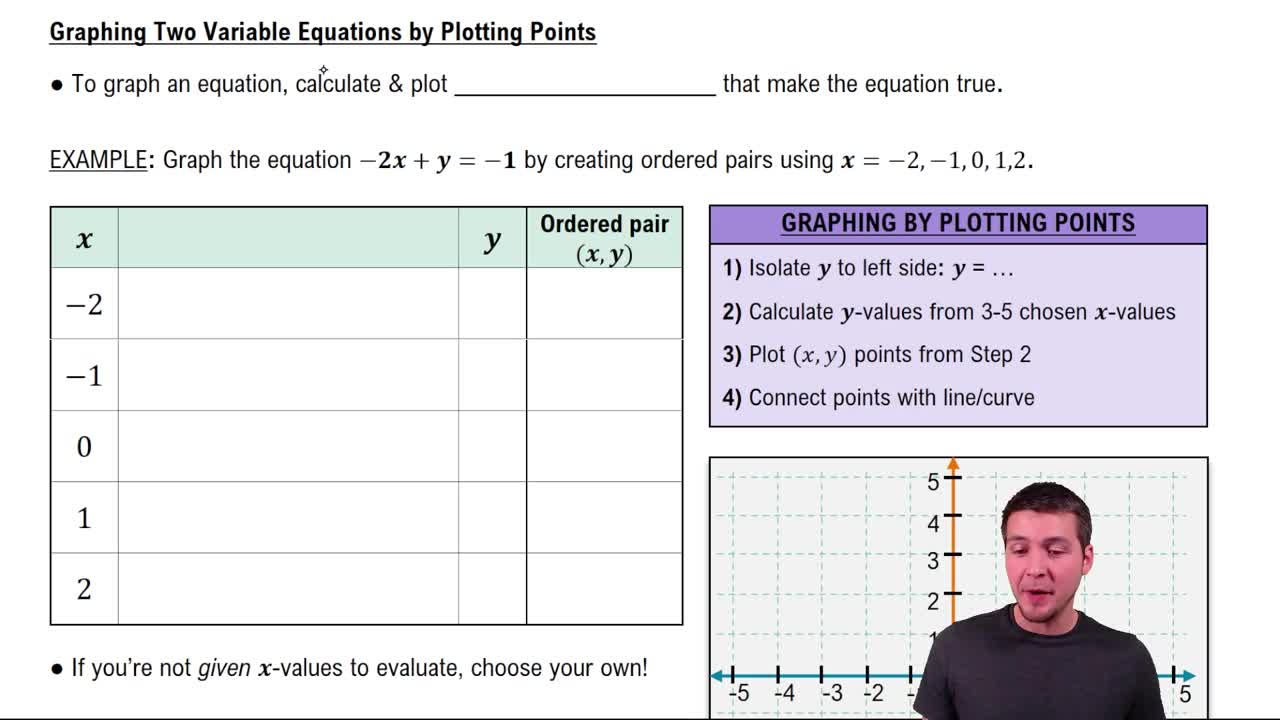
Graphing Equations of Two Variables by Plotting Points