Ch. 1 - Equations and Inequalities
Blitzer - College Algebra 8th Edition
Blitzer8th EditionCollege AlgebraISBN: 9780136970514Not the one you use?Change textbook
Chapter 2, Problem 105

In Exercises 101–106, solve each equation.x(x+1)342(x+1)2=0 x(x + 1)^3 - 42(x + 1)^2 = 0

Verified step by step guidance
1
Start by observing the given equation: \(x(x + 1)^3 - 42(x + 1)^2 = 0\). Notice that both terms contain a common factor involving \((x + 1)^2\).
Factor out the greatest common factor (GCF), which is \((x + 1)^2\), from the entire equation: \( (x + 1)^2 \left[ x(x + 1) - 42 \right] = 0 \).
Simplify the expression inside the brackets: \(x(x + 1) - 42 = x^2 + x - 42\).
Set each factor equal to zero to find the solutions: 1) \((x + 1)^2 = 0\) 2) \(x^2 + x - 42 = 0\).
Solve each equation separately: - For \((x + 1)^2 = 0\), solve for \(x\). - For \(x^2 + x - 42 = 0\), use the quadratic formula or factoring to find the values of \(x\).

Verified video answer for a similar problem:

This video solution was recommended by our tutors as helpful for the problem above.
Video duration:
5m
Was this helpful?

Key Concepts

Here are the essential concepts you must grasp in order to answer the question correctly.

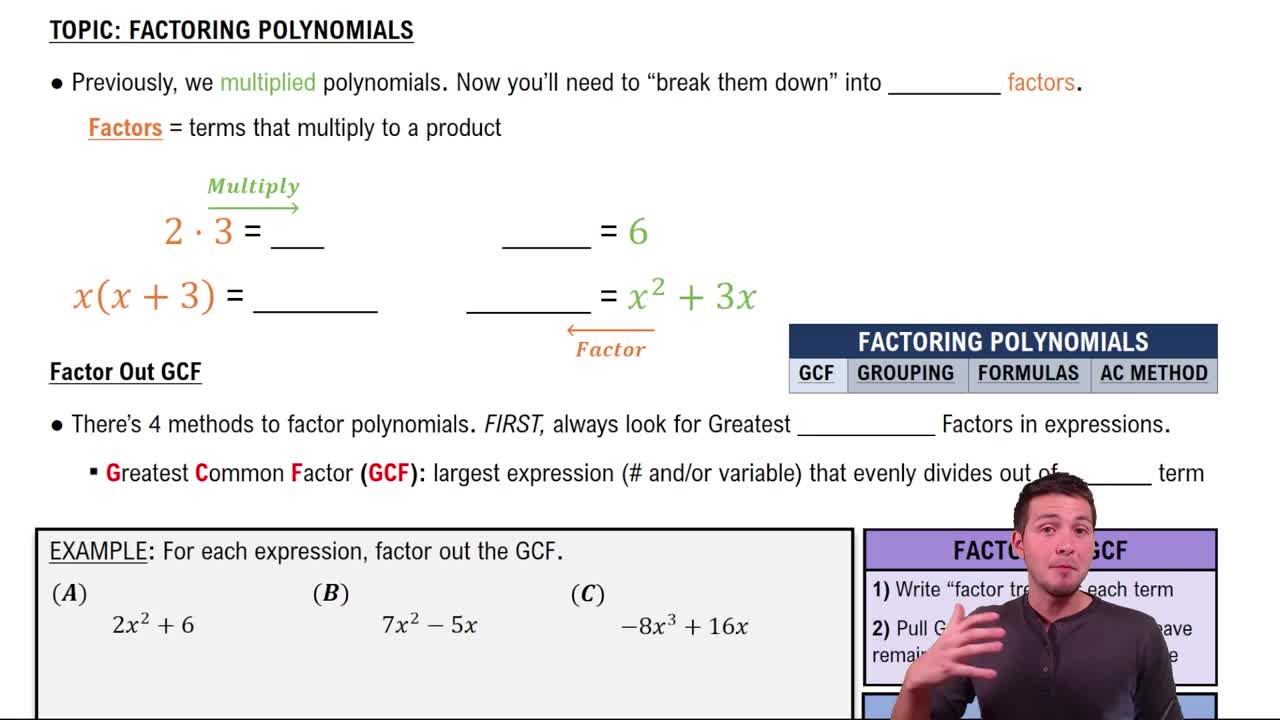
Factoring Polynomial Expressions

Factoring involves rewriting a polynomial as a product of simpler polynomials or expressions. It is essential for solving equations by setting each factor equal to zero. Recognizing common factors, such as powers of (x + 1), helps simplify the equation and find solutions efficiently.
Recommended video:
Guided course
07:30
Introduction to Factoring Polynomials

Zero Product Property

The zero product property states that if the product of two or more factors is zero, then at least one of the factors must be zero. This principle allows us to solve polynomial equations by factoring and then setting each factor equal to zero to find all possible solutions.
Recommended video:
3:49
Product, Quotient, and Power Rules of Logs

Solving Polynomial Equations

Solving polynomial equations involves finding all values of the variable that satisfy the equation. After factoring, each factor is set to zero, and the resulting simpler equations are solved. This process may yield multiple roots, including repeated roots if factors have powers greater than one.
Recommended video:
5:02
Solving Logarithmic Equations