Ch. 1 - Equations and Inequalities
Blitzer - College Algebra 8th Edition
Blitzer8th EditionCollege AlgebraISBN: 9780136970514Not the one you use?Change textbook
Chapter 2, Problem 7

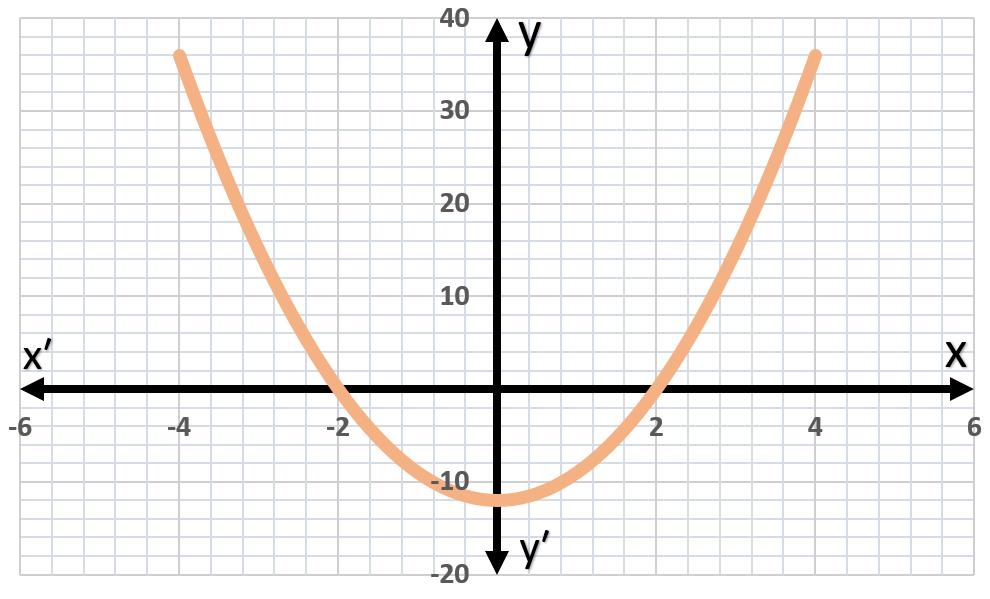
In Exercises 6–8, use the graph and determine the x-intercepts if any, and the y-intercepts if any. For each graph, tick marks along the axes represent one unit each.
Graph of a quadratic function showing x and y axes with tick marks for unit measurement.

Verified step by step guidance
1
Observe the graph of the quadratic function provided. The x-axis and y-axis are labeled, and tick marks represent one unit each.
To find the x-intercepts, look for the points where the graph crosses the x-axis. These are the points where the y-value is 0.
From the graph, identify the x-coordinates of the points where the curve intersects the x-axis. These are the x-intercepts.
To find the y-intercept, look for the point where the graph crosses the y-axis. This is the point where the x-value is 0.
From the graph, identify the y-coordinate of the point where the curve intersects the y-axis. This is the y-intercept.

Verified video answer for a similar problem:

This video solution was recommended by our tutors as helpful for the problem above.
Video duration:
1m
Was this helpful?

Key Concepts

Here are the essential concepts you must grasp in order to answer the question correctly.

X-Intercepts

X-intercepts are the points where a graph crosses the x-axis. At these points, the value of y is zero. To find the x-intercepts of a function, one typically sets the function equal to zero and solves for x. In the context of a quadratic function, this can involve factoring, using the quadratic formula, or completing the square.
Recommended video:
Guided course
04:08
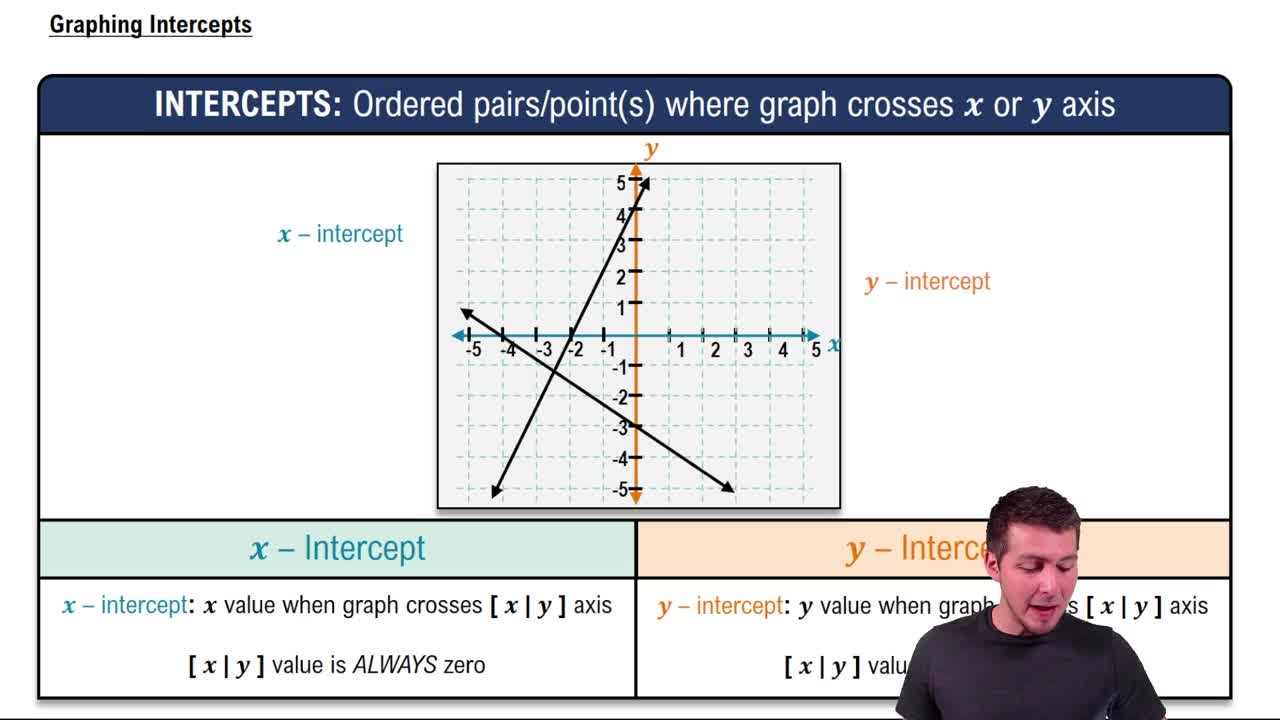
Graphing Intercepts

Y-Intercepts

Y-intercepts are the points where a graph crosses the y-axis, which occurs when the value of x is zero. To determine the y-intercept of a function, one evaluates the function at x = 0. For quadratic functions, this is simply the constant term when the function is expressed in standard form.
Recommended video:
Guided course
04:08
Graphing Intercepts

Quadratic Functions

Quadratic functions are polynomial functions of degree two, typically expressed in the form f(x) = ax² + bx + c, where a, b, and c are constants. The graph of a quadratic function is a parabola, which can open upwards or downwards depending on the sign of the coefficient 'a'. Understanding the shape and properties of parabolas is essential for analyzing their intercepts.
Recommended video:
06:36
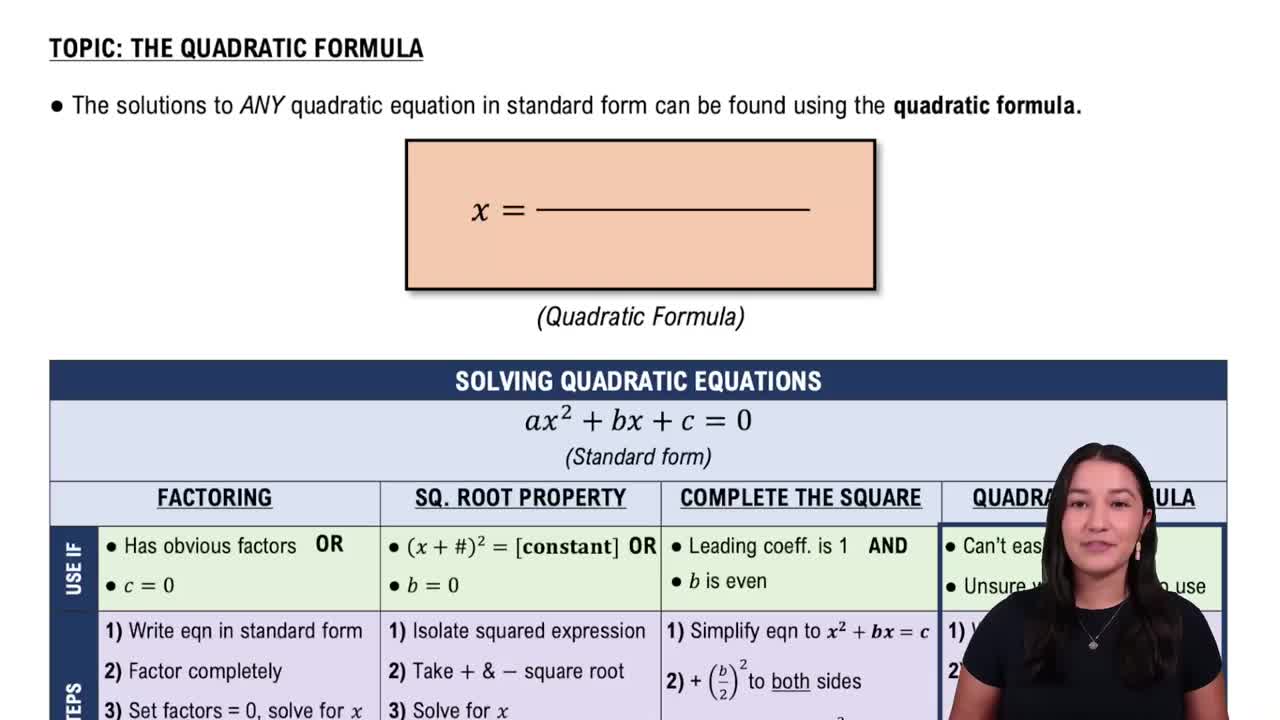
Solving Quadratic Equations Using The Quadratic Formula