Exercises 41–60 contain rational equations with variables in denominators. For each equation, a. write the value or values of the variable that make a denominator zero. These are the restrictions on the variable. b. Keeping the restrictions in mind, solve the equation. 3/(x + 2) + 2/(x - 2) = 8/(x + 2)(x - 2)
Ch. 1 - Equations and Inequalities

Chapter 2, Problem 55
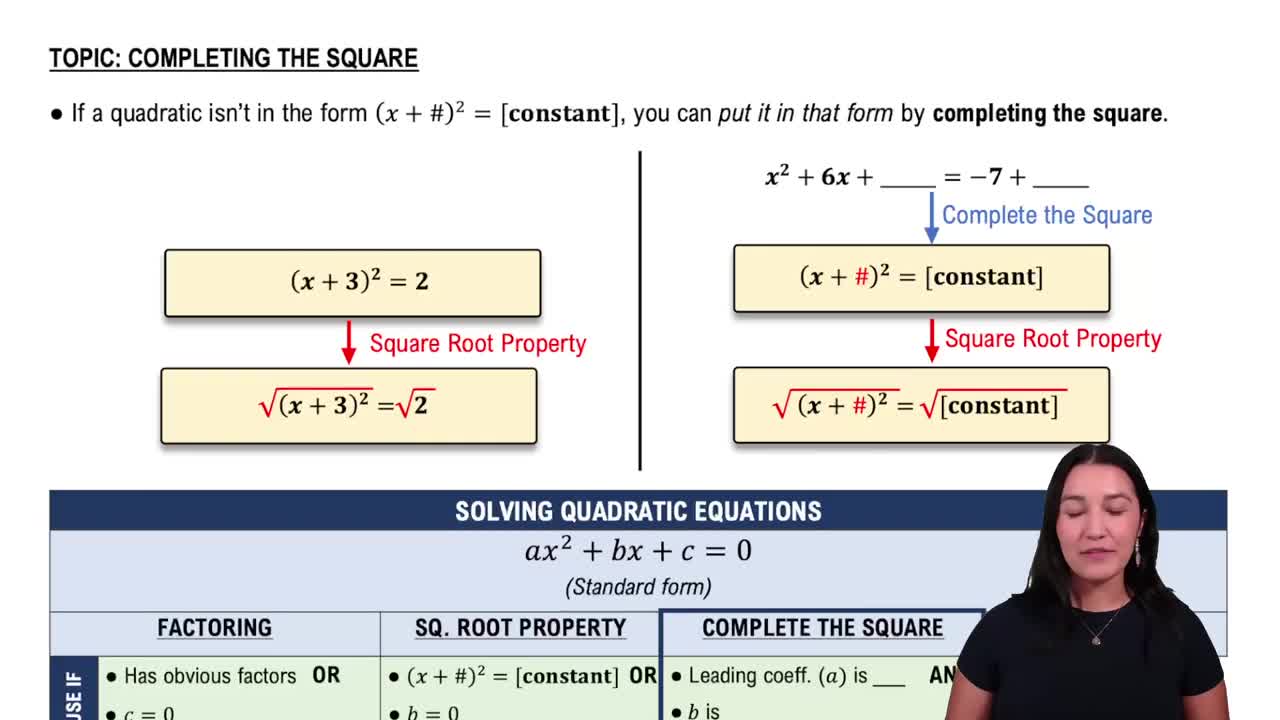
Solve each equation in Exercises 47–64 by completing the square.
Verified step by step guidance1
Start with the given quadratic equation: \(x^2 - 5x + 6 = 0\).
Move the constant term to the other side to isolate the quadratic and linear terms: \(x^2 - 5x = -6\).
To complete the square, take half of the coefficient of \(x\), which is \(-5\), divide by 2 to get \(-\frac{5}{2}\), then square it to get \(\left(-\frac{5}{2}\right)^2 = \frac{25}{4}\).
Add \(\frac{25}{4}\) to both sides of the equation to maintain equality: \(x^2 - 5x + \frac{25}{4} = -6 + \frac{25}{4}\).
Rewrite the left side as a perfect square trinomial: \(\left(x - \frac{5}{2}\right)^2 = -6 + \frac{25}{4}\). From here, you can simplify the right side and solve for \(x\) by taking the square root of both sides.

Verified video answer for a similar problem:
This video solution was recommended by our tutors as helpful for the problem above.
Video duration:
4mWas this helpful?
Key Concepts
Here are the essential concepts you must grasp in order to answer the question correctly.
Completing the Square
Completing the square is a method used to solve quadratic equations by transforming the equation into a perfect square trinomial. This involves adding and subtracting a specific value to create a binomial squared, making it easier to solve for the variable.
Recommended video:
Solving Quadratic Equations by Completing the Square
Quadratic Equations
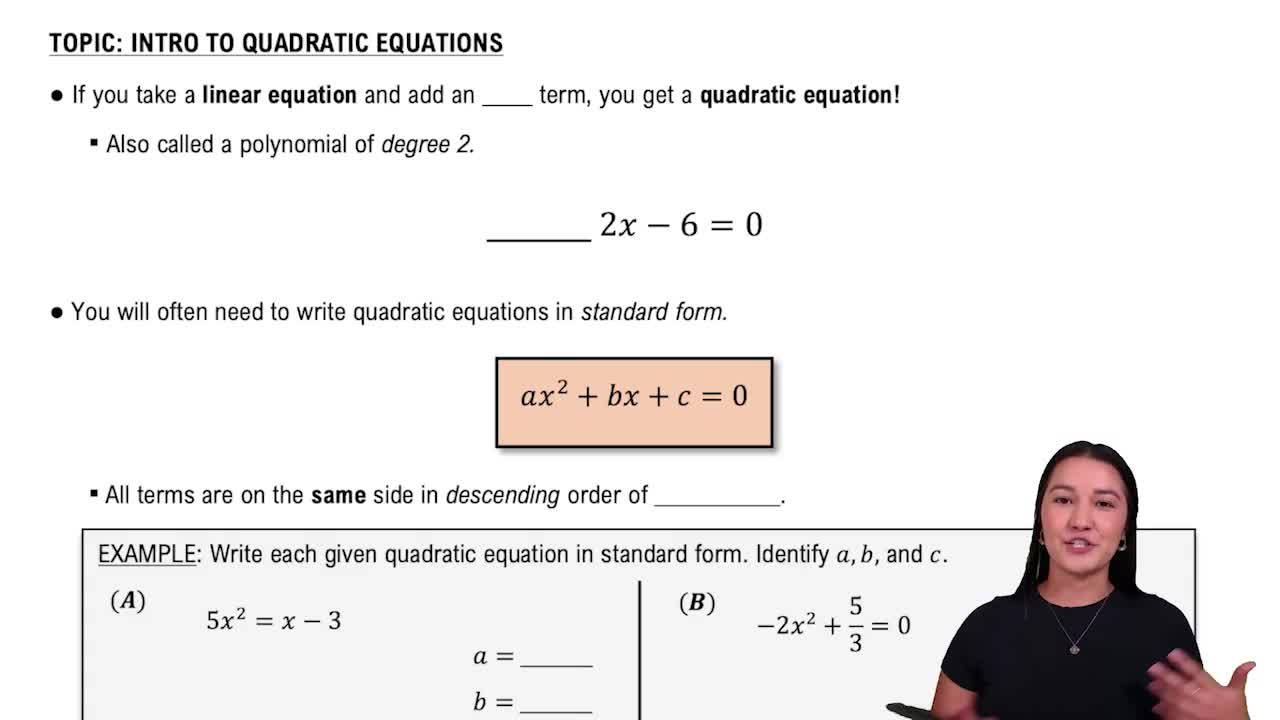
A quadratic equation is a second-degree polynomial equation in the form ax² + bx + c = 0. Understanding its structure is essential for applying methods like factoring, completing the square, or using the quadratic formula to find the roots.
Recommended video:
Introduction to Quadratic Equations
Solving Equations Using Square Roots
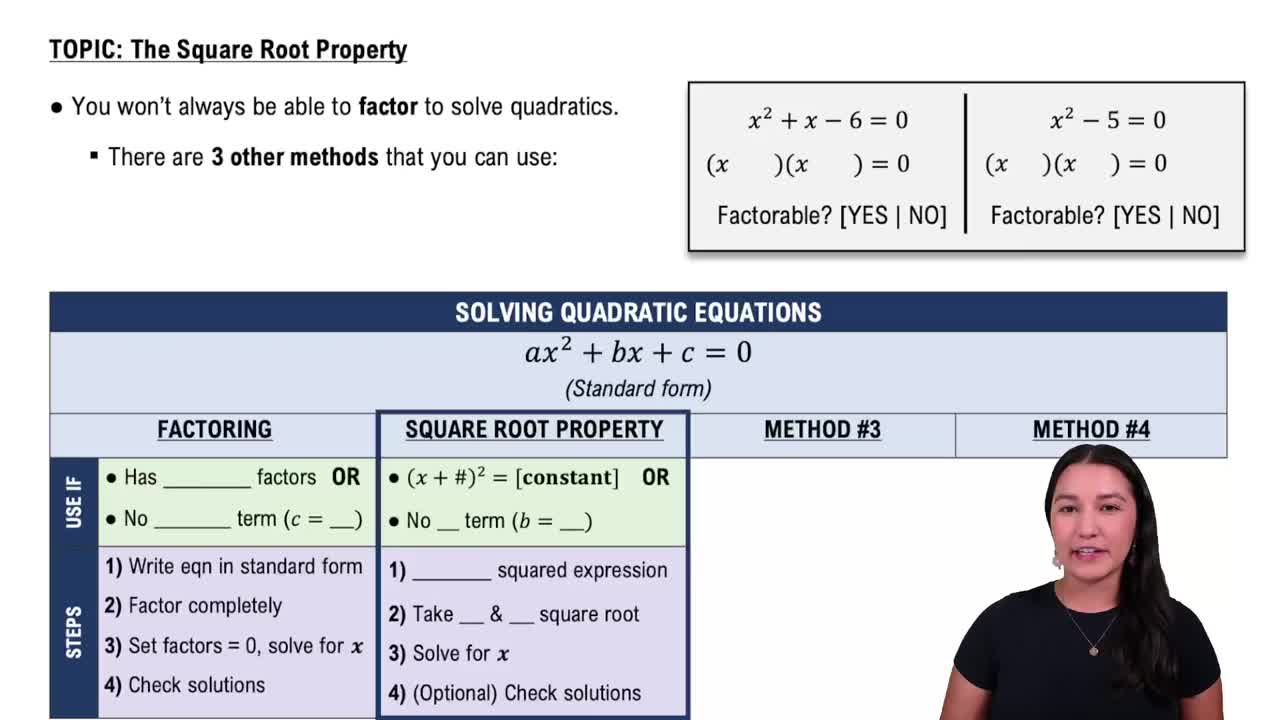
Once a quadratic equation is written as a perfect square equal to a constant, you can solve it by taking the square root of both sides. This step introduces both positive and negative roots, which are critical for finding all solutions.
Recommended video:
Solving Quadratic Equations by the Square Root Property
Related Practice
Textbook Question
1168
views
Textbook Question
Write each power of i as i, - 1, - i, or 1.
i44
892
views
Textbook Question
Solve each equation in Exercises 41–60 by making an appropriate substitution. (x - 5)2 - 4(x - 5) - 21 = 0
639
views
Textbook Question
Solve each formula for the specified variable. Do you recognize the formula? If so, what does it describe? 1/R = 1/R1 + 1/R2 for R1
617
views
Textbook Question
In Exercises 48–57, perform the indicated operations and write the result in standard form. √ (-32) - √ (-18)
768
views
Textbook Question
In Exercises 51–58, solve each compound inequality. - 11 < 2x - 1 ≤ - 5
903
views
