Simplify and write the result in standard form. √-49
Ch. 1 - Equations and Inequalities

Chapter 2, Problem 30
Solve each radical equation in Exercises 11–30. Check all proposed solutions.
Verified step by step guidance1
Start by letting \( y = \sqrt{x} \). This substitution simplifies the equation and helps avoid dealing with nested radicals directly.
Rewrite the original equation \( \sqrt{1 + 4\sqrt{x}} = 1 + \sqrt{x} \) as \( \sqrt{1 + 4y} = 1 + y \) using the substitution.
Square both sides of the equation to eliminate the square root on the left side: \( (\sqrt{1 + 4y})^2 = (1 + y)^2 \), which simplifies to \( 1 + 4y = (1 + y)^2 \).
Expand the right side: \( (1 + y)^2 = 1 + 2y + y^2 \). So the equation becomes \( 1 + 4y = 1 + 2y + y^2 \).
Bring all terms to one side to form a quadratic equation: \( 1 + 4y - 1 - 2y - y^2 = 0 \), which simplifies to \( y^2 - 2y = 0 \). Then solve for \( y \) by factoring or using the quadratic formula.

Verified video answer for a similar problem:
This video solution was recommended by our tutors as helpful for the problem above.
Video duration:
9mWas this helpful?
Key Concepts
Here are the essential concepts you must grasp in order to answer the question correctly.
Radical Equations
Radical equations involve variables inside a root, such as square roots. Solving them often requires isolating the radical expression and then eliminating the root by raising both sides to the appropriate power. This process can introduce extraneous solutions, so checking all proposed solutions is essential.
Recommended video:
Guided course
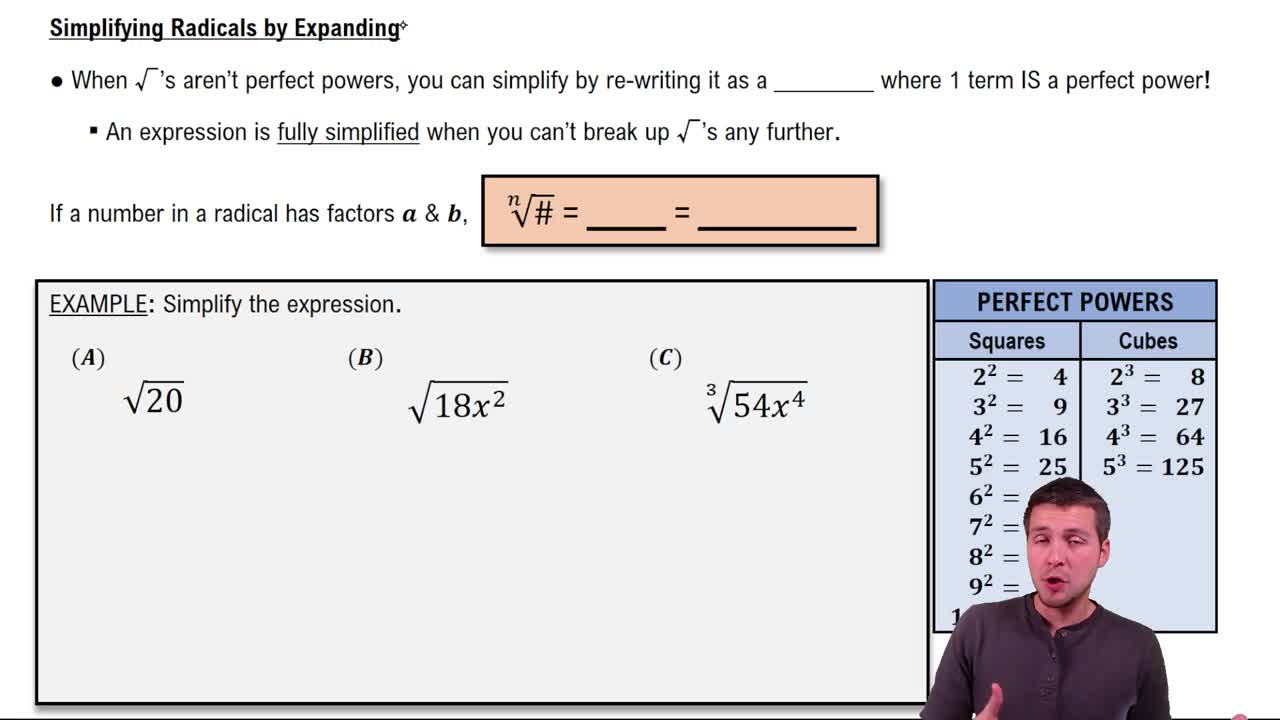
Expanding Radicals
Nested Radicals
Nested radicals occur when a radical expression contains another radical inside it, like √(1 + 4√x). Understanding how to simplify or manipulate nested radicals is crucial for solving such equations, often by substitution or careful algebraic manipulation.
Recommended video:
Guided course
Expanding Radicals
Extraneous Solutions and Verification
When solving radical equations, raising both sides to a power can introduce solutions that do not satisfy the original equation. Therefore, every solution must be substituted back into the original equation to verify its validity and discard any extraneous solutions.
Recommended video:
Categorizing Linear Equations
Related Practice
Textbook Question
853
views
Textbook Question
Solve each equation in Exercises 15–34 by the square root property. (4x - 1)2 = 16
710
views
Textbook Question
Exercises 27–40 contain linear equations with constants in denominators. Solve each equation. 20 - x/3 = x/2
943
views
Textbook Question
Exercises 27–40 contain linear equations with constants in denominators. Solve each equation. x/5 - 1/2 = x/6
1019
views
1
rank
Textbook Question
In all exercises, other than exercises with no solution, use interval notation to express solution sets and graph each solution set on a number line. In Exercises 27–50, solve each linear inequality. -9x ≥ 36
721
views
Textbook Question
An automobile repair shop charged a customer \$1182, listing \$357 for parts and the remainder for labor. If the cost of labor is \$75 per hour, how many hours of labor did it take to repair the car?
706
views