Ch. 1 - Equations and Inequalities
Blitzer - College Algebra 8th Edition
Blitzer8th EditionCollege AlgebraISBN: 9780136970514Not the one you use?Change textbook
Chapter 2, Problem 125

When the sum of 6 and twice a positive number is subtracted from the square of the number, 0 results. Find the number.

Verified step by step guidance
1
Let the positive number be represented by the variable x.
Translate the problem into an equation: The square of the number is x², twice the number is 2x, and the sum of 6 and twice the number is 6 + 2x. Subtracting this from the square of the number gives the equation x² - (6 + 2x) = 0.
Simplify the equation by distributing the negative sign: x² - 6 - 2x = 0.
Rearrange the equation into standard quadratic form: x² - 2x - 6 = 0.
Solve the quadratic equation x² - 2x - 6 = 0 using the quadratic formula x = (-b ± √(b² - 4ac)) / 2a, where a = 1, b = -2, and c = -6. Simplify the discriminant and solve for x, ensuring to only consider the positive solution since the problem specifies a positive number.

Verified video answer for a similar problem:

This video solution was recommended by our tutors as helpful for the problem above.
Video duration:
2m
Was this helpful?

Key Concepts

Here are the essential concepts you must grasp in order to answer the question correctly.

Algebraic Expressions

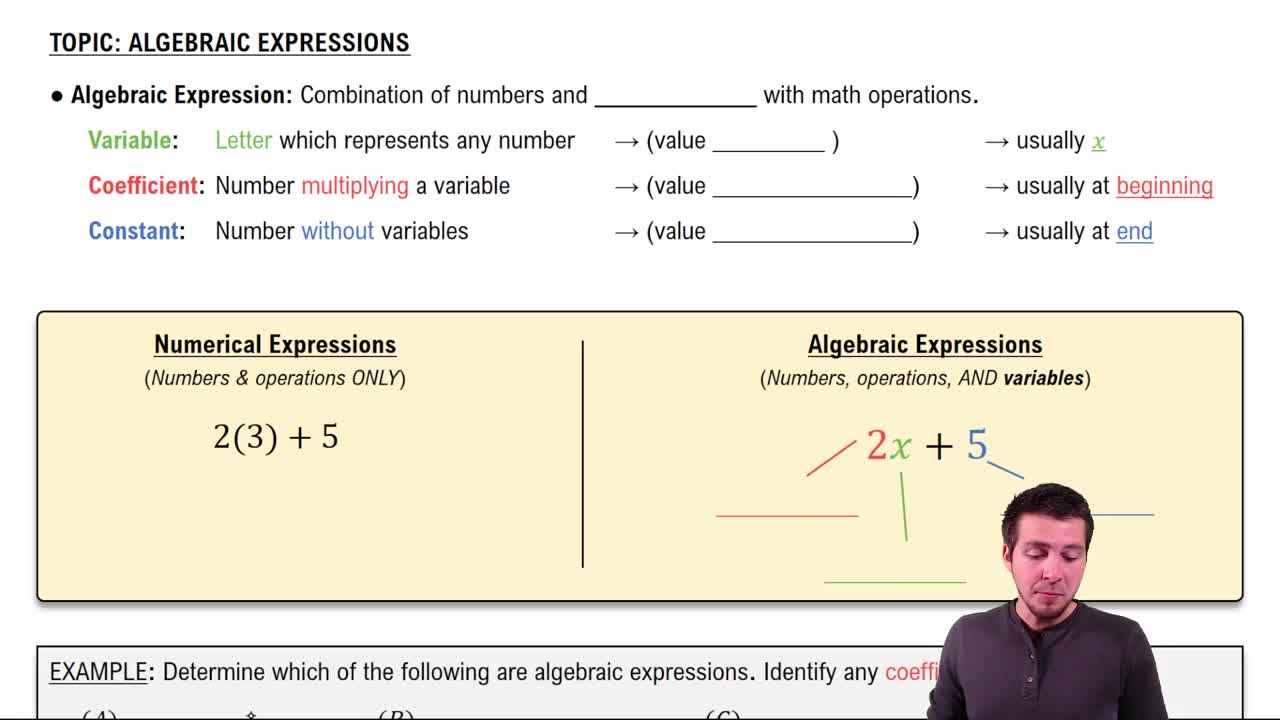
Algebraic expressions are mathematical phrases that can include numbers, variables, and operations. In this problem, we need to translate the verbal statement into an algebraic expression, which involves identifying the positive number as a variable and expressing the relationships described in the question using algebraic notation.
Recommended video:
Guided course
05:09
Introduction to Algebraic Expressions

Quadratic Equations

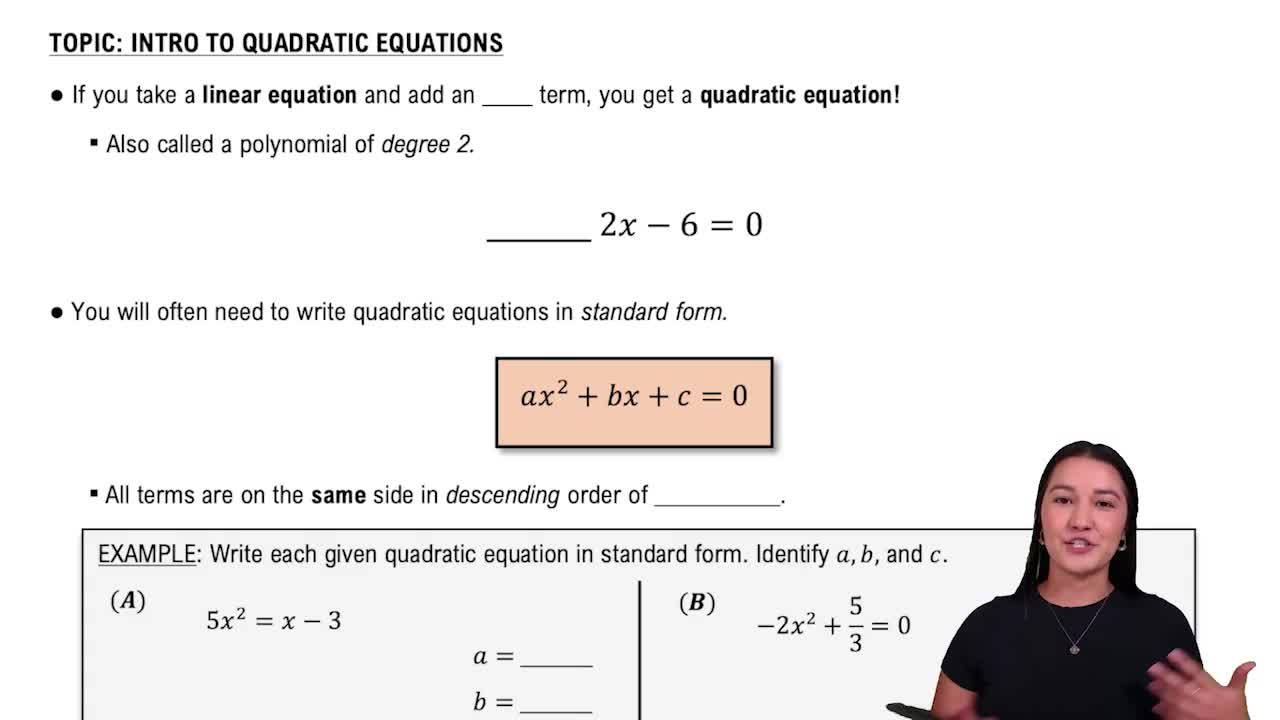
A quadratic equation is a polynomial equation of the form ax² + bx + c = 0, where a, b, and c are constants. The problem leads us to form a quadratic equation by setting the expression derived from the problem equal to zero, allowing us to find the value of the variable that satisfies the equation.
Recommended video:
05:35
Introduction to Quadratic Equations

Solving for Variables

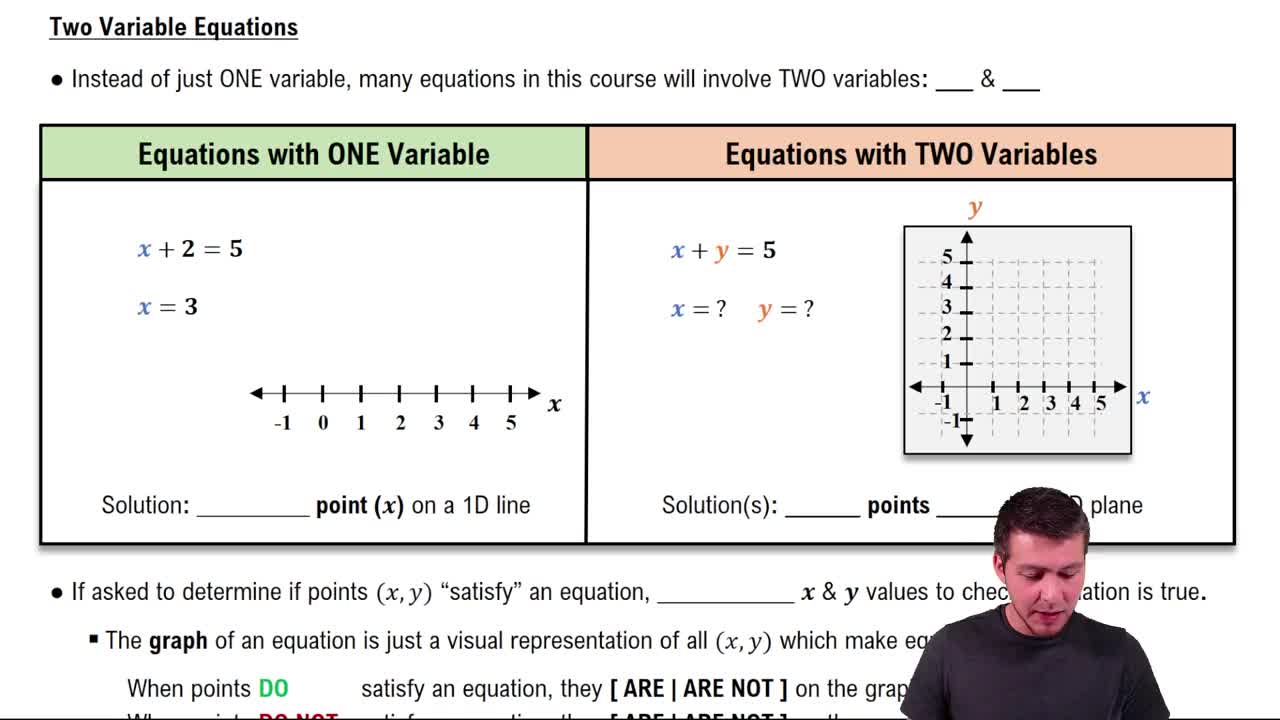
Solving for variables involves finding the value of the unknown that makes the equation true. This can be done through various methods such as factoring, using the quadratic formula, or completing the square. In this case, once we have the quadratic equation, we will apply one of these methods to determine the positive number that meets the conditions of the problem.
Recommended video:
Guided course
05:28
Equations with Two Variables