Begin by graphing the cube root function, f(x) = ∛x. Then use transformations of this graph to graph the given function. g(x) = ∛x+2
Ch. 2 - Functions and Graphs

Chapter 3, Problem 105
Exercises 103–105 will help you prepare for the material covered in the next section. Solve by completing the square: y² – 6y — 4 = 0.
Verified step by step guidance1
Start with the given quadratic equation: \(y^2 - 6y - 4 = 0\).
Move the constant term to the right side to isolate the terms involving \(y\): \(y^2 - 6y = 4\).
To complete the square, take half of the coefficient of \(y\) (which is \(-6\)), divide by 2 to get \(-3\), then square it to get \((-3)^2 = 9\).
Add 9 to both sides of the equation to maintain equality: \(y^2 - 6y + 9 = 4 + 9\).
Rewrite the left side as a perfect square trinomial: \((y - 3)^2 = 13\).

Verified video answer for a similar problem:
This video solution was recommended by our tutors as helpful for the problem above.
Video duration:
2mWas this helpful?
Key Concepts
Here are the essential concepts you must grasp in order to answer the question correctly.
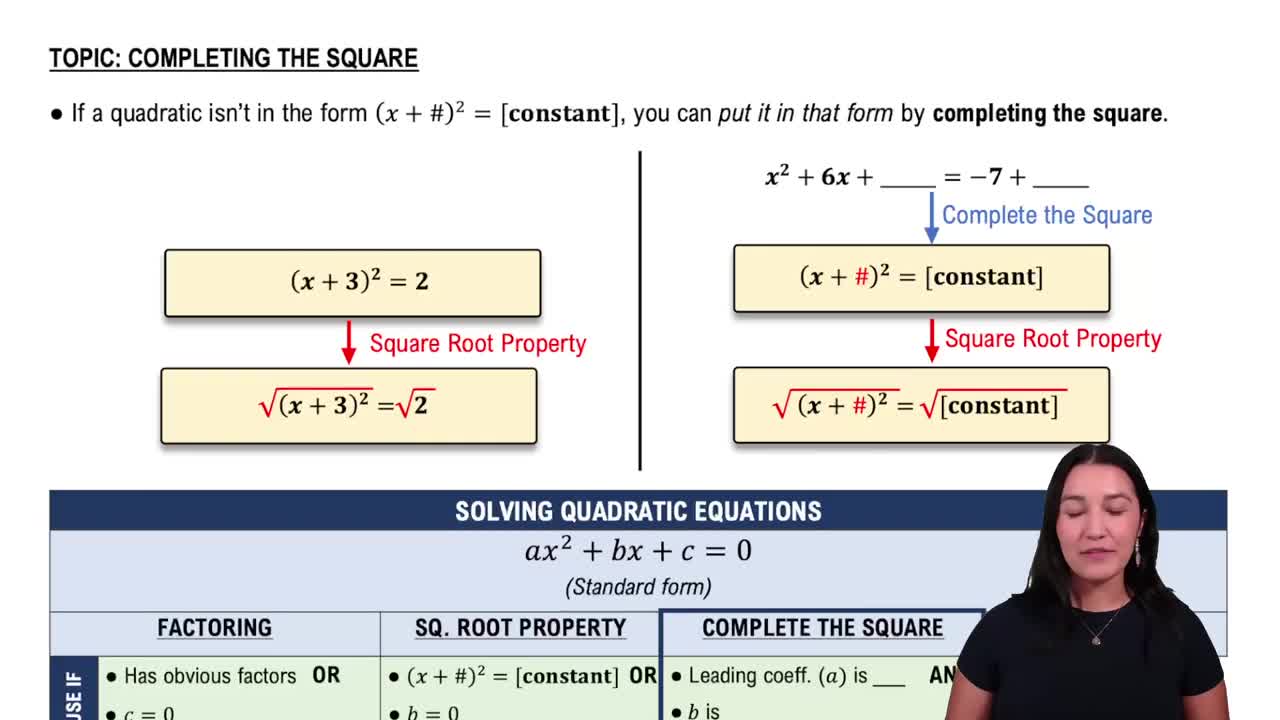
Completing the Square
Completing the square is a method used to solve quadratic equations by transforming the equation into a perfect square trinomial. This involves adding and subtracting a specific value to create a binomial squared, making it easier to solve for the variable.
Recommended video:
Solving Quadratic Equations by Completing the Square
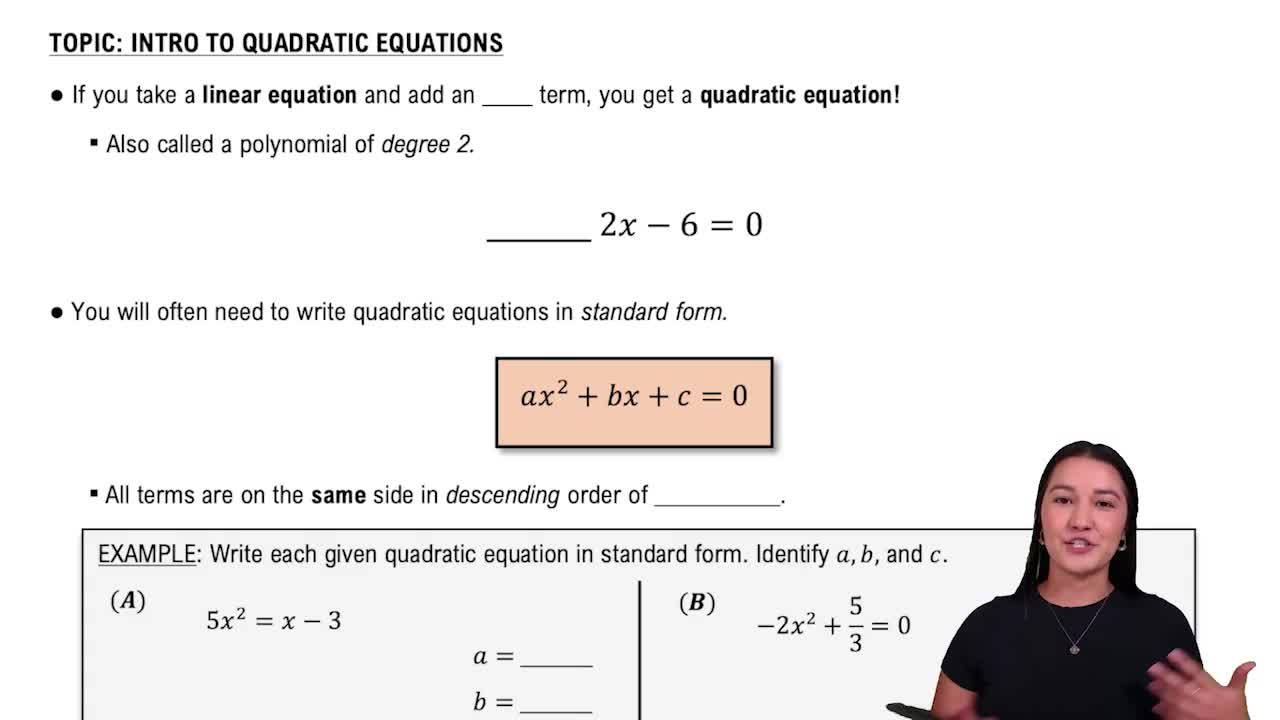
Quadratic Equations
A quadratic equation is a second-degree polynomial equation in the form ax² + bx + c = 0. Understanding its structure is essential for applying methods like completing the square, factoring, or using the quadratic formula to find the roots.
Recommended video:
Introduction to Quadratic Equations
Isolating the Variable
Isolating the variable means rearranging the equation so that the variable term stands alone on one side. This step is crucial before completing the square, as it simplifies the process and helps in accurately solving the equation.
Recommended video:
Guided course
Equations with Two Variables
Related Practice
Textbook Question
1142
views
Textbook Question
Begin by graphing the standard cubic function, f(x) = x³. Then use transformations of this graph to graph the given function. r(x) = (x − 2)³ +1
714
views
Textbook Question
In Exercises 107–108, write the standard form of the equation of the circle with the given center and radius. Center (-2. 4), r = 6
925
views
Textbook Question
Begin by graphing the standard cubic function, f(x) = x³. Then use transformations of this graph to graph the given function. h(x) = (1/2)(x − 2)³ – 1
829
views
Textbook Question
In Exercises 105–106, find the midpoint of each line segment with the given endpoints. (2, 6) and (-12, 4)
993
views
Textbook Question
Exercises 103–105 will help you prepare for the material covered in the next section. Use a rectangular coordinate system to graph the circle with center (1, -1) and radius 1.
817
views