Find the slope of the line passing through each pair of points or state that the slope is undefined. Then indicate whether the line through the points rises, falls, is horizontal, or is vertical. (-2, 1) and (2, 2)
Ch. 2 - Functions and Graphs

Chapter 3, Problem 3
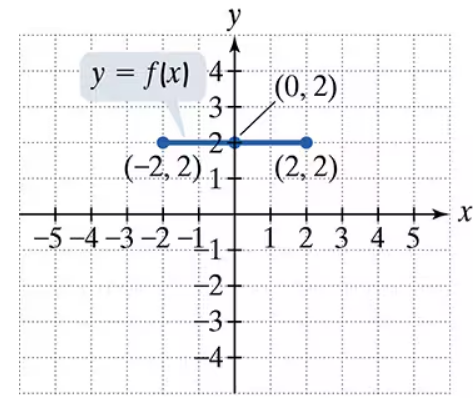
Use the graph of y = f(x) to graph each function g.

g(x) = f(x+1)
Verified step by step guidance1
Understand that the function g(x) = f(x + 1) represents a horizontal shift of the original function f(x). Specifically, the graph of f(x) is shifted to the left by 1 unit because the input x is replaced by (x + 1).
Identify key points on the original graph y = f(x). For example, note the coordinates of points where the function changes direction or has important features (like endpoints or peaks).
For each key point (x, y) on the graph of f(x), find the corresponding point on g(x) by subtracting 1 from the x-coordinate. This means the new point will be at (x - 1, y).
Plot these new points on the coordinate plane. Since the function is shifted left, all points move one unit to the left compared to their original positions on f(x).
Connect the new points smoothly, maintaining the shape of the original graph, to complete the graph of g(x) = f(x + 1).

Verified video answer for a similar problem:
This video solution was recommended by our tutors as helpful for the problem above.
Video duration:
2mWas this helpful?
Key Concepts
Here are the essential concepts you must grasp in order to answer the question correctly.
Function Transformation
Function transformation involves changing the graph of a function by shifting, stretching, compressing, or reflecting it. In this problem, the transformation is a horizontal shift, which moves the graph left or right without altering its shape.
Recommended video:
Domain & Range of Transformed Functions
Horizontal Shift
A horizontal shift occurs when the input variable x in the function is replaced by (x + c) or (x - c). For g(x) = f(x + 1), the graph of f(x) shifts 1 unit to the left because adding inside the function moves the graph in the opposite direction of the sign.
Recommended video:
Shifts of Functions
Graph Interpretation
Interpreting graphs requires understanding how points and shapes move under transformations. The image shows the original function f(x) and the shifted function g(x), illustrating how each point on f(x) moves horizontally to create g(x).
Recommended video:
Guided course
Graphs and Coordinates - Example
Related Practice
Textbook Question
1627
views
Textbook Question
Find the distance between each pair of points. If necessary, express answers in simplified radical form and then round to two decimal places. (4, -1) and (-6, 3)
805
views
Textbook Question
Find the domain of each function. g(x) = 3/(x-4)
826
views
Textbook Question
Determine whether each relation is a function. Give the domain and range for each relation. {(3, 4), (3, 5), (4, 4), (4, 5)}
162
views
Textbook Question
Write an equation for line L in point-slope form and slope-intercept form.
1565
views
Textbook Question
Find f(g(x)) and g (f(x)) and determine whether each pair of functions ƒ and g are inverses of each other. f(x)=3x+8 and g(x) = (x-8)/3
620
views