Use the vertical line test to identify graphs in which y is a function of x.
Ch. 2 - Functions and Graphs

Chapter 3, Problem 15
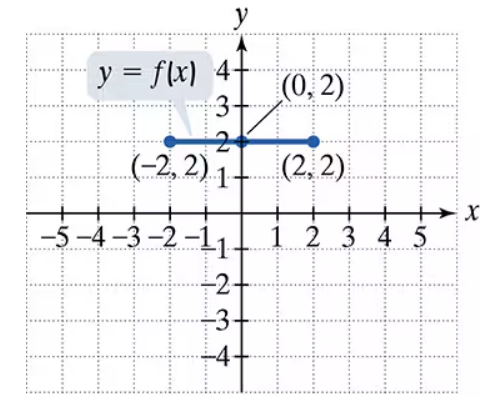
Use the graph of y = f(x) to graph each function g.

g(x) = −ƒ( x/2) +1
Verified step by step guidance1
Step 1: Analyze the given graph of y = f(x). The graph is a horizontal line segment with endpoints at (1, -3) and (4, -3). This indicates that f(x) = -3 for all x in the interval [1, 4].
Step 2: Understand the transformation g(x) = -f(x/2) + 1. This involves three transformations: (1) horizontal scaling by a factor of 2 (x/2), (2) reflection across the x-axis (-f), and (3) vertical shift upward by 1 (+1).
Step 3: Apply the horizontal scaling. Replace x with x/2 in f(x). This stretches the graph horizontally by a factor of 2. The new domain of f(x/2) becomes [2, 8] because the original domain [1, 4] is scaled by 2.
Step 4: Apply the reflection across the x-axis. Multiply the function values by -1. Since f(x/2) = -3 for x in [2, 8], the reflected values become +3 for the same interval.
Step 5: Apply the vertical shift. Add 1 to the reflected values. The final function g(x) = -f(x/2) + 1 will have values of 3 + 1 = 4 for x in [2, 8]. The graph of g(x) is a horizontal line segment at y = 4 over the interval [2, 8].

Verified video answer for a similar problem:
This video solution was recommended by our tutors as helpful for the problem above.
Video duration:
2mWas this helpful?
Key Concepts
Here are the essential concepts you must grasp in order to answer the question correctly.
Function Transformation
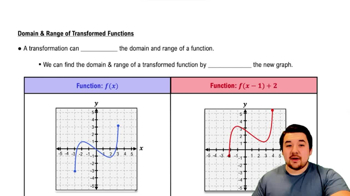
Function transformations involve altering the graph of a function through shifts, stretches, compressions, or reflections. In this case, the function g(x) = -f(x/2) + 1 reflects the original function f(x) across the x-axis, stretches it horizontally by a factor of 2, and shifts it upward by 1 unit.
Recommended video:
Domain & Range of Transformed Functions
Horizontal Stretch
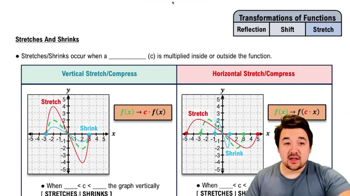
A horizontal stretch occurs when the input of a function is multiplied by a factor less than 1. For g(x) = -f(x/2), the x-values of f(x) are effectively doubled, which means that the graph of g will spread out horizontally, making it wider compared to f.
Recommended video:
Stretches & Shrinks of Functions
Reflection Across the X-axis
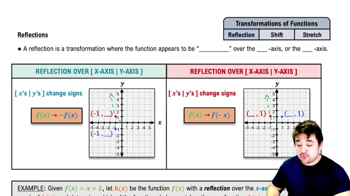
Reflection across the x-axis changes the sign of the output values of a function. In g(x) = -f(x/2), this reflection means that if f(x) has positive values, g(x) will have corresponding negative values, effectively flipping the graph of f over the x-axis.
Recommended video:
Reflections of Functions
Related Practice
Textbook Question
1938
views
Textbook Question
Find the average rate of change of the function from x1 to x2. f(x) = x² + 2x from x1 = 3 to x2 = 5
1008
views
Textbook Question
Use the given conditions to write an equation for each line in point-slope form and slope-intercept form. Slope = 8, passing through (4, −1)
1059
views
1
comments
Textbook Question
The functions in Exercises 11-28 are all one-to-one. For each function, a. Find an equation for f-1(x), the inverse function. b. Verify that your equation is correct by showing that f(ƒ-1 (x)) = = x and ƒ-1 (f(x)) = x. f(x) = 2x + 3
659
views
Textbook Question
Find the distance between each pair of points. If necessary, express answers in simplified radical form and then round to two decimal places. (3√3, √5) and (−√3, 4√5)
874
views
Textbook Question
In Exercises 11–26, determine whether each equation defines y as a function of x. x² + y = 25
102
views