Find the average rate of change of the function from x1 to x2. f(x) = x² + 2x from x1 = 3 to x2 = 5
Ch. 2 - Functions and Graphs

Chapter 3, Problem 15a
Find the domain of each function. f(x) = 1/[4/(x - 1) - 2]
Verified step by step guidance1
Step 1: Recall that the domain of a function is the set of all possible input values (x-values) for which the function is defined. For rational functions, the function is undefined when the denominator equals zero. Identify the denominator of the given function: \( \frac{3}{x - 1} - 2 \).
Step 2: Set the denominator equal to zero to find the x-values that make the function undefined: \( \frac{3}{x - 1} - 2 = 0 \).
Step 3: Solve the equation \( \frac{3}{x - 1} - 2 = 0 \). First, isolate the fraction by adding 2 to both sides: \( \frac{3}{x - 1} = 2 \).
Step 4: Eliminate the fraction by multiplying both sides of the equation by \( x - 1 \) (note: \( x - 1 \neq 0 \) to avoid division by zero): \( 3 = 2(x - 1) \). Expand and solve for x: \( 3 = 2x - 2 \), then \( 2x = 5 \), and finally \( x = \frac{5}{2} \).
Step 5: Combine the results. The function is undefined when \( x = 1 \) (from the denominator \( x - 1 \neq 0 \)) and when \( x = \frac{5}{2} \) (from solving \( \frac{3}{x - 1} - 2 = 0 \)). Therefore, the domain of the function is all real numbers except \( x = 1 \) and \( x = \frac{5}{2} \).

Verified video answer for a similar problem:
This video solution was recommended by our tutors as helpful for the problem above.
Video duration:
2mWas this helpful?
Key Concepts
Here are the essential concepts you must grasp in order to answer the question correctly.
Domain of a Function
The domain of a function refers to the set of all possible input values (x-values) for which the function is defined. For rational functions, the domain is typically restricted by values that would make the denominator zero, as division by zero is undefined.
Recommended video:
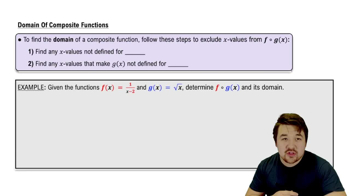
Domain Restrictions of Composed Functions
Rational Functions
A rational function is a function that can be expressed as the ratio of two polynomials. In the given function f(x) = 1/[3/(x - 1) - 2], the denominator must be analyzed to ensure it does not equal zero, which is crucial for determining the domain.
Recommended video:
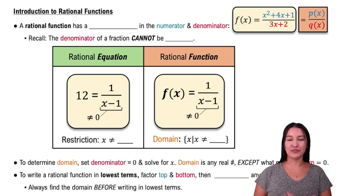
Intro to Rational Functions
Solving for Undefined Points
To find the domain, one must identify values of x that make the denominator zero. This involves setting the denominator equal to zero and solving for x. Any x-value that results in a zero denominator must be excluded from the domain.
Recommended video:
Guided course
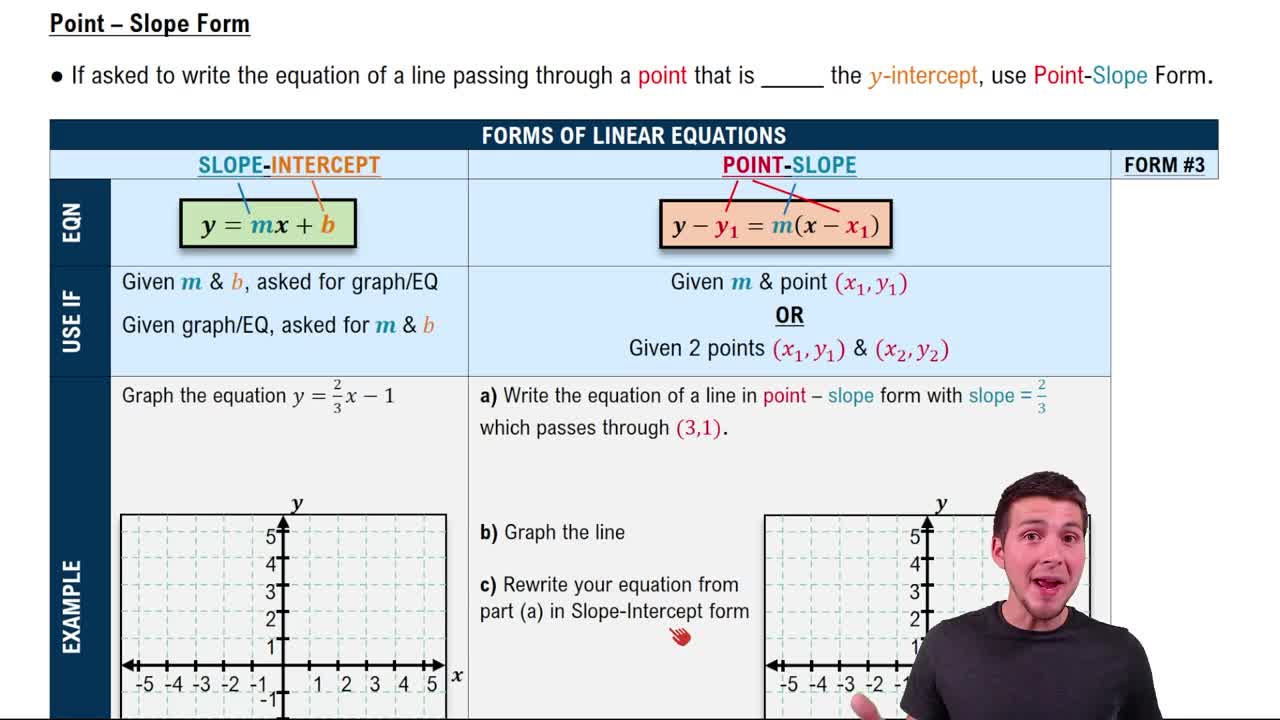
Point-Slope Form
Related Practice
Textbook Question
1008
views
Textbook Question
The functions in Exercises 11-28 are all one-to-one. For each function, a. Find an equation for f-1(x), the inverse function. b. Verify that your equation is correct by showing that f(ƒ-1 (x)) = = x and ƒ-1 (f(x)) = x. f(x) = 2x + 3
659
views
Textbook Question
Use the given conditions to write an equation for each line in point-slope form and slope-intercept form. Slope = -5, passing through (-4, -2)
90
views
Textbook Question
In Exercises 1-16, use the graph of y = f(x) to graph each function g.
g(x) = -f(2x) - 1
753
views
Textbook Question
Find the distance between each pair of points. If necessary, express answers in simplified radical form and then round to two decimal places. (3√3, √5) and (−√3, 4√5)
874
views
Textbook Question
Find the average rate of change of the function from x1 to x2. f(x) = √x from x1 = 4 to x2 = 9
69
views