Ch. 2 - Functions and Graphs
Blitzer - College Algebra 8th Edition
Blitzer8th EditionCollege AlgebraISBN: 9780136970514Not the one you use?Change textbook
Chapter 3, Problem 2

Find the domain of each function. f(x) = 2(x+5)

Verified step by step guidance
1
Step 1: Understand the concept of the domain of a function. The domain refers to all possible values of x for which the function is defined. For most algebraic functions, this means identifying any restrictions on x, such as division by zero or square roots of negative numbers.
Step 2: Analyze the given function f(x) = -2(x + 5). This is a linear function because it involves a constant multiplied by a linear expression (x + 5). Linear functions are defined for all real numbers since there are no restrictions like division by zero or square roots.
Step 3: Confirm that there are no restrictions on x. In the function f(x) = -2(x + 5), the expression (x + 5) is a simple addition operation, and multiplying by -2 does not introduce any restrictions.
Step 4: Conclude that the domain of the function is all real numbers. This means x can take any value from negative infinity to positive infinity.
Step 5: Express the domain in interval notation. The domain of f(x) = -2(x + 5) is (-∞, ∞), which represents all real numbers.

Verified video answer for a similar problem:

This video solution was recommended by our tutors as helpful for the problem above.
Video duration:
1m
Was this helpful?

Key Concepts

Here are the essential concepts you must grasp in order to answer the question correctly.

Domain of a Function

The domain of a function refers to the set of all possible input values (x-values) for which the function is defined. For polynomial functions like f(x) = -2(x + 5), the domain typically includes all real numbers, as there are no restrictions such as division by zero or square roots of negative numbers.
Recommended video:
3:51
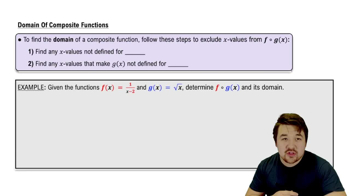
Domain Restrictions of Composed Functions

Polynomial Functions

Polynomial functions are mathematical expressions that involve variables raised to whole number powers, combined using addition, subtraction, and multiplication. The function f(x) = -2(x + 5) is a linear polynomial, which means it is a first-degree polynomial and is defined for all real numbers, contributing to its unrestricted domain.
Recommended video:
06:04
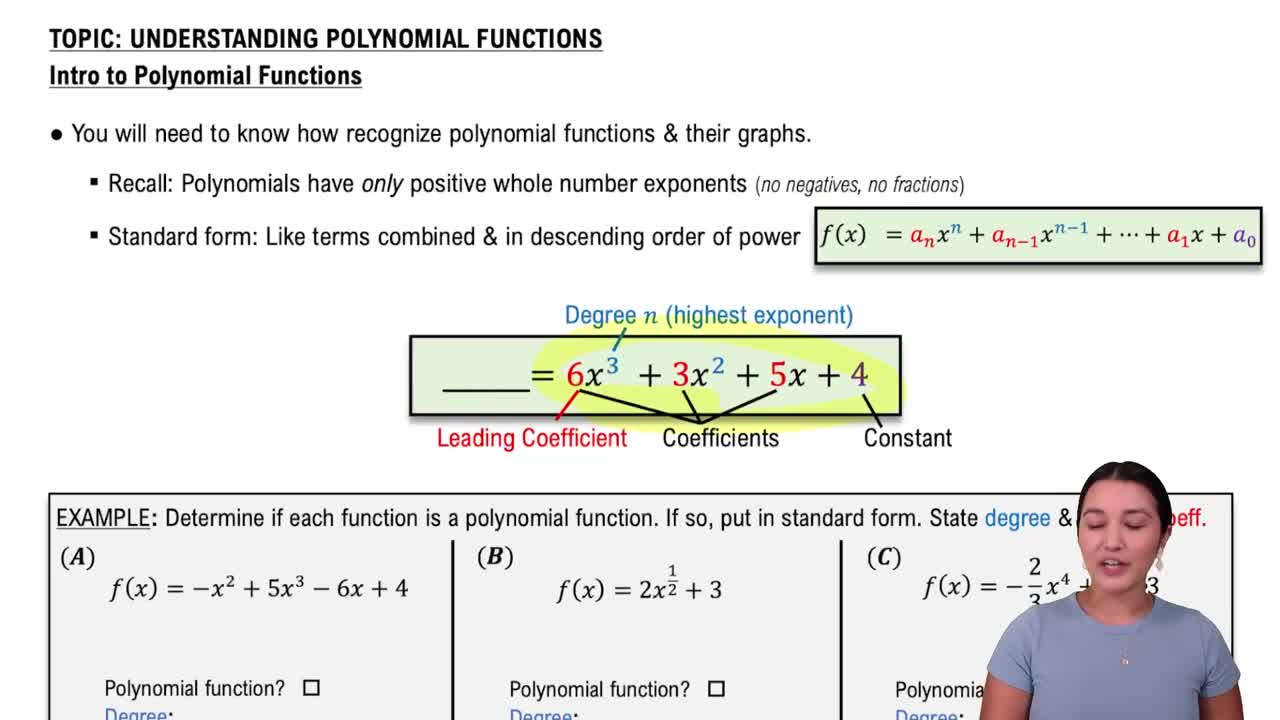
Introduction to Polynomial Functions

Graphing Linear Functions

Graphing linear functions involves plotting points that satisfy the function's equation and connecting them to form a straight line. The graph of f(x) = -2(x + 5) will be a straight line, and understanding its slope and y-intercept can help visualize the function, reinforcing that its domain is all real numbers.
Recommended video:
5:26
Graphs of Logarithmic Functions