Ch. 2 - Functions and Graphs
Blitzer - College Algebra 8th Edition
Blitzer8th EditionCollege AlgebraISBN: 9780136970514Not the one you use?Change textbook
Chapter 3, Problem 5

Find the domain of each function. f(x) = x² - 2x - 15

Verified step by step guidance
1
Identify the type of function given. Here, the function is a polynomial: \(f(x) = x^{2} - 2x - 15\).
Recall that polynomial functions are defined for all real numbers because there are no restrictions such as division by zero or square roots of negative numbers.
Since there are no denominators or even roots in the function, there are no values of \(x\) that would make the function undefined.
Therefore, the domain of the function is all real numbers, which can be expressed in interval notation as \((-\infty, \infty)\).
Summarize the domain: \(\text{Domain} = \{ x \mid x \in \mathbb{R} \}\) or \((-\infty, \infty)\).

Verified video answer for a similar problem:

This video solution was recommended by our tutors as helpful for the problem above.
Video duration:
1m
Was this helpful?

Key Concepts

Here are the essential concepts you must grasp in order to answer the question correctly.

Domain of a Function

The domain of a function is the set of all possible input values (x-values) for which the function is defined. For polynomial functions like f(x) = x² - 2x - 15, the domain typically includes all real numbers because polynomials are defined everywhere on the real number line.
Recommended video:
3:51
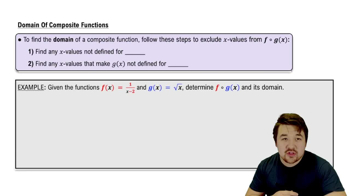
Domain Restrictions of Composed Functions

Polynomial Functions

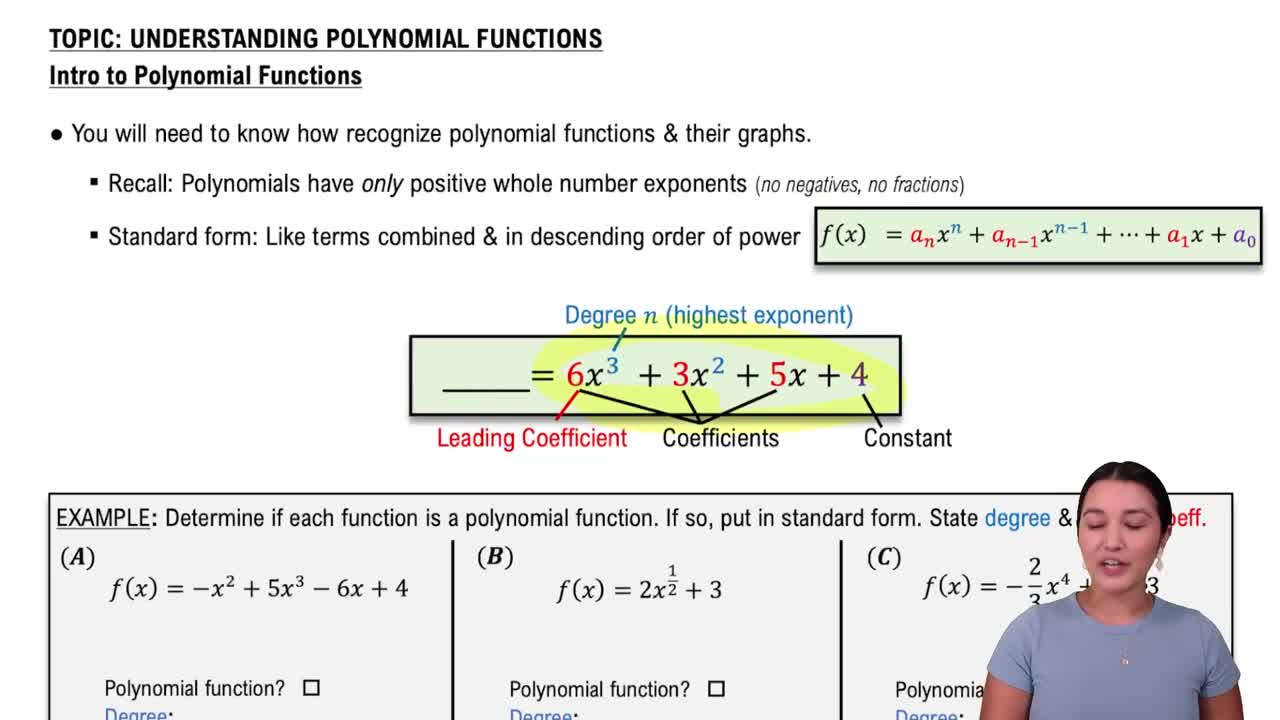
Polynomial functions are expressions involving variables raised to whole-number exponents combined using addition, subtraction, and multiplication. They are continuous and defined for all real numbers, meaning their domain is usually all real numbers unless otherwise restricted.
Recommended video:
06:04
Introduction to Polynomial Functions

Function Notation and Evaluation

Function notation, such as f(x), represents a function with input x. Understanding how to interpret and evaluate functions helps in determining the domain by identifying any restrictions on x that would make the function undefined.
Recommended video:
4:26
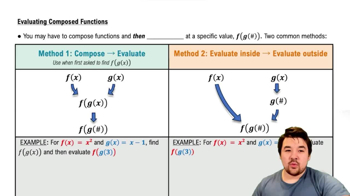
Evaluating Composed Functions