Find f(g(x)) and g (f(x)) and determine whether each pair of functions ƒ and g are inverses of each other. f(x) = = -x and g(x) = -x
Ch. 2 - Functions and Graphs

Chapter 3, Problem 7a
Find the domain of each function. g(x) = 3/(x2-2x-15)
Verified step by step guidance1
Step 1: Recall that the domain of a function is the set of all possible input values (x-values) for which the function is defined. For rational functions like g(x) = 3/(x^2 - 2x - 15), the function is undefined when the denominator equals zero.
Step 2: Set the denominator equal to zero to find the x-values that make the function undefined. Solve the equation x^2 - 2x - 15 = 0.
Step 3: Factor the quadratic expression x^2 - 2x - 15. Look for two numbers that multiply to -15 and add to -2. These numbers are -5 and 3, so the factorization is (x - 5)(x + 3).
Step 4: Solve the factored equation (x - 5)(x + 3) = 0. Set each factor equal to zero: x - 5 = 0 and x + 3 = 0. Solve for x to find x = 5 and x = -3.
Step 5: Exclude the values x = 5 and x = -3 from the domain, as these make the denominator zero. The domain of g(x) is all real numbers except x = 5 and x = -3, which can be written in interval notation as (-∞, -3) ∪ (-3, 5) ∪ (5, ∞).

Verified video answer for a similar problem:
This video solution was recommended by our tutors as helpful for the problem above.
Video duration:
3mWas this helpful?
Key Concepts
Here are the essential concepts you must grasp in order to answer the question correctly.
Domain of a Function
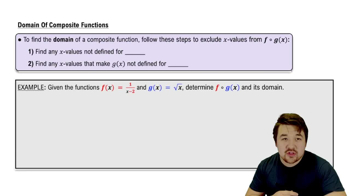
The domain of a function refers to the set of all possible input values (x-values) for which the function is defined. For rational functions, the domain is typically restricted by values that would make the denominator zero, as division by zero is undefined.
Recommended video:
Domain Restrictions of Composed Functions
Factoring Quadratic Expressions
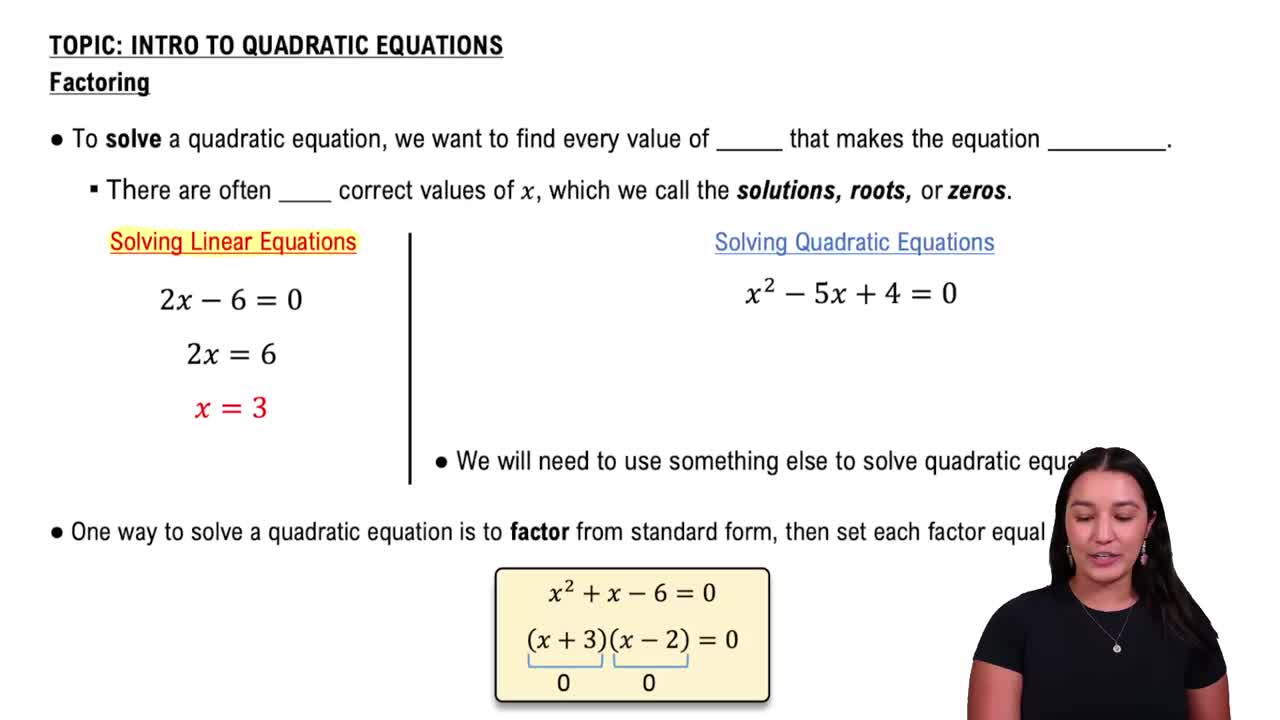
Factoring quadratic expressions involves rewriting them as a product of their linear factors. This is essential for identifying the values that make the denominator zero. In the case of g(x) = 3/(x^2-2x-15), factoring the quadratic will help determine the critical points that affect the domain.
Recommended video:
Solving Quadratic Equations by Factoring
Finding Asymptotes
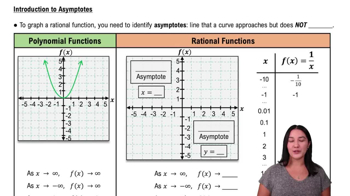
Asymptotes are lines that a graph approaches but never touches. For rational functions, vertical asymptotes occur at the x-values that make the denominator zero. Understanding asymptotes is crucial for determining the domain, as these points indicate where the function is undefined.
Recommended video:
Introduction to Asymptotes
Related Practice
Textbook Question
633
views
Textbook Question
Use the given conditions to write an equation for each line in point-slope form and slope-intercept form. Passing through (2, −3) and perpendicular to the line whose equation is y = (1/5)x + 6
81
views
Textbook Question
In Exercises 1–10, determine whether each relation is a function. Give the domain and range for each relation. {(1, 4), (1, 5), (1, 6)}
142
views
Textbook Question
Find f(g(x)) and g (f(x)) and determine whether each pair of functions ƒ and g are inverses of each other. f(x) = 3/(x-4) and g(x) = (3/x) + 4
680
views
Textbook Question
Evaluate each function at the given values of the independent variable and simplify. g(x) = 3x^2 - 5x + 2 (a) g(0), (b) g(-2), (c) g(x-1), (d) g(-x)
207
views
Textbook Question
Use the graph of y = f(x) to graph each function g.
g(x) = f(-x)
899
views