Begin by graphing the cube root function, f(x) = ∛x. Then use transformations of this graph to graph the given function. g(x) = ∛x+2
Ch. 2 - Functions and Graphs

Chapter 3, Problem 111
In Exercises 109–111, give the center and radius of each circle. x^2 + y^2 - 4x + 2y - 4 = 0
Verified step by step guidance1
Rewrite the given equation of the circle: . Group the terms involving and together: .
Complete the square for the -terms. Take half the coefficient of (which is ), square it, and add it inside the parentheses: . To maintain equality, add to the right-hand side of the equation.
Rewrite the equation with the completed squares: . This is now in the standard form of a circle: , where is the center and is the radius.
Identify the center and radius from the equation. The center is , and the radius is .

Verified video answer for a similar problem:
This video solution was recommended by our tutors as helpful for the problem above.
Video duration:
5mWas this helpful?
Key Concepts
Here are the essential concepts you must grasp in order to answer the question correctly.
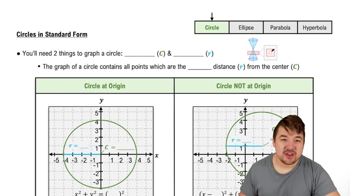
Standard Form of a Circle
The standard form of a circle's equation is (x - h)² + (y - k)² = r², where (h, k) is the center and r is the radius. To identify the center and radius from a general equation, it is often necessary to rearrange the equation into this standard form through completing the square.
Recommended video:
Circles in Standard Form
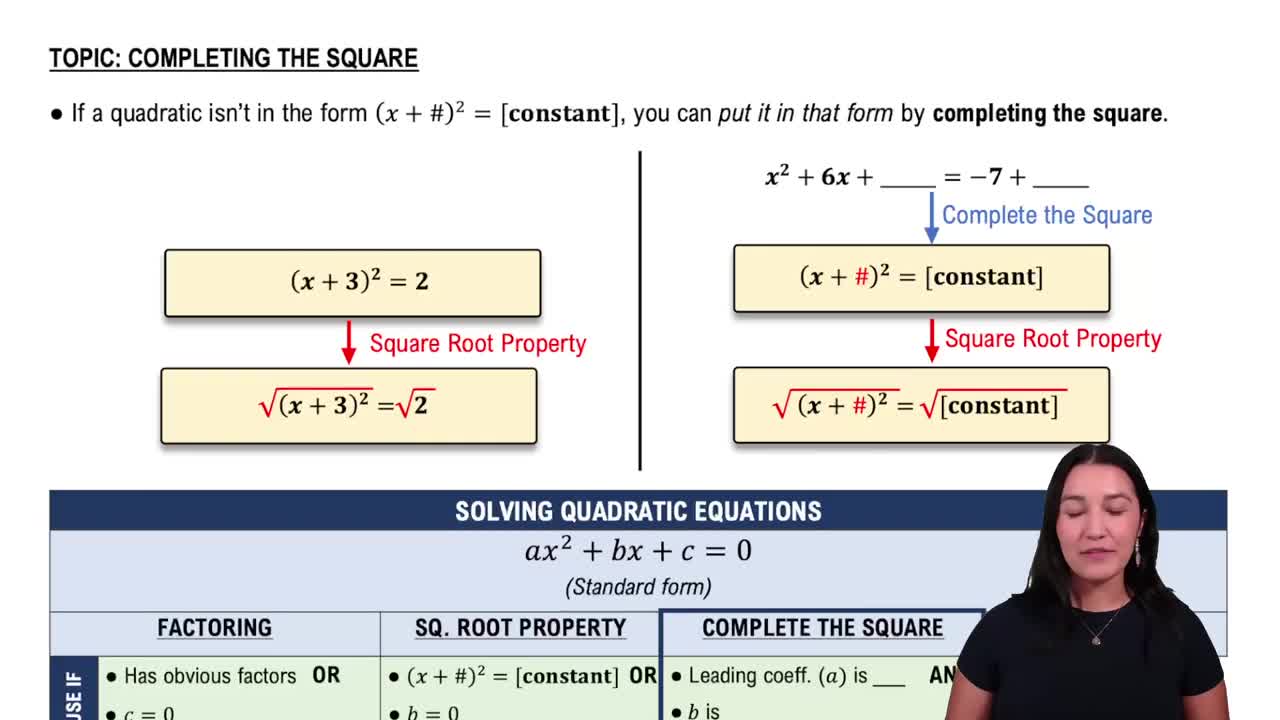
Completing the Square
Completing the square is a method used to transform a quadratic expression into a perfect square trinomial. This technique involves manipulating the equation to isolate the variable terms and create a squared term, which simplifies the process of identifying the center and radius of a circle.
Recommended video:
Solving Quadratic Equations by Completing the Square
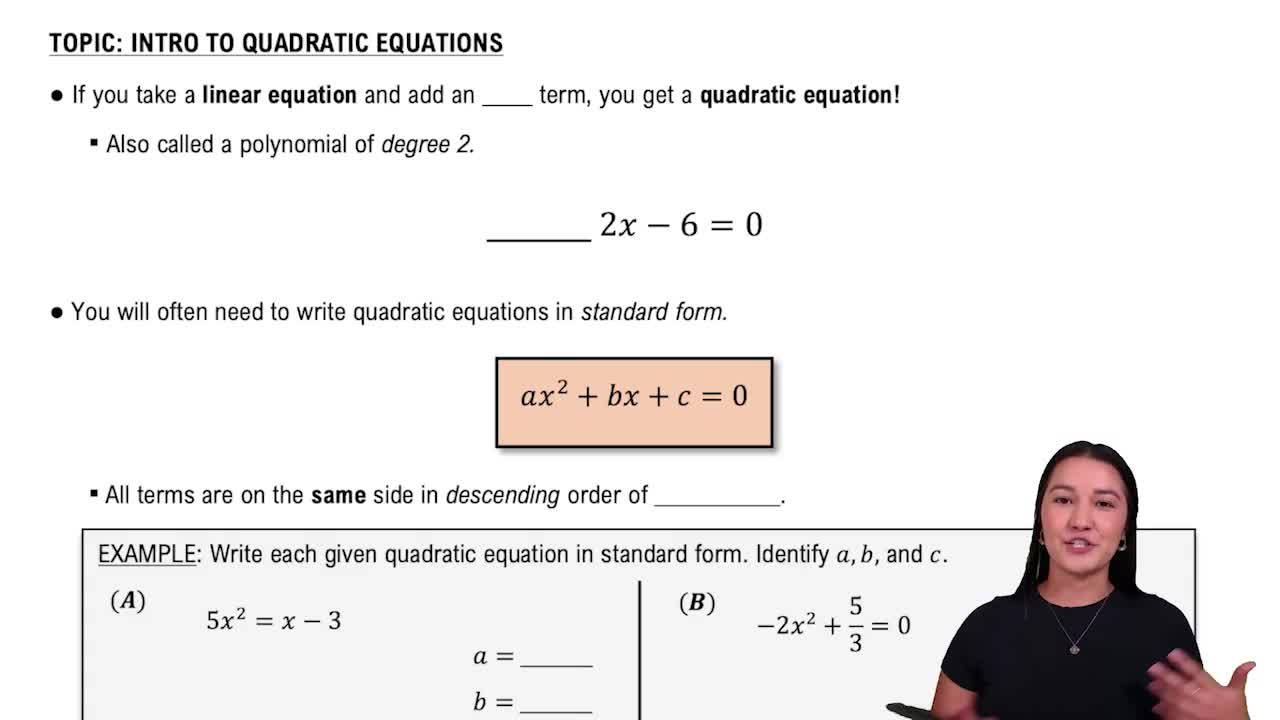
Quadratic Equations
Quadratic equations are polynomial equations of the form ax² + bx + c = 0. In the context of circles, the terms involving x and y can be rearranged to form a quadratic equation, which is essential for identifying the geometric properties of the circle, such as its center and radius.
Recommended video:
Introduction to Quadratic Equations
Related Practice
Textbook Question
1142
views
Textbook Question
In Exercises 107–108, write the standard form of the equation of the circle with the given center and radius. Center (-2. 4), r = 6
925
views
Textbook Question
Begin by graphing the cube root function, f(x) = ∛x. Then use transformations of this graph to graph the given function. g(x) = (1/2)∛(x-2)
724
views
Textbook Question
Begin by graphing the cube root function, f(x) = ∛x. Then use transformations of this graph to graph the given function. g(x) = ∛(x-2)
1451
views
Textbook Question
Begin by graphing the cube root function, f(x) = ∛x. Then use transformations of this graph to graph the given function. -∛(x+2)
1315
views
Textbook Question
Begin by graphing the cube root function, f(x) = ∛x. Then use transformations of this graph to graph the given function. g(x) = (1/2)∛(x+2) - 2
846
views