Ch. 2 - Functions and Graphs
Blitzer - College Algebra 8th Edition
Blitzer8th EditionCollege AlgebraISBN: 9780136970514Not the one you use?Change textbook
Chapter 3, Problem 20

Determine whether each equation defines y as a function of x. y=x+4y=-\(\sqrt{x+4}\)

Verified step by step guidance
1
Recall that a relation defines y as a function of x if for every x-value in the domain, there is exactly one corresponding y-value.
Look at the given equation: \(y = - \sqrt{x} + 4\). The square root function \(\sqrt{x}\) is defined only for \(x \geq 0\).
Since the square root function outputs only the principal (non-negative) root, \(\sqrt{x}\) is always non-negative, so \(-\sqrt{x}\) is always non-positive.
For each \(x \geq 0\), the expression \(-\sqrt{x} + 4\) produces exactly one value of \(y\), because the square root function is single-valued and the operations are well-defined.
Therefore, the equation defines \(y\) as a function of \(x\) because each \(x\) in the domain corresponds to exactly one \(y\).

Verified video answer for a similar problem:

This video solution was recommended by our tutors as helpful for the problem above.
Video duration:
1m
Was this helpful?

Key Concepts

Here are the essential concepts you must grasp in order to answer the question correctly.

Definition of a Function

A function is a relation where each input (x-value) corresponds to exactly one output (y-value). To determine if an equation defines y as a function of x, check if for every x there is only one y. If multiple y-values exist for a single x, it is not a function.
Recommended video:
5:57
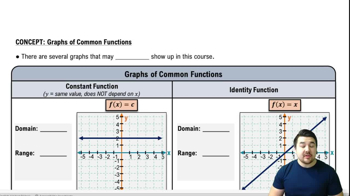
Graphs of Common Functions

Square Root Function and Domain

The square root function, √x, is defined only for x ≥ 0 because the square root of a negative number is not real. When analyzing y = -√x + 4, the domain is restricted to x ≥ 0, ensuring the expression under the root is valid.
Recommended video:
02:20
Imaginary Roots with the Square Root Property

Evaluating Function Output Uniqueness

To verify if y = -√x + 4 defines y as a function of x, substitute values of x and observe the output y. Since the square root yields a single non-negative value and the equation applies a negative sign and addition, each x produces exactly one y, confirming it is a function.
Recommended video:
4:26
Evaluating Composed Functions