Write an equation in slope-intercept form of a linear function f whose graph satisfies the given conditions. The graph of ƒ passes through (−1, 5) and is perpendicular to the line whose equation is x = 6.
Ch. 2 - Functions and Graphs

Chapter 3, Problem 19
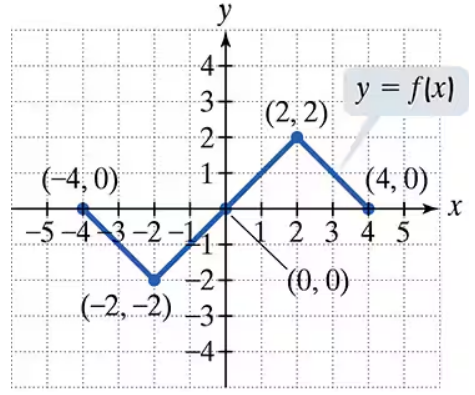
use the graph of y = f(x) to graph each function g.

g(x) = f(x-1)
Verified step by step guidance1
Identify the given function and the transformation: The original function is \(y = f(x)\), and the new function is \(g(x) = f(x - 1)\). This represents a horizontal shift of the graph of \(f(x)\).
Understand the effect of \(f(x - 1)\): Replacing \(x\) with \(x - 1\) shifts the graph of \(f(x)\) to the right by 1 unit. This means every point on the graph of \(f(x)\) moves 1 unit to the right to get the graph of \(g(x)\).
Apply the horizontal shift to key points: Take the key points from the original graph of \(f(x)\), which are \((-4, 0)\), \((0, -16)\), and \((4, 0)\). Add 1 to each x-coordinate to find the corresponding points on \(g(x)\).
Calculate the new points for \(g(x)\): The points become \((-4 + 1, 0) = (-3, 0)\), \((0 + 1, -16) = (1, -16)\), and \((4 + 1, 0) = (5, 0)\).
Sketch the graph of \(g(x)\): Plot the new points \((-3, 0)\), \((1, -16)\), and \((5, 0)\) on the coordinate plane and draw a smooth parabola through these points, maintaining the shape of the original graph but shifted right by 1 unit.

Verified video answer for a similar problem:
This video solution was recommended by our tutors as helpful for the problem above.
Video duration:
2mWas this helpful?
Key Concepts
Here are the essential concepts you must grasp in order to answer the question correctly.
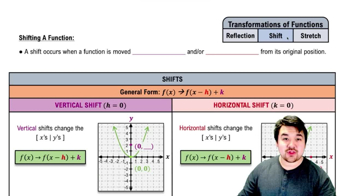
Function Transformation - Horizontal Shift
A horizontal shift of a function occurs when the input variable x is replaced by (x - h), shifting the graph h units to the right if h > 0, or to the left if h < 0. For g(x) = f(x - 1), the graph of f(x) moves 1 unit to the right.
Recommended video:
Shifts of Functions
Graphing Quadratic Functions
Quadratic functions form parabolas, typically expressed as y = ax^2 + bx + c. Key points such as vertex and x-intercepts help in sketching the graph. The given graph shows a parabola with vertex at (0, -16) and x-intercepts at (-4, 0) and (4, 0).
Recommended video:
Graphs of Logarithmic Functions
Interpreting Key Points on a Graph
Identifying and using key points like intercepts and vertex is essential for graph transformations. These points help visualize how the graph shifts or changes shape. For g(x) = f(x - 1), each key point of f(x) moves 1 unit right, e.g., vertex moves from (0, -16) to (1, -16).
Recommended video:
Guided course
Graphing Equations of Two Variables by Plotting Points
Related Practice
Textbook Question
123
views
Textbook Question
Find the midpoint of each line segment with the given endpoints. (6, 8) and (2, 4)
869
views
Textbook Question
The functions in Exercises 11-28 are all one-to-one. For each function, a. Find an equation for f-1(x), the inverse function. b. Verify that your equation is correct by showing that f(ƒ-1 (x)) = = x and ƒ-1 (f(x)) = x. f(x) = (x+2)³
623
views
Textbook Question
Write an equation in slope-intercept form of a linear function f whose graph satisfies the given conditions. The graph of ƒ passes through (−2, 6) and is perpendicular to the line whose equation is x = -4.
1259
views
Textbook Question
Determine whether each equation defines y as a function of x. y = √x +4
248
views
Textbook Question
Find the domain of each function. f(x) = 1/√(x - 3)
1064
views