Ch. 2 - Functions and Graphs
Blitzer - College Algebra 8th Edition
Blitzer8th EditionCollege AlgebraISBN: 9780136970514Not the one you use?Change textbook
Chapter 3, Problem 33b

In Exercises 27–38, evaluate each function at the given values of the independent variable and simplify. f(r) = √(r + 6) +3 b. f(10)

Verified step by step guidance
1
Step 1: Understand the problem. The function f(r) = √(r + 6) + 3 is given, and you are tasked with evaluating it at r = 10. This means substituting 10 for r in the function.
Step 2: Substitute r = 10 into the function. Replace r in the expression √(r + 6) + 3 with 10, resulting in f(10) = √(10 + 6) + 3.
Step 3: Simplify the expression inside the square root. Add 10 and 6 to get 16, so the function becomes f(10) = √(16) + 3.
Step 4: Evaluate the square root. The square root of 16 is 4, so the function simplifies further to f(10) = 4 + 3.
Step 5: Add the remaining terms. Combine 4 and 3 to complete the simplification of f(10).

Verified video answer for a similar problem:

This video solution was recommended by our tutors as helpful for the problem above.
Video duration:
1m
Was this helpful?

Key Concepts

Here are the essential concepts you must grasp in order to answer the question correctly.

Function Evaluation

Function evaluation involves substituting a specific value for the independent variable in a function. In this case, we replace 'r' in the function f(r) = √(r + 6) + 3 with the value 10. This process allows us to determine the output of the function for that particular input.
Recommended video:
4:26
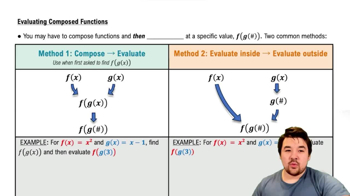
Evaluating Composed Functions

Square Root Function

The square root function, denoted as √x, represents the principal square root of x, which is the non-negative value that, when squared, gives x. In the function f(r), the term √(r + 6) requires us to ensure that the expression inside the square root is non-negative, as square roots of negative numbers are not defined in the realm of real numbers.
Recommended video:
02:20
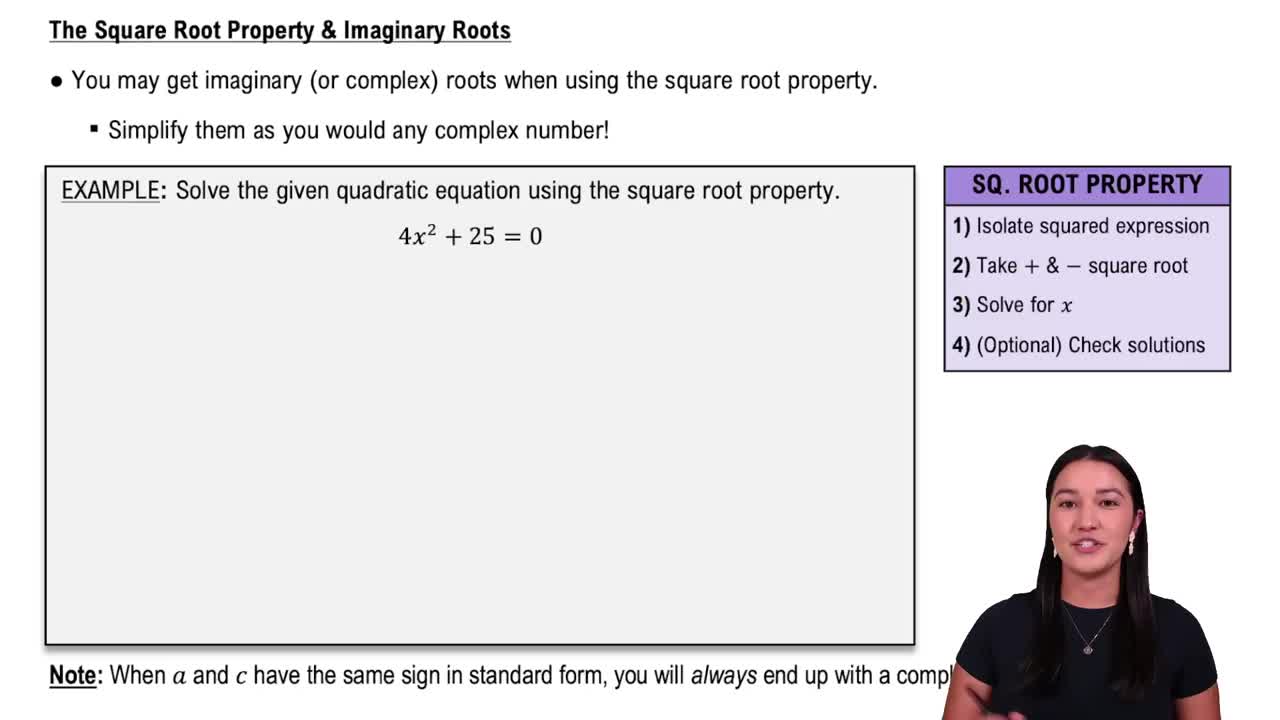
Imaginary Roots with the Square Root Property

Simplification

Simplification is the process of reducing an expression to its simplest form. After evaluating the function at a specific value, we may need to combine like terms or perform arithmetic operations to arrive at a final, simplified answer. This step is crucial for clarity and ease of understanding in mathematical expressions.
Recommended video:
Guided course
04:15
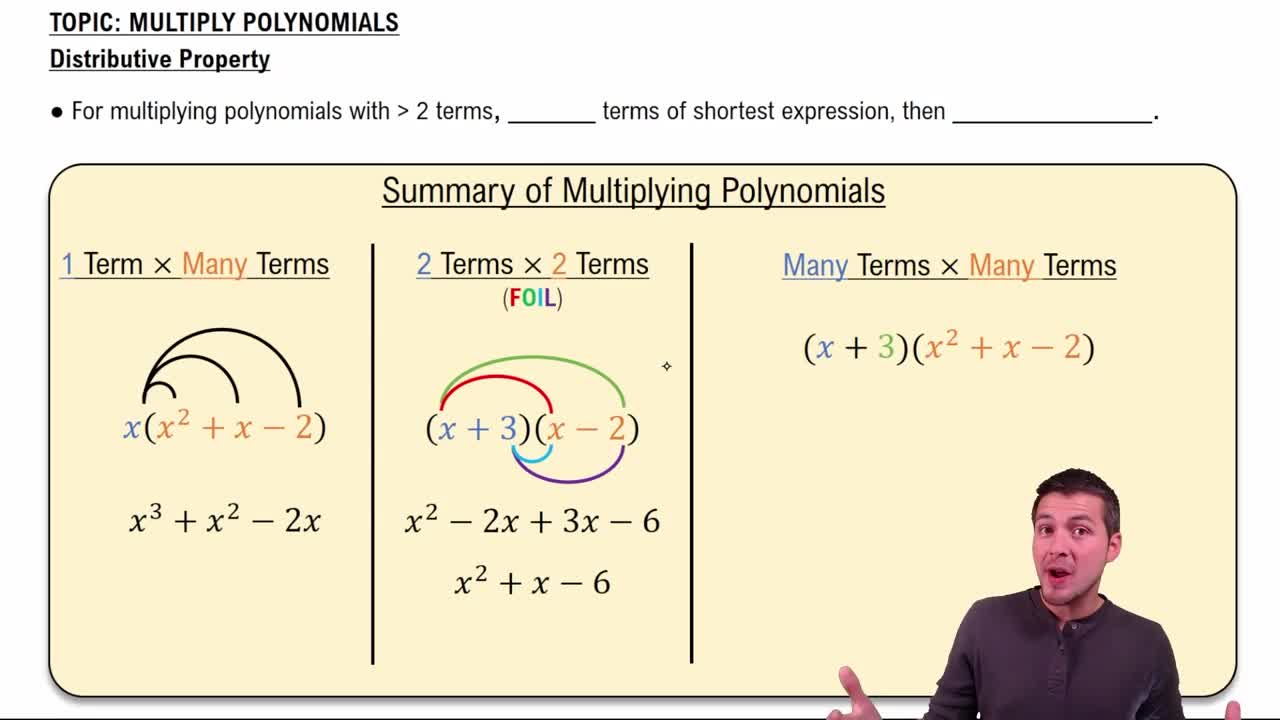
Multiply Polynomials Using the Distributive Property