In Exercises 41–44, use the given conditions to write an equation for each line in point-slope form and slope-intercept form. Passing through (-3, 2) with slope - 6
Ch. 2 - Functions and Graphs

Chapter 3, Problem 41
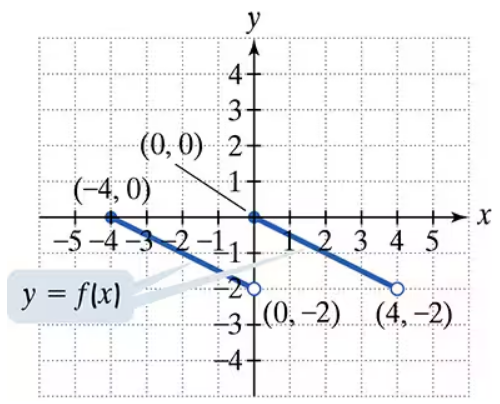
Use the graph of y = f(x) to graph each function g. g(x) = -½ ƒ ( x + 2) - 2

Verified step by step guidance1
Start by understanding the transformations applied to the base function y = f(x). The given function g(x) = -½ ƒ(x + 2) - 2 involves multiple transformations: a horizontal shift, a vertical stretch/compression, a reflection, and a vertical shift.
Identify the horizontal shift: The term (x + 2) inside the function indicates a horizontal shift to the left by 2 units. This means every point on the graph of f(x) will move 2 units to the left.
Determine the vertical stretch/compression and reflection: The coefficient -½ in front of ƒ(x + 2) indicates two transformations. The negative sign reflects the graph across the x-axis, and the factor of ½ compresses the graph vertically by a factor of ½. This means the y-values of the graph will be halved and flipped in sign.
Account for the vertical shift: The -2 at the end of the function indicates a vertical shift downward by 2 units. This means every point on the graph will move 2 units down.
Combine all transformations: To graph g(x), start with the graph of y = f(x). First, shift the graph 2 units to the left. Then, reflect it across the x-axis and compress it vertically by a factor of ½. Finally, shift the resulting graph 2 units downward. Plot the transformed points to complete the graph of g(x).

Verified video answer for a similar problem:
This video solution was recommended by our tutors as helpful for the problem above.
Video duration:
6mWas this helpful?
Key Concepts
Here are the essential concepts you must grasp in order to answer the question correctly.
Function Transformation
Function transformation involves altering the graph of a function through various operations such as shifting, reflecting, stretching, or compressing. In the given function g(x) = -½ f(x + 2) - 2, the transformations include a horizontal shift to the left by 2 units, a vertical compression by a factor of ½, and a vertical shift downward by 2 units.
Recommended video:
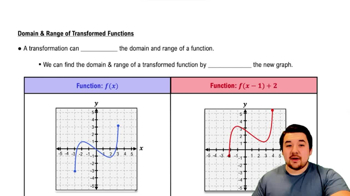
Domain & Range of Transformed Functions
Horizontal Shifts
Horizontal shifts occur when the input of a function is adjusted by adding or subtracting a constant. For g(x) = -½ f(x + 2), the '+2' indicates a shift to the left by 2 units on the x-axis. This means that every point on the graph of f(x) will move leftward, affecting the overall position of the graph of g(x).
Recommended video:
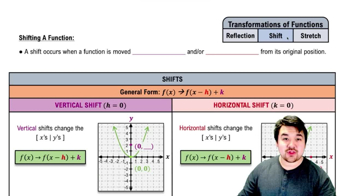
Shifts of Functions
Vertical Shifts and Reflections
Vertical shifts involve moving the graph of a function up or down by adding or subtracting a constant from the function's output. In g(x), the '-2' indicates a downward shift of 2 units. Additionally, the negative sign in front of the ½ reflects the graph across the x-axis, inverting its orientation while also compressing it vertically by a factor of ½.
Recommended video:
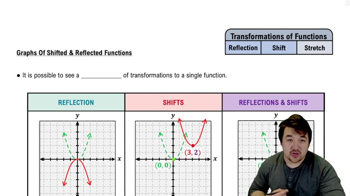
Graphs of Shifted & Reflected Functions
Related Practice
Textbook Question
1162
views
Textbook Question
Find f/g and determine the domain for each function. f(x) = √x, g(x) = x − 4
1111
views
Textbook Question
Give the center and radius of the circle described by the equation and graph each equation. Use the graph to identify the relation's domain and range. x² + y² = 16
867
views
Textbook Question
Find , , , and . Determine the domain for each function.
,
717
views
Textbook Question
In Exercises 39–48, give the slope and y-intercept of each line whose equation is given. Then graph the linear function. f(x) = -2x+1
132
views
Textbook Question
Graph the given functions, f and g, in the same rectangular coordinate system. Select integers for x, starting with -2 and ending with 2. Once you have obtained your graphs, describe how the graph of g is related to the graph of f. f(x) = -2x, g(x) = -2x-1
625
views