Give the center and radius of the circle described by the equation and graph each equation. Use the graph to identify the relation's domain and range. (x − 3)² + (y + 1)² = 36
Ch. 2 - Functions and Graphs

Chapter 3, Problem 43abc
In Exercises 39-52, a. Find an equation for ƒ¯¹(x). b. Graph ƒ and ƒ¯¹(x) in the same rectangular coordinate system. c. Use interval notation to give the domain and the range off and ƒ¯¹. f(x) = (x − 1)², x ≤ 1
Verified step by step guidance1
Step 1: To find the inverse function ƒ¯¹(x), start by replacing f(x) with y. So, rewrite the given function as y = (x - 1)², where x ≤ 1.
Step 2: Swap x and y to begin solving for the inverse. This gives x = (y - 1)². Now, solve for y by taking the square root of both sides, keeping in mind the restriction x ≤ 1, which affects the sign of the square root.
Step 3: Solve for y by isolating it. Take the negative square root (since x ≤ 1 implies the function is decreasing) and then add 1 to both sides. This gives y = 1 - √x. Replace y with ƒ¯¹(x) to express the inverse function.
Step 4: To graph ƒ(x) and ƒ¯¹(x) on the same coordinate system, plot the parabola f(x) = (x - 1)² for x ≤ 1 and the inverse function ƒ¯¹(x) = 1 - √x. Remember that the graph of a function and its inverse are reflections of each other across the line y = x.
Step 5: Determine the domain and range of both functions. For f(x), the domain is (-∞, 1] and the range is [0, ∞). For ƒ¯¹(x), the domain is [0, ∞) and the range is (-∞, 1]. Use interval notation to express these sets.

Verified video answer for a similar problem:
This video solution was recommended by our tutors as helpful for the problem above.
Video duration:
13mWas this helpful?
Key Concepts
Here are the essential concepts you must grasp in order to answer the question correctly.
Inverse Functions
An inverse function reverses the effect of the original function. For a function f(x), its inverse f¯¹(x) satisfies the condition f(f¯¹(x)) = x for all x in the domain of f¯¹. To find the inverse, one typically swaps the roles of x and y in the equation and solves for y. Understanding this concept is crucial for part (a) of the question.
Recommended video:
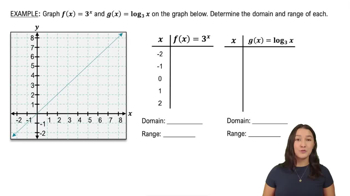
Graphing Logarithmic Functions
Graphing Functions
Graphing functions involves plotting points on a coordinate system to visually represent the relationship between the input (x) and output (f(x)). For the original function f(x) and its inverse f¯¹(x), their graphs will reflect across the line y = x. This symmetry is essential for part (b) of the question, as it helps in understanding how the two functions relate to each other.
Recommended video:
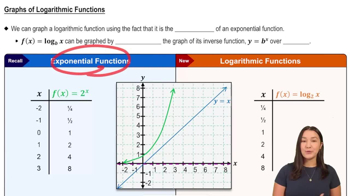
Graphs of Logarithmic Functions
Domain and Range
The domain of a function is the set of all possible input values (x-values), while the range is the set of all possible output values (f(x)). For the function f(x) = (x - 1)² with the restriction x ≤ 1, the domain is limited, affecting the range. Understanding how to express these sets in interval notation is necessary for part (c) of the question, as it provides a concise way to describe the function's behavior.
Recommended video:
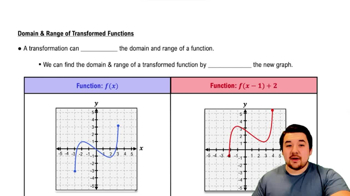
Domain & Range of Transformed Functions
Related Practice
Textbook Question
811
views
Textbook Question
Find f/g and determine the domain for each function. f(x)= = (5x+1)/(x² - 9), g(x) = (4x -2)/(x² - 9)
1239
views
Textbook Question
Find f−g and determine the domain for each function. f(x)= = (5x+1)/(x² - 9), g(x) = (4x -2)/(x² - 9)
1195
views
Textbook Question
Find ƒ+g and determine the domain for each function.
f(x)= = (5x+1)/(x² - 9), g(x) = (4x -2)/(x² - 9)
914
views
Textbook Question
Find fg and determine the domain for each function. f(x)= = (5x+1)/(x² - 9), g(x) = (4x -2)/(x² - 9)
1289
views
Textbook Question
In Exercises 41–44, use the given conditions to write an equation for each line in point-slope form and slope-intercept form. Passing through (4, -7) and parallel to the line whose equation is 3x + y - 9 = 0.
305
views