In Exercises 39–50, graph the given functions, f and g, in the same rectangular coordinate system. Select integers for x, starting with -2 and ending with 2. Once you have obtained your graphs, describe how the graph of g is related to the graph of f. f(x) = x³, g(x) = x³ +2

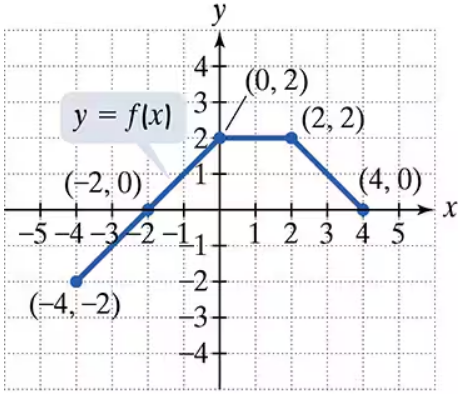
Use the graph of y = f(x) to graph each function g. g(x) = -f(x-1) + 1

Verified step by step guidance
Verified video answer for a similar problem:
Key Concepts
Function Transformations
Horizontal Shifts
Reflections and Vertical Shifts
Give the center and radius of the circle described by the equation and graph each equation. Use the graph to identify the relation's domain and range. (x + 2)² + (y + 2)² = 4
Find ƒ+g and determine the domain for each function. f(x) = √(x +4), g(x) = √(x − 1)
In Exercises 46–49, give the slope and y-intercept of each line whose equation is given. Then graph the line. y = (2/5)x - 1
In Exercises 39–50, graph the given functions, f and g, in the same rectangular coordinate system. Select integers for x, starting with -2 and ending with 2. Once you have obtained your graphs, describe how the graph of g is related to the graph of f. f(x)= |x|, g(x) = |x| +1
Find ƒ+g, f−g, fg, and f/g. Determine the domain for each function. f(x)= = 9x/(x - 4), g(x) = 7/(x+8)
