Find a. (fog) (x) b. (go f) (x). f(x) = √x, g(x) = x − 1
Ch. 2 - Functions and Graphs

Chapter 3, Problem 62
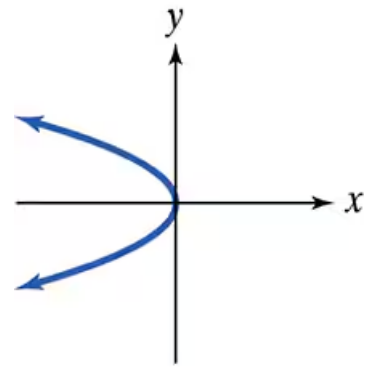
Use the vertical line test to identify graphs in which y is a function of x.

Verified step by step guidance1
Recall that the vertical line test is used to determine if a graph represents a function of x. The test states that if any vertical line intersects the graph at more than one point, then y is not a function of x.
Observe the graph carefully and imagine drawing vertical lines (lines parallel to the y-axis) at various x-values along the curve.
Notice that for some x-values, a vertical line will intersect the graph at two points (one on the upper branch and one on the lower branch of the curve).
Since there are vertical lines that intersect the graph at more than one point, this means that for those x-values, there are multiple y-values.
Conclude that the graph does not pass the vertical line test, so y is not a function of x for this graph.

Verified video answer for a similar problem:
This video solution was recommended by our tutors as helpful for the problem above.
Video duration:
50sWas this helpful?
Key Concepts
Here are the essential concepts you must grasp in order to answer the question correctly.
Vertical Line Test
The vertical line test is a visual method used to determine if a graph represents a function. If any vertical line drawn through the graph intersects it at more than one point, the graph does not represent a function because a single input (x-value) corresponds to multiple outputs (y-values).
Recommended video:
Guided course
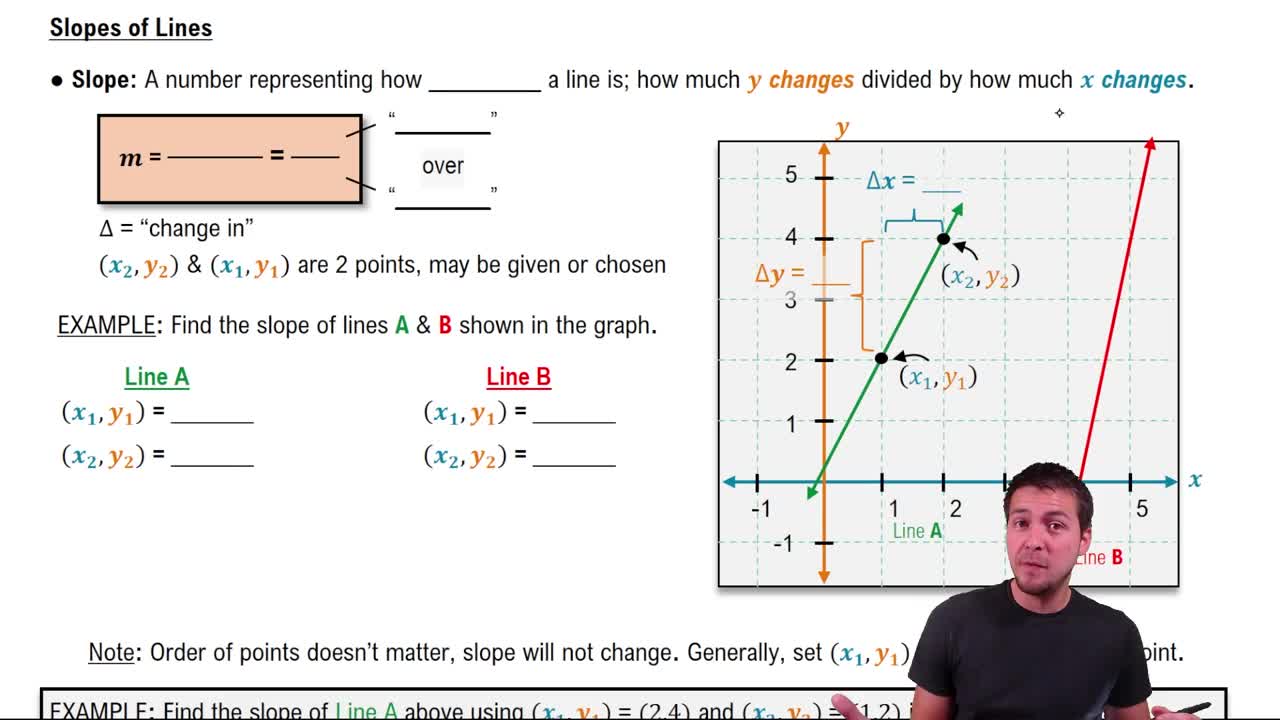
The Slope of a Line
Definition of a Function
A function is a relation where each input (x-value) has exactly one output (y-value). This means no x-value can be paired with more than one y-value. Understanding this definition is essential to apply the vertical line test correctly.
Recommended video:
Graphs of Common Functions
Graph Interpretation
Interpreting graphs involves understanding the relationship between variables and how they are represented visually. Recognizing the shape and behavior of the graph, such as whether it curves back or overlaps vertically, helps in applying tests like the vertical line test to identify functions.
Recommended video:
Guided course
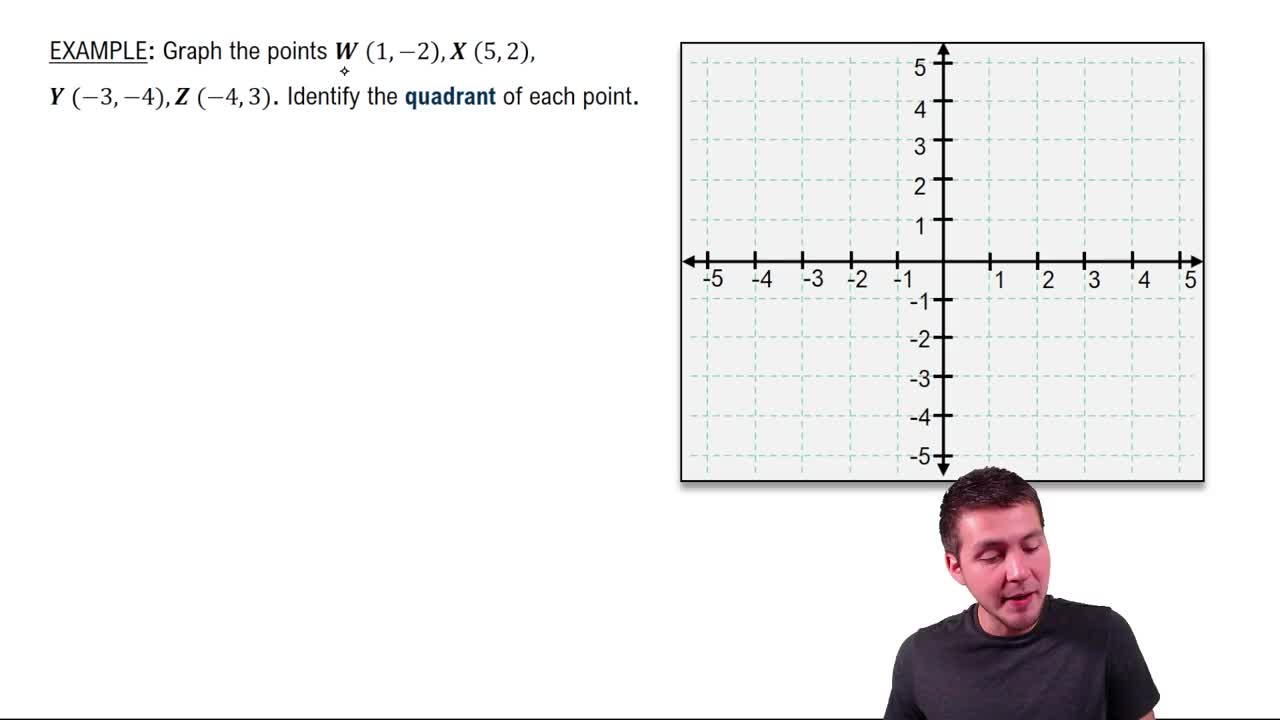
Graphs and Coordinates - Example
Related Practice
Textbook Question
1093
views
Textbook Question
In Exercises 59-66, a. Rewrite the given equation in slope-intercept form. b. Give the slope and y-intercept. c. Use the slope and y-intercept to graph the linear function. 8x – 4y – 12 =0
162
views
Textbook Question
In Exercises 60–63, begin by graphing the standard quadratic function, f(x) = x2. Then use transformations of this graph to graph the given function. r(x) = -(x + 1)2
858
views
Textbook Question
Complete the square and write the equation in standard form. Then give the center and radius of each circle and graph the equation. x² + y² − x + 2y + 1 = 0
856
views
Textbook Question
Begin by graphing the standard quadratic function, f(x) = x². Then use transformations of this graph to graph the given function. g(x) = (1/2)(x − 1)²
868
views
Textbook Question
Find c. (fog) (2) d. (go f) (2). f(x) = √x, g(x) = x − 1
845
views