In Exercises 77–92, use the graph to determine a. the function's domain; b. the function's range; c. the x-intercepts, if any; d. the y-intercept, if any; and e. the missing function values, indicated by question marks, below each graph.
Ch. 2 - Functions and Graphs

Chapter 3, Problem 87
Find a. (f ○ g)(x); b. the domain of (f ○ g). f(x) = (x + 1)/(x - 2), g(x) = 1/x
Verified step by step guidance1
Step 1: Understand that the composition (f \(\circ\) g)(x) means f(g(x)), which is the function f applied to the output of g(x). So, first substitute g(x) into f(x).
Step 2: Write the expression for (f \(\circ\) g)(x) by replacing every x in f(x) with g(x). Since f(x) = \(\frac{x + 1}{x - 2}\) and g(x) = \(\frac{1}{x}\), we have (f \(\circ\) g)(x) = f\(\left\)(\(\frac{1}{x}\)\(\right\)) = \(\frac{\frac{1}{x}\) + 1}{\(\frac{1}{x}\) - 2}.
Step 3: Simplify the complex fraction by finding a common denominator for the numerator and denominator separately, then simplify the overall expression.
Step 4: Determine the domain of (f \(\circ\) g)(x) by considering the domain restrictions of both g(x) and f(g(x)). First, find where g(x) is defined (denominator \(\neq\) 0), then find where f is defined when its input is g(x) (denominator of f(g(x)) \(\neq\) 0).
Step 5: Combine the domain restrictions from both functions to write the domain of (f \(\circ\) g)(x) in interval or set notation, excluding values that make any denominator zero or cause undefined expressions.

Verified video answer for a similar problem:
This video solution was recommended by our tutors as helpful for the problem above.
Video duration:
3mWas this helpful?
Key Concepts
Here are the essential concepts you must grasp in order to answer the question correctly.
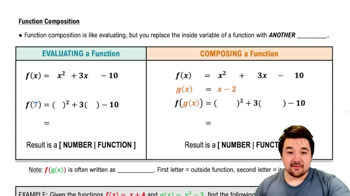
Function Composition
Function composition involves applying one function to the result of another, denoted as (f ○ g)(x) = f(g(x)). It requires substituting the entire output of g(x) into the function f. Understanding this process is essential to correctly find (f ○ g)(x).
Recommended video:
Function Composition
Domain of a Function
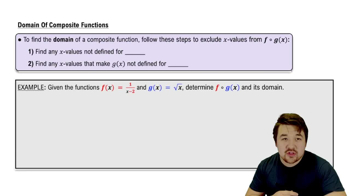
The domain of a function is the set of all input values (x) for which the function is defined. When composing functions, the domain of (f ○ g) includes all x-values in the domain of g for which g(x) is in the domain of f. Identifying restrictions like division by zero is crucial.
Recommended video:
Domain Restrictions of Composed Functions
Rational Functions and Restrictions
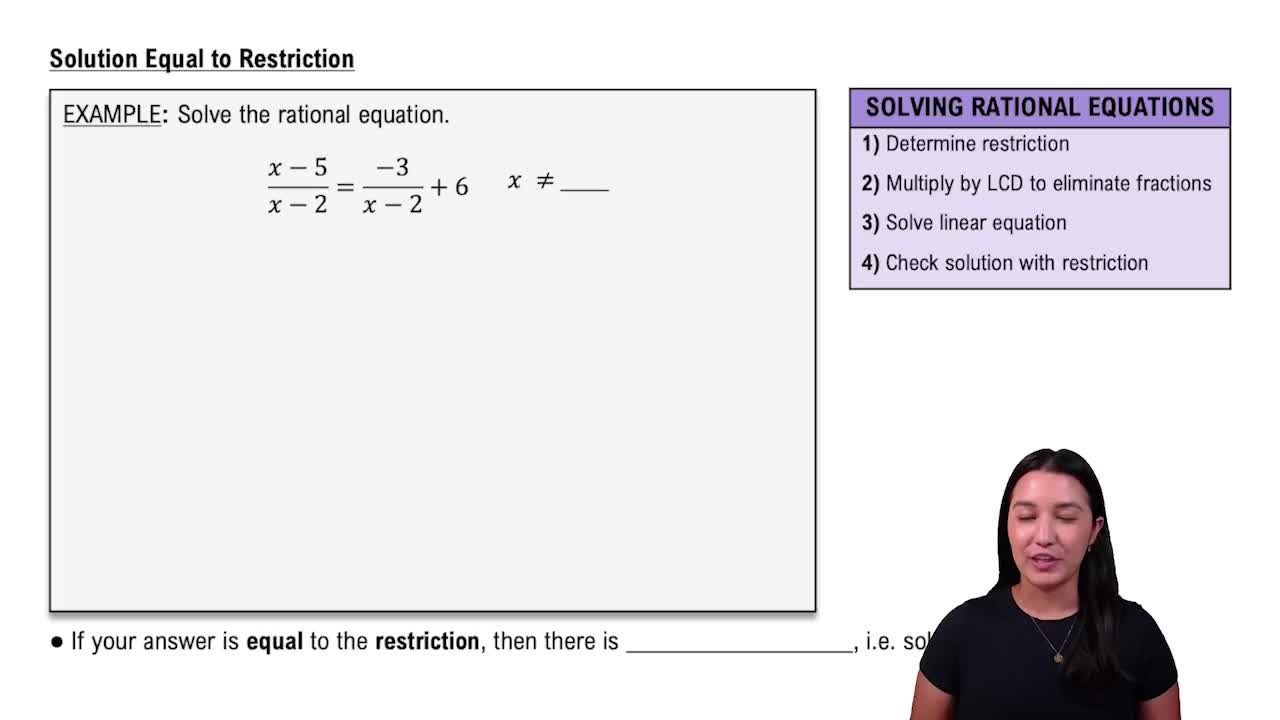
Rational functions are ratios of polynomials, which can have restrictions where the denominator equals zero. For f(x) = (x + 1)/(x - 2) and g(x) = 1/x, values that make denominators zero must be excluded from the domain to avoid undefined expressions.
Recommended video:
Restrictions on Rational Equations
Related Practice
Textbook Question
129
views
Textbook Question
Use the graphs of f and g to solve Exercises 83–90.
Find the domain of ƒ + g.
1267
views
Textbook Question
Begin by graphing the absolute value function, f(x) = |x|. Then use transformations of this graph to graph the given function. h(x) = |x + 3| - 2
791
views
Textbook Question
Begin by graphing the absolute value function, f(x) = |x|. Then use transformations of this graph to graph the given function. h(x) = -|x+3|
1611
views
Textbook Question
Use the graphs of f and g to solve Exercises 83–90.
Find(g/f)(3)
1294
views
Textbook Question
In Exercises 77–92, use the graph to determine a. the function's domain; b. the function's range; c. the x-intercepts, if any; d. the y-intercept, if any; and e. the missing function values, indicated by question marks, below each graph.
107
views
