Use the given conditions to write an equation for each line in point-slope form and slope-intercept form. Slope = - 3/5, passing through (10, −4)
Ch. 2 - Functions and Graphs

Chapter 3, Problem 23
The functions in Exercises 11-28 are all one-to-one. For each function, a. Find an equation for f-1(x), the inverse function. b. Verify that your equation is correct by showing that f(ƒ-1 (x)) = = x and ƒ-1 (f(x)) = x. f(x) = √x
Verified step by step guidance1
Start with the given function: \(f(x) = \sqrt{x}\). To find the inverse function \(f^{-1}(x)\), first replace \(f(x)\) with \(y\): \(y = \sqrt{x}\).
Next, interchange the variables \(x\) and \(y\) to find the inverse: \(x = \sqrt{y}\). This step reflects the idea that the inverse function swaps the roles of inputs and outputs.
Now, solve the equation \(x = \sqrt{y}\) for \(y\). Square both sides to eliminate the square root: \(x^2 = y\).
Rewrite \(y\) as \(f^{-1}(x)\) to express the inverse function explicitly: \(f^{-1}(x) = x^2\). Remember to consider the domain restrictions since the original function outputs only non-negative values.
To verify the inverse, compute the compositions \(f(f^{-1}(x))\) and \(f^{-1}(f(x))\). Substitute \(f^{-1}(x)\) into \(f(x)\) and simplify, then substitute \(f(x)\) into \(f^{-1}(x)\) and simplify. Both should simplify to \(x\) if the inverse is correct.

Verified video answer for a similar problem:
This video solution was recommended by our tutors as helpful for the problem above.
Video duration:
5mWas this helpful?
Key Concepts
Here are the essential concepts you must grasp in order to answer the question correctly.
One-to-One Functions
A one-to-one function (injective) assigns each input a unique output, ensuring no two different inputs share the same output. This property is essential for a function to have an inverse because it guarantees that the inverse will also be a function.
Recommended video:
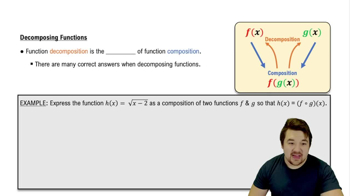
Decomposition of Functions
Inverse Functions
The inverse of a function reverses the roles of inputs and outputs, meaning if f(x) maps x to y, then f⁻¹(y) maps y back to x. Finding the inverse involves solving the equation y = f(x) for x in terms of y and then swapping variables.
Recommended video:
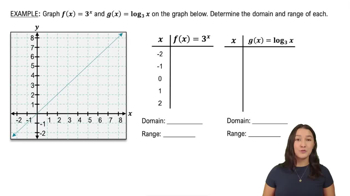
Graphing Logarithmic Functions
Verification of Inverse Functions
To verify that two functions are inverses, you must show that composing them in either order returns the original input: f(f⁻¹(x)) = x and f⁻¹(f(x)) = x. This confirms that the functions undo each other's operations perfectly.
Recommended video:
Graphing Logarithmic Functions
Related Practice
Textbook Question
99
views
Textbook Question
Find the domain of each function. f(x) = √(24 - 2x)
942
views
Textbook Question
Find the midpoint of each line segment with the given endpoints. (-3, -4) and (6, −8)
840
views
Textbook Question
Write an equation in slope-intercept form of a linear function f whose graph satisfies the given conditions. The graph of ƒ is perpendicular to the line whose equation is 3x - 2y - 4 = 0 and has the same y-intercept as this line.
115
views
Textbook Question
In Exercises 11–26, determine whether each equation defines y as a function of x. xy - 5y =1
113
views
Textbook Question
Determine whether the graph of each equation is symmetric with respect to the y-axis, the x-axis, the origin, more than one of those, or none of these. x^2 + y^2 =17
182
views