Ch. 3 - Polynomial and Rational Functions
Blitzer - College Algebra 8th Edition
Blitzer8th EditionCollege AlgebraISBN: 9780136970514Not the one you use?Change textbook
Chapter 4, Problem 107

Exercises 107–109 will help you prepare for the material covered in the next section. Factor: x3+3x2−x−3

Verified step by step guidance
1
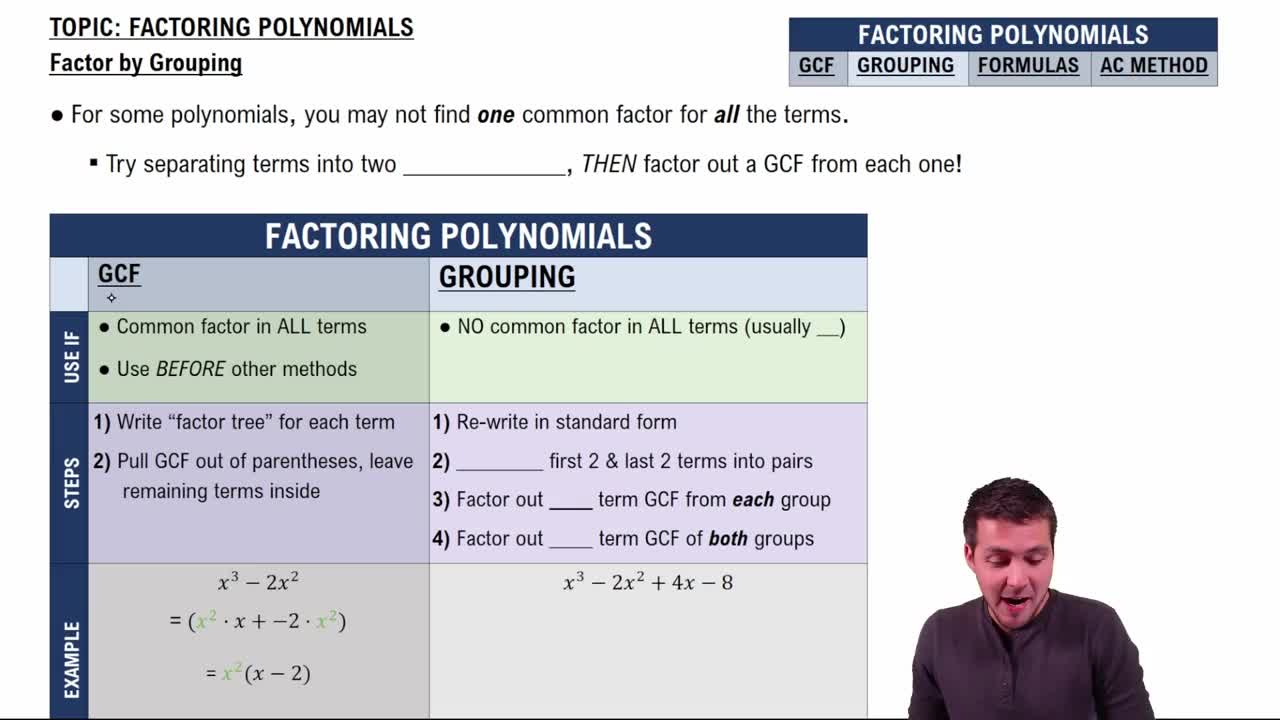
First, group the terms in pairs to make factoring easier: \(\left(x^{3} + 3x^{2}\right) + \left(-x - 3\right)\).
Next, factor out the greatest common factor (GCF) from each group: from the first group, factor out \(x^{2}\) to get \(x^{2}(x + 3)\); from the second group, factor out \(-1\) to get \(-1(x + 3)\).
Now, notice that both groups contain the common binomial factor \((x + 3)\), so factor this out: \((x + 3)(x^{2} - 1)\).
Recognize that \(x^{2} - 1\) is a difference of squares, which can be factored further as \((x - 1)(x + 1)\).
Write the fully factored form as \((x + 3)(x - 1)(x + 1)\).

Verified video answer for a similar problem:

This video solution was recommended by our tutors as helpful for the problem above.
Video duration:
2m
Was this helpful?

Key Concepts

Here are the essential concepts you must grasp in order to answer the question correctly.

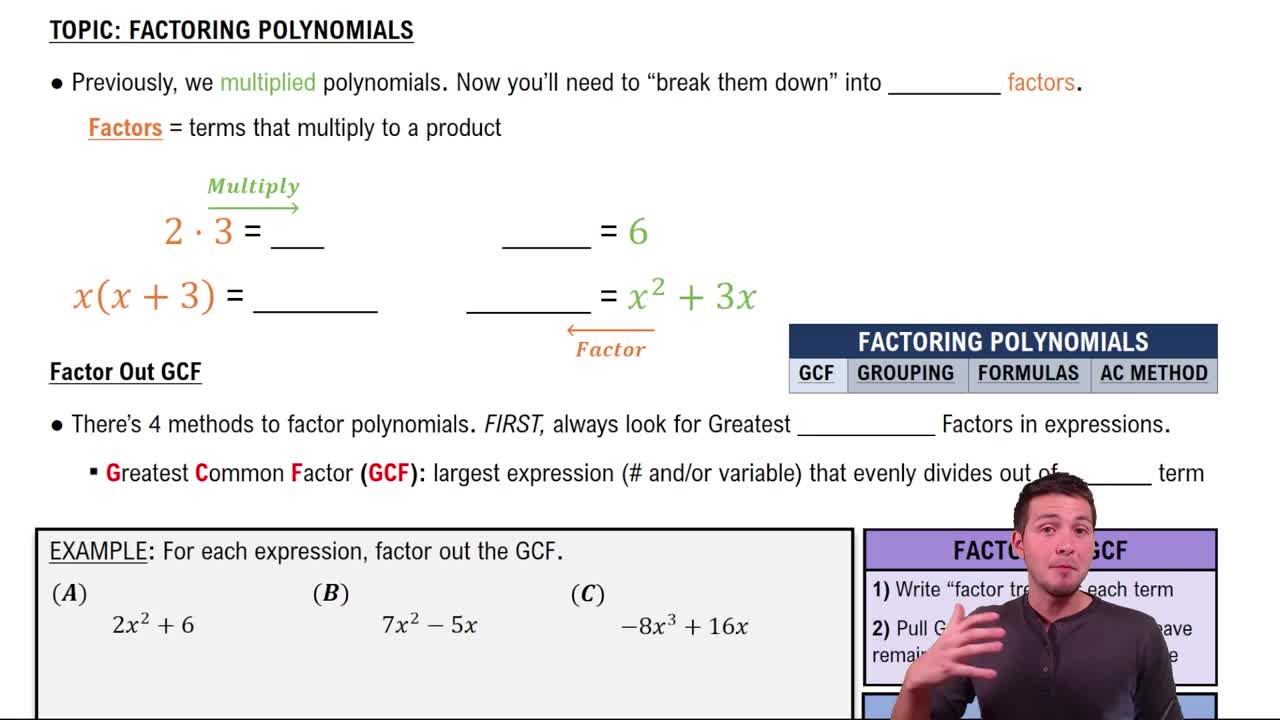
Polynomial Factoring

Factoring polynomials involves rewriting a polynomial as a product of simpler polynomials. This process helps simplify expressions and solve polynomial equations by breaking them down into factors that are easier to work with.
Recommended video:
Guided course
07:30
Introduction to Factoring Polynomials

Grouping Method

The grouping method is a factoring technique where terms in a polynomial are grouped in pairs or sets to find common factors. This method is especially useful for polynomials with four or more terms, allowing you to factor by extracting common binomial factors.
Recommended video:
Guided course
04:36
Factor by Grouping

Rational Root Theorem

The Rational Root Theorem helps identify possible rational roots of a polynomial by considering factors of the constant term and leading coefficient. Testing these roots can simplify factoring by finding zeros that correspond to linear factors.
Recommended video:
Guided course
04:06
Rational Exponents