In Exercises 81–88, a. Find the slant asymptote of the graph of each rational function and b. Follow the seven-step strategy and use the slant asymptote to graph each rational function. f(x)=(x2+x−6)/(x−3)
Ch. 3 - Polynomial and Rational Functions

Chapter 4, Problem 83
Exercises 82–84 will help you prepare for the material covered in the next section. Solve: x2+4x+6=0
Verified step by step guidance1
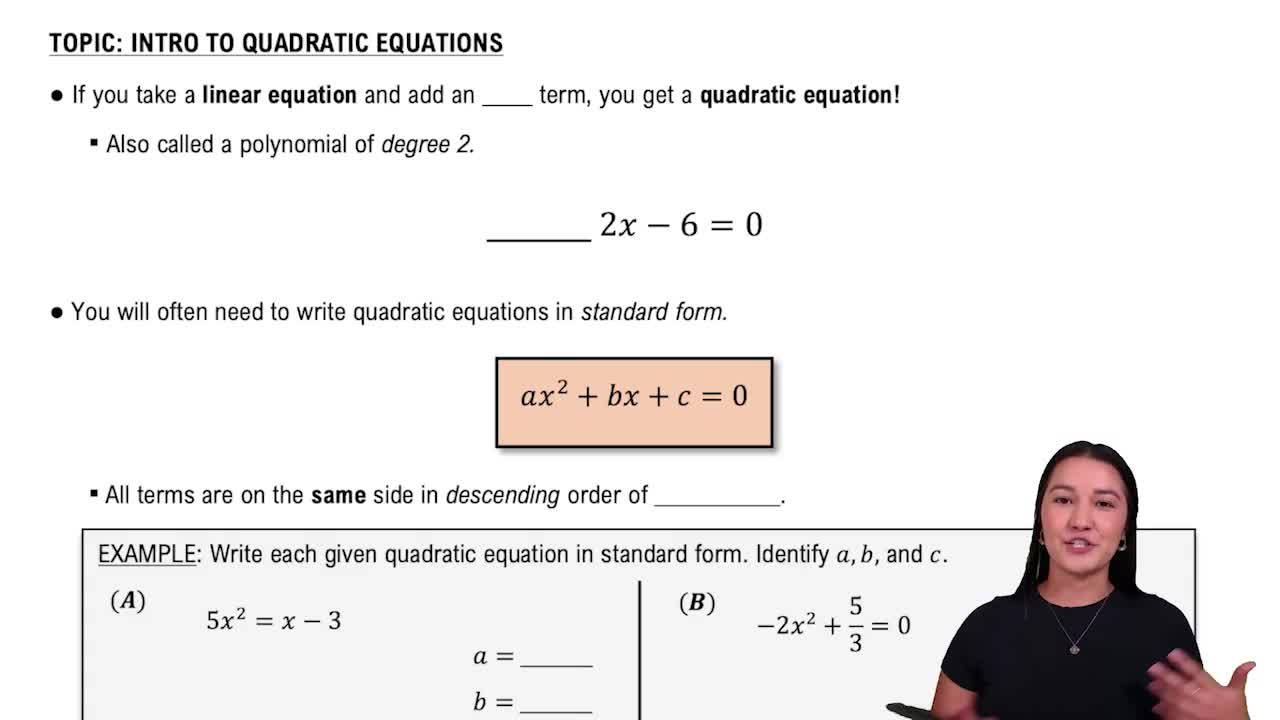
Identify the type of equation given. Here, the equation is a quadratic equation of the form , where the highest power of is 2.
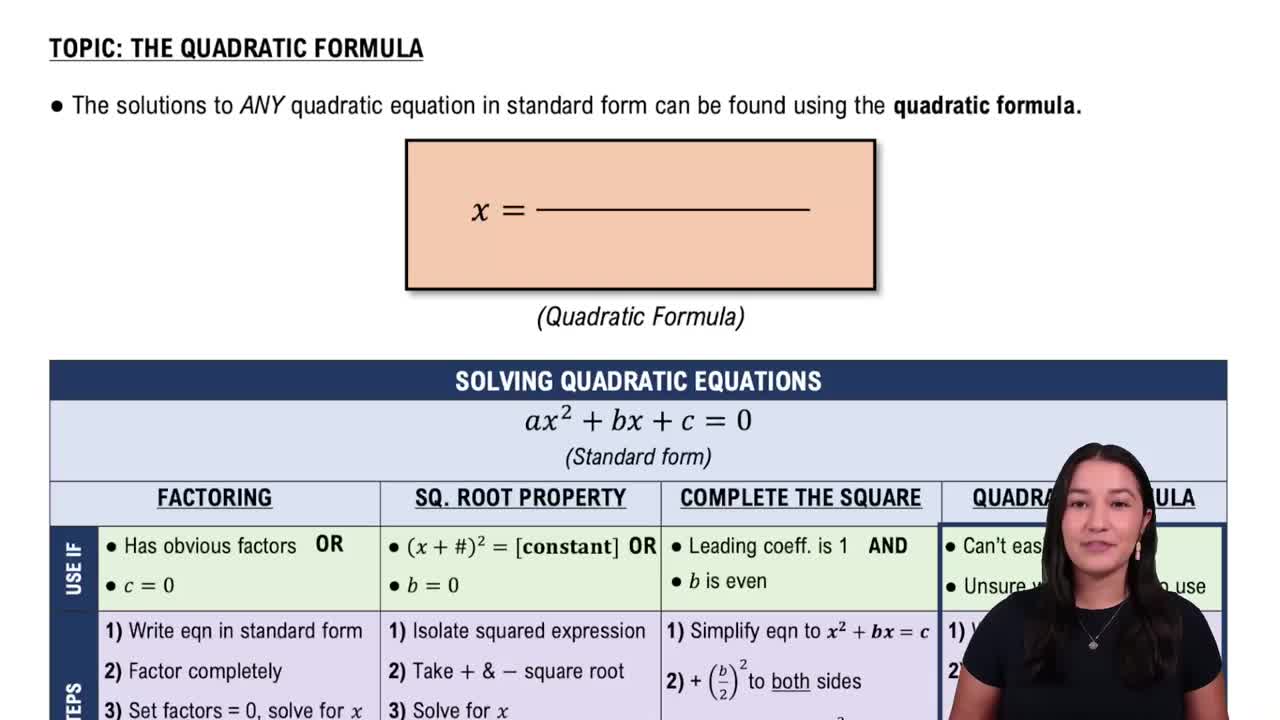
Recall the quadratic formula, which is used to solve any quadratic equation . The formula is .
Identify the coefficients from the equation: , , and .
Substitute the values of , , and into the quadratic formula: .
Simplify the expression under the square root (the discriminant) and then simplify the entire expression to find the two possible values of .

Verified video answer for a similar problem:
This video solution was recommended by our tutors as helpful for the problem above.
Video duration:
3mWas this helpful?
Key Concepts
Here are the essential concepts you must grasp in order to answer the question correctly.
Quadratic Equations
A quadratic equation is a polynomial equation of degree two, generally written as ax² + bx + c = 0. It represents a parabola when graphed, and solving it means finding the values of x that satisfy the equation.
Recommended video:
Introduction to Quadratic Equations
Completing the Square
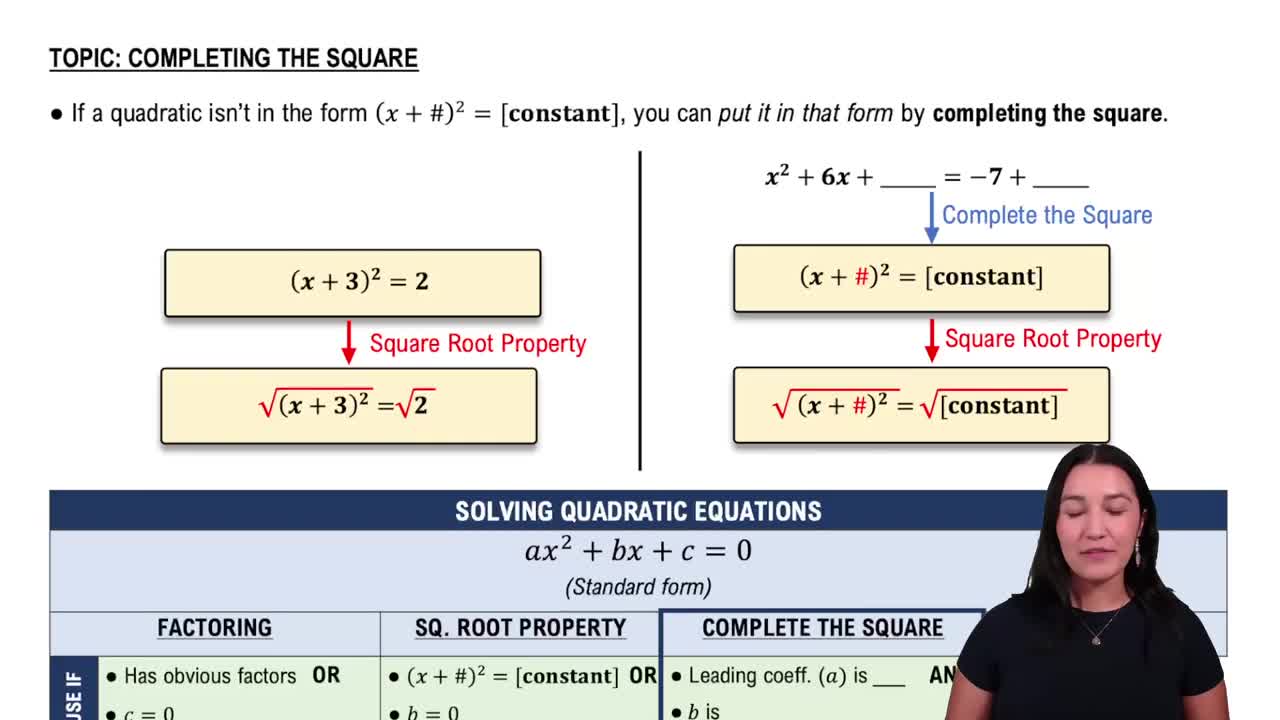
Completing the square is a method used to solve quadratic equations by rewriting the equation in the form (x + p)² = q. This technique transforms the quadratic into a perfect square trinomial, making it easier to solve for x.
Recommended video:
Solving Quadratic Equations by Completing the Square
Quadratic Formula
The quadratic formula, x = (-b ± √(b² - 4ac)) / (2a), provides a direct way to find the roots of any quadratic equation ax² + bx + c = 0. It uses the coefficients to calculate the solutions, including complex roots when the discriminant is negative.
Recommended video:
Solving Quadratic Equations Using The Quadratic Formula
Related Practice
Textbook Question
629
views
Textbook Question
Exercises 82–84 will help you prepare for the material covered in the next section. Let f(x)=an(x4−3x2−4). If f(3)=−150, determine the value of a_n.
370
views
Textbook Question
In Exercises 81–88, a. Find the slant asymptote of the graph of each rational function and b. Follow the seven-step strategy and use the slant asymptote to graph each rational function. f(x)=(x2+1)/x
604
views
Textbook Question
In Exercises 81–88, a. Find the slant asymptote of the graph of each rational function and b. Follow the seven-step strategy and use the slant asymptote to graph each rational function. f(x)=(x2−1)/x
648
views
Textbook Question
Find the inverse of f(x)=(x−10)/(x+10).
559
views
Textbook Question
Exercises 82–84 will help you prepare for the material covered in the next section. Solve: x2+4x−1=0
474
views