Ch. 3 - Polynomial and Rational Functions
Blitzer - College Algebra 8th Edition
Blitzer8th EditionCollege AlgebraISBN: 9780136970514Not the one you use?Change textbook
Chapter 4, Problem 17

In Exercises 15–18, use the Leading Coefficient Test to determine the end behavior of the graph of the given polynomial function. Then use this end behavior to match the polynomial function with its graph. [The graphs are labeled (a) through (d).] <IMAGE>
f(x)=(x3)2f(x)=(x−3)^2

Verified step by step guidance
1
Identify the degree of the polynomial function. Since the function is \(f(x) = (x - 3)^2\), expand or recognize that the degree is 2 because the expression is squared.
Determine the leading coefficient. When expanded, the leading term is \(x^2\), so the leading coefficient is 1, which is positive.
Apply the Leading Coefficient Test: For an even degree polynomial with a positive leading coefficient, the end behavior is that as \(x \to \infty\), \(f(x) \to \infty\), and as \(x \to -\infty\), \(f(x) \to \infty\).
Use this end behavior to match the polynomial with the correct graph. Look for a graph where both ends rise upwards, consistent with the behavior of a positive leading coefficient and even degree.
Confirm that the graph also reflects the vertex at \(x=3\), since the function is \((x-3)^2\), which shifts the parabola to the right by 3 units.

Verified video answer for a similar problem:

This video solution was recommended by our tutors as helpful for the problem above.
Video duration:
3m
Was this helpful?

Key Concepts

Here are the essential concepts you must grasp in order to answer the question correctly.

Leading Coefficient Test

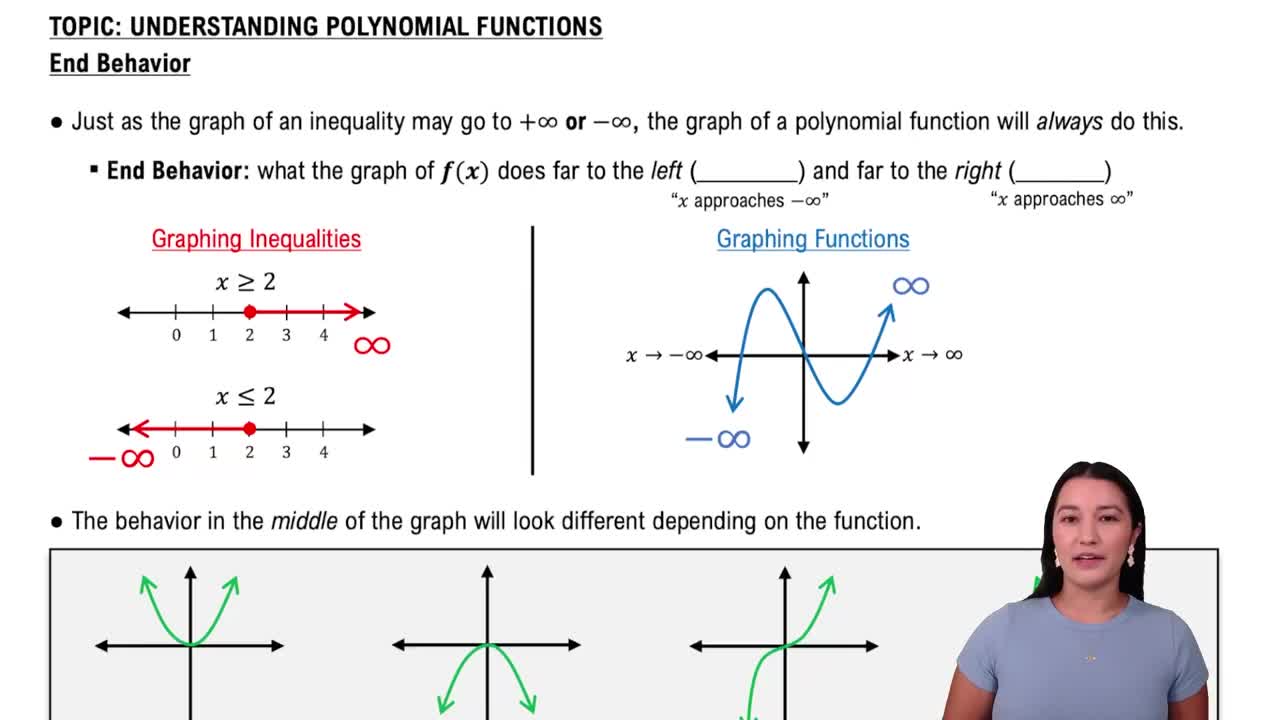
The Leading Coefficient Test helps determine the end behavior of a polynomial function by examining the degree and the leading coefficient. For large positive or negative values of x, the sign and degree dictate whether the graph rises or falls on each end.
Recommended video:
06:08
End Behavior of Polynomial Functions

Polynomial Degree and Its Effect on Graph Shape

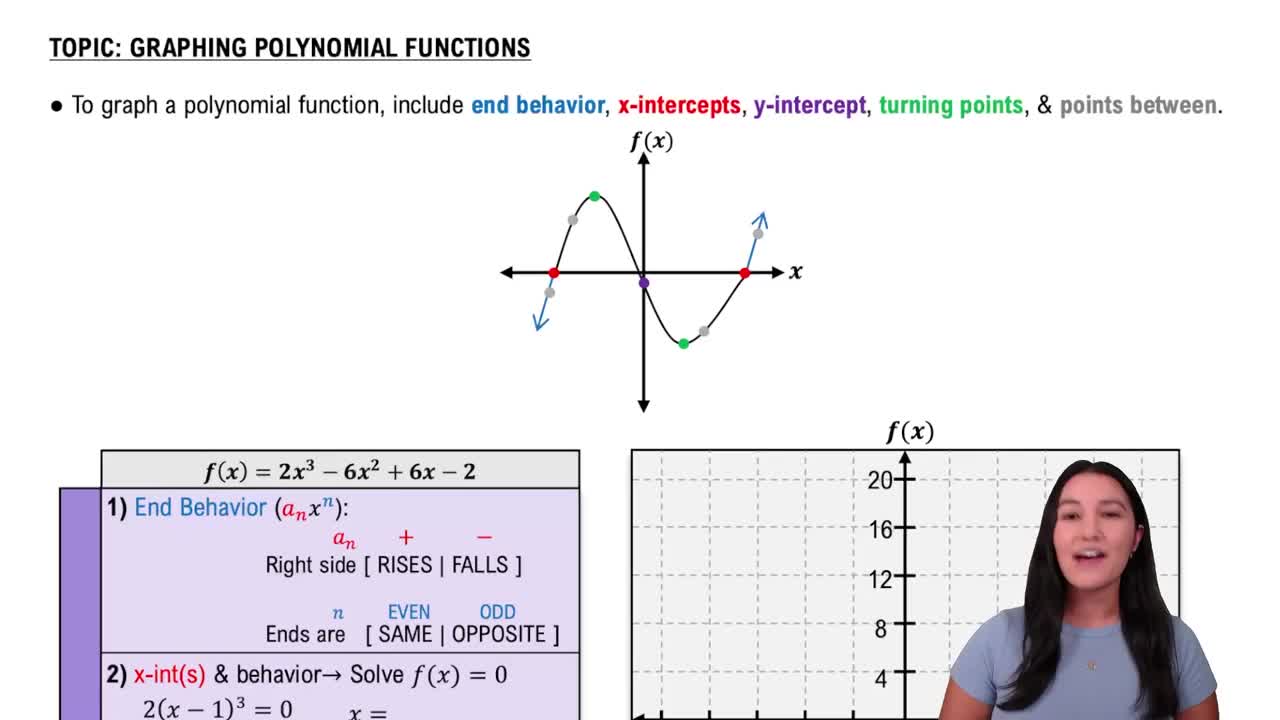
The degree of a polynomial indicates the highest power of x and influences the number of turning points and the general shape of the graph. Even-degree polynomials have similar end behaviors on both sides, while odd-degree polynomials have opposite end behaviors.
Recommended video:
05:25
Graphing Polynomial Functions

End Behavior of Polynomial Functions

End behavior describes how the values of a polynomial function behave as x approaches positive or negative infinity. Understanding this helps match the function to its graph by predicting whether the graph rises or falls at the extremes.
Recommended video:
06:08
End Behavior of Polynomial Functions