
Textbook Question
Solve each polynomial inequality in Exercises 1–42 and graph the solution set on a real number line. Express each solution set in interval notation. (2−x)2(x−7/2)<0
757
views

 Verified step by step guidance
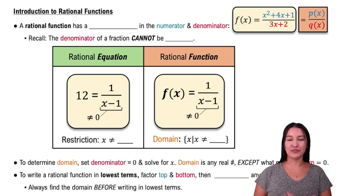
 6:04
6:04
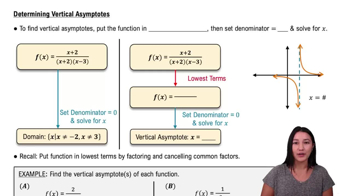 3:12
3:12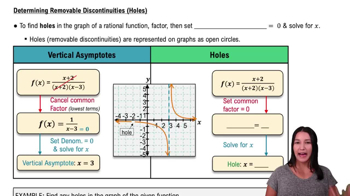 3:34
3:34Solve each polynomial inequality in Exercises 1–42 and graph the solution set on a real number line. Express each solution set in interval notation. (2−x)2(x−7/2)<0
Use synthetic division and the Remainder Theorem to find the indicated function value. f(x)=2x3−11x2+7x−5;f(4)
Use the Intermediate Value Theorem to show that each polynomial has a real zero between the given integers. f(x)=x3−x−1; between 1 and 2
Solve each polynomial inequality in Exercises 1–42 and graph the solution set on a real number line. Express each solution set in interval notation. x(4−x)(x−6)≤0
Use Descartes's Rule of Signs to determine the possible number of positive and negative real zeros for each given function. f(x)=x3+2x2+5x+4
In Exercises 17–38, use the vertex and intercepts to sketch the graph of each quadratic function. Give the equation of the parabola's axis of symmetry. Use the graph to determine the function's domain and range. f(x)=x2+6x+3