Solve each polynomial inequality in Exercises 1–42 and graph the solution set on a real number line. Express each solution set in interval notation. (2−x)2(x−7/2)<0
Ch. 3 - Polynomial and Rational Functions

Chapter 4, Problem 34
Use the Intermediate Value Theorem to show that each polynomial has a real zero between the given integers. f(x)=x3−4x2+2; between 0 and 1
Verified step by step guidance1
Recall the Intermediate Value Theorem (IVT), which states that if a function \(f\) is continuous on a closed interval \([a, b]\) and \(f(a)\) and \(f(b)\) have opposite signs, then there exists at least one \(c\) in \((a, b)\) such that \(f(c) = 0\).
Identify the function and the interval: here, \(f(x) = x^{3} - 4x^{2} + 2\) and the interval is \([0, 1]\).
Evaluate the function at the endpoints of the interval: calculate \(f(0)\) and \(f(1)\).
Check the signs of \(f(0)\) and \(f(1)\): if one is positive and the other is negative, then by the IVT, there is at least one root between 0 and 1.
Conclude that since \(f\) is a polynomial (and thus continuous everywhere) and the function values at 0 and 1 have opposite signs, there must be a real zero of \(f(x)\) between 0 and 1.

Verified video answer for a similar problem:
This video solution was recommended by our tutors as helpful for the problem above.
Video duration:
2mWas this helpful?
Key Concepts
Here are the essential concepts you must grasp in order to answer the question correctly.
Intermediate Value Theorem
The Intermediate Value Theorem states that if a function is continuous on a closed interval [a, b] and takes values f(a) and f(b) at each end, then it takes any value between f(a) and f(b) at some point within the interval. This theorem is used to prove the existence of roots by showing the function changes sign.
Recommended video:
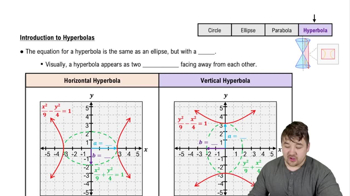
Introduction to Hyperbolas
Continuity of Polynomial Functions
Polynomial functions are continuous everywhere on the real number line, meaning there are no breaks, jumps, or holes in their graphs. This property ensures that the Intermediate Value Theorem can be applied to any interval when dealing with polynomials.
Recommended video:
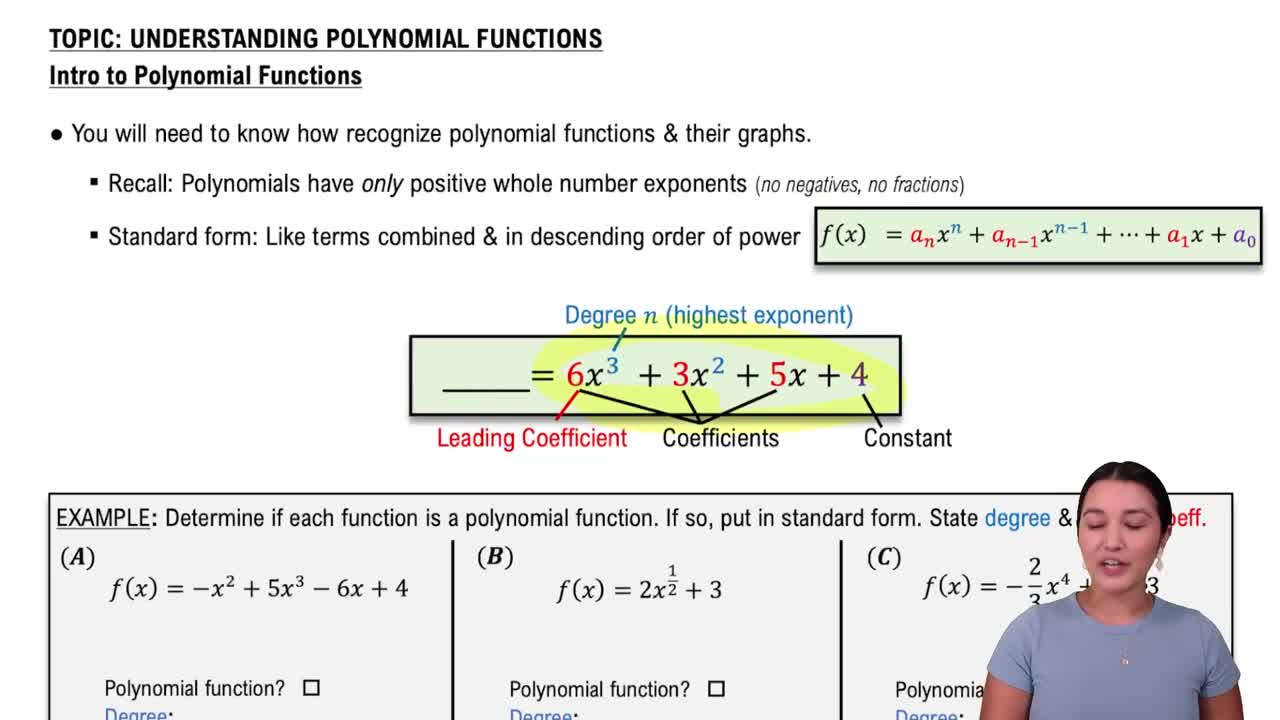
Introduction to Polynomial Functions
Evaluating Function Values at Given Points
To apply the Intermediate Value Theorem, you must calculate the function's values at the endpoints of the interval. If the function values have opposite signs, it indicates the function crosses zero somewhere between those points, confirming the existence of a real root.
Recommended video:
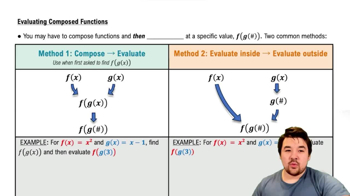
Evaluating Composed Functions
Related Practice
Textbook Question
757
views
Textbook Question
Solve each polynomial inequality in Exercises 1–42 and graph the solution set on a real number line. Express each solution set in interval notation. (1−x)2(x−5/2)<0
380
views
Textbook Question
Use the Intermediate Value Theorem to show that each polynomial has a real zero between the given integers. f(x)=x3−x−1; between 1 and 2
941
views
Textbook Question
Use Descartes's Rule of Signs to determine the possible number of positive and negative real zeros for each given function. f(x)=x3+2x2+5x+4
493
views
Textbook Question
Solve each polynomial inequality in Exercises 1–42 and graph the solution set on a real number line. Express each solution set in interval notation.
521
views
Textbook Question
Use the Intermediate Value Theorem to show that each polynomial has a real zero between the given integers.f(x)=2x4−4x2+1; between -1 and 0
616
views