In Exercises 33–40, use the Intermediate Value Theorem to show that each polynomial has a real zero between the given integers. f(x)=x5−x3−1; between 1 and 2
Ch. 3 - Polynomial and Rational Functions

Chapter 4, Problem 39
Find the horizontal asymptote, if there is one, of the graph of each rational function. g(x)=12x2/(3x2+1)
Verified step by step guidance1
Identify the degrees of the numerator and denominator polynomials in the rational function \(g(x) = \frac{12x^2}{3x^2 + 1}\). The degree of the numerator is 2, and the degree of the denominator is also 2.
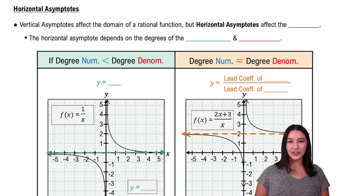
Recall the rule for horizontal asymptotes of rational functions: If the degrees of numerator and denominator are equal, the horizontal asymptote is the ratio of the leading coefficients.
Determine the leading coefficient of the numerator, which is 12 (from \$12x^2\(), and the leading coefficient of the denominator, which is 3 (from \)3x^2$).
Write the horizontal asymptote as \(y = \frac{\text{leading coefficient of numerator}}{\text{leading coefficient of denominator}} = \frac{12}{3}\).
Simplify the fraction to express the horizontal asymptote in simplest form.

Verified video answer for a similar problem:
This video solution was recommended by our tutors as helpful for the problem above.
Video duration:
2mWas this helpful?
Key Concepts
Here are the essential concepts you must grasp in order to answer the question correctly.
Rational Functions
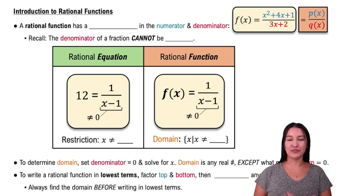
A rational function is a ratio of two polynomials, expressed as f(x) = P(x)/Q(x). Understanding the behavior of rational functions, especially their graphs, is essential for analyzing asymptotes and limits.
Recommended video:
Intro to Rational Functions
Horizontal Asymptotes
A horizontal asymptote describes the behavior of a function as x approaches infinity or negative infinity. It is a horizontal line y = L that the graph approaches but does not necessarily touch, indicating the end behavior of the function.
Recommended video:
Determining Horizontal Asymptotes
Degree of Polynomials in Rational Functions
The degrees of the numerator and denominator polynomials determine the horizontal asymptote. If degrees are equal, the asymptote is the ratio of leading coefficients; if numerator degree is less, asymptote is y=0; if greater, no horizontal asymptote exists.
Recommended video:
Intro to Rational Functions
Related Practice
Textbook Question
519
views
Textbook Question
Use Descartes' Rule of Signs to explain why has no real roots.
950
views
Textbook Question
In Exercises 17–38, use the vertex and intercepts to sketch the graph of each quadratic function. Give the equation of the parabola's axis of symmetry. Use the graph to determine the function's domain and range. f(x)=2x−x2−2
1007
views
Textbook Question
Solve each polynomial inequality in Exercises 1–42 and graph the solution set on a real number line. Express each solution set in interval notation.
507
views
Textbook Question
Solve each polynomial inequality in Exercises 1–42 and graph the solution set on a real number line. Express each solution set in interval notation.
618
views
Textbook Question
Use the Intermediate Value Theorem to show that each polynomial has a real zero between the given integers. f(x)=3x3−10x+9; between -3 and -2
577
views