Ch. 3 - Polynomial and Rational Functions
Blitzer - College Algebra 8th Edition
Blitzer8th EditionCollege AlgebraISBN: 9780136970514Not the one you use?Change textbook
Chapter 4, Problem 41

Find the horizontal asymptote, if there is one, of the graph of each rational function. h(x)=12x3/(3x2+1)

Verified step by step guidance
1
Identify the degrees of the numerator and denominator polynomials in the rational function \(h(x) = \frac{12x^{3}}{3x^{2} + 1}\). The degree of the numerator is 3, and the degree of the denominator is 2.
Recall the rule for horizontal asymptotes of rational functions: - If the degree of the numerator is less than the degree of the denominator, the horizontal asymptote is \(y = 0\). - If the degrees are equal, the horizontal asymptote is the ratio of the leading coefficients. - If the degree of the numerator is greater than the degree of the denominator, there is no horizontal asymptote (there may be an oblique/slant asymptote instead).
Since the degree of the numerator (3) is greater than the degree of the denominator (2), conclude that there is no horizontal asymptote for \(h(x)\).
Optionally, to further analyze the behavior of \(h(x)\) as \(x\) approaches infinity, consider performing polynomial long division or examining the end behavior to find any oblique asymptotes.
Summarize: For \(h(x) = \frac{12x^{3}}{3x^{2} + 1}\), no horizontal asymptote exists because the numerator's degree is higher than the denominator's.

Verified video answer for a similar problem:

This video solution was recommended by our tutors as helpful for the problem above.
Video duration:
1m
Was this helpful?

Key Concepts

Here are the essential concepts you must grasp in order to answer the question correctly.

Rational Functions

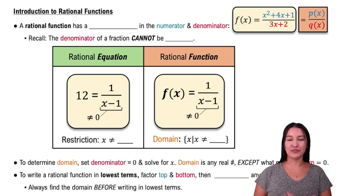
A rational function is a ratio of two polynomials, expressed as f(x) = P(x)/Q(x). Understanding the degrees and leading coefficients of the numerator and denominator polynomials is essential for analyzing the behavior of the function, especially for asymptotes.
Recommended video:
6:04
Intro to Rational Functions

Horizontal Asymptotes

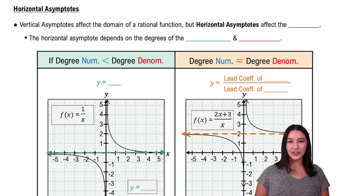
Horizontal asymptotes describe the behavior of a function as x approaches infinity or negative infinity. For rational functions, the horizontal asymptote depends on the degrees of the numerator and denominator polynomials and indicates the value the function approaches at extreme x-values.
Recommended video:
4:48
Determining Horizontal Asymptotes

Degree Comparison of Polynomials

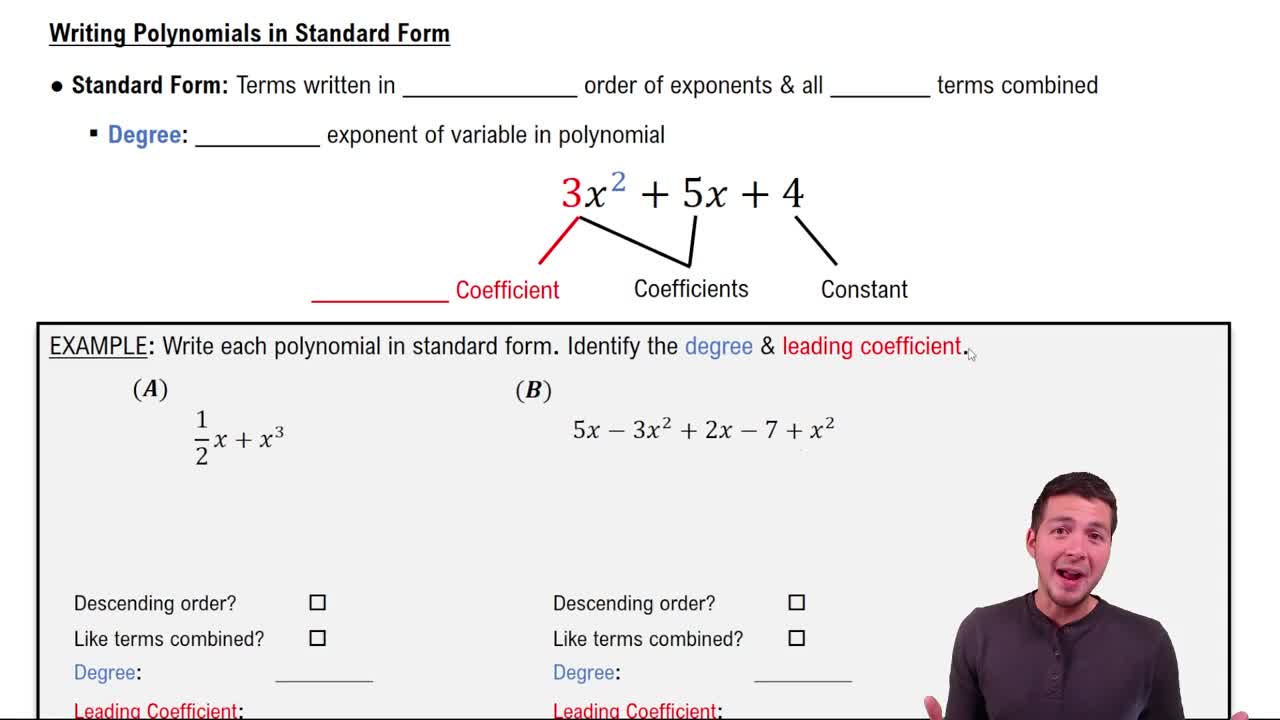
The degree of a polynomial is the highest power of x in the expression. Comparing the degrees of the numerator and denominator in a rational function helps determine the horizontal asymptote: if numerator degree < denominator degree, asymptote is y=0; if equal, ratio of leading coefficients; if numerator degree > denominator degree, no horizontal asymptote.
Recommended video:
Guided course
05:16
Standard Form of Polynomials
Related Practice
Textbook Question

In Exercises 39–52, find all zeros of the polynomial function or solve the given polynomial equation. Use the Rational Zero Theorem, Descartes's Rule of Signs, and possibly the graph of the polynomial function shown by a graphing utility as an aid in obtaining the first zero or the first root. 2x3−x2−9x−4=0

603
views
Textbook Question

For Exercises 40–46, (a) List all possible rational roots or rational zeros. (b) Use Descartes's Rule of Signs to determine the possible number of positive and negative real roots or real zeros. (c) Use synthetic division to test the possible rational roots or zeros and find an actual root or zero. (d) Use the quotient from part (c) to find all the remaining roots or zeros. f(x)=x3+3x24f(x) = x^3 + 3x^2 - 4

785
views
Textbook Question

Solve each polynomial inequality in Exercises 1–42 and graph the solution set on a real number line. Express each solution set in interval notation. x39x2x^3≥9x^2

528
views
Textbook Question

Use synthetic division and the Remainder Theorem to find the indicated function value. f(x)=6x4+10x3+5x2+x+1; f(−2/3)

781
views
Textbook Question

An equation of a quadratic function is given. a) Determine, without graphing, whether the function has a minimum value or a maximum value. b) Find the minimum or maximum value and determine where it occurs. c) Identify the function's domain and its range. f(x)=−4x2+8x−3

1150
views
Textbook Question

Use synthetic division to divide f(x)=x3−4x2+x+6 by x+1. Use the result to find all zeros of f.

1686
views
1
comments