Ch. 3 - Polynomial and Rational Functions
Blitzer - College Algebra 8th Edition
Blitzer8th EditionCollege AlgebraISBN: 9780136970514Not the one you use?Change textbook
Chapter 4, Problem 51

Find all zeros of the polynomial function or solve the given polynomial equation. Use the Rational Zero Theorem, Descartes's Rule of Signs, and possibly the graph of the polynomial function shown by a graphing utility as an aid in obtaining the first zero or the first root. 2x5+7x4−18x2−8x+8=0

Verified step by step guidance
1
Identify the polynomial equation: \(2x^{5} + 7x^{4} - 18x^{2} - 8x + 8 = 0\).
Apply the Rational Zero Theorem to list all possible rational zeros. These are of the form \(\pm \frac{p}{q}\), where \(p\) divides the constant term (8) and \(q\) divides the leading coefficient (2). So possible zeros are \(\pm 1, \pm 2, \pm 4, \pm 8, \pm \frac{1}{2}, \pm \frac{3}{2}\) (check carefully for all divisors).
Use Descartes's Rule of Signs to estimate the number of positive and negative real zeros: Count sign changes in \(f(x)\) for positive zeros and in \(f(-x)\) for negative zeros to narrow down the number of possible real roots.
Test the possible rational zeros from step 2 by substituting them into the polynomial or by using synthetic division to find a zero that makes the polynomial equal to zero.
Once a zero is found, use polynomial division (synthetic or long division) to divide the original polynomial by the corresponding factor \((x - r)\), reducing the polynomial's degree. Then repeat the process on the quotient polynomial to find all remaining zeros.

Verified video answer for a similar problem:

This video solution was recommended by our tutors as helpful for the problem above.
Video duration:
9m
Was this helpful?

Key Concepts

Here are the essential concepts you must grasp in order to answer the question correctly.

Rational Zero Theorem

The Rational Zero Theorem helps identify all possible rational roots of a polynomial equation by considering factors of the constant term and the leading coefficient. These possible zeros are tested to find actual roots, simplifying the process of solving higher-degree polynomials.
Recommended video:
Guided course
02:58
Rationalizing Denominators

Descartes's Rule of Signs

Descartes's Rule of Signs provides a way to estimate the number of positive and negative real zeros of a polynomial by counting sign changes in the polynomial and its substitution with negative variable values. This helps narrow down the search for roots before testing candidates.
Recommended video:
Guided course
6:54
Cramer's Rule - 2 Equations with 2 Unknowns

Graphing Polynomial Functions

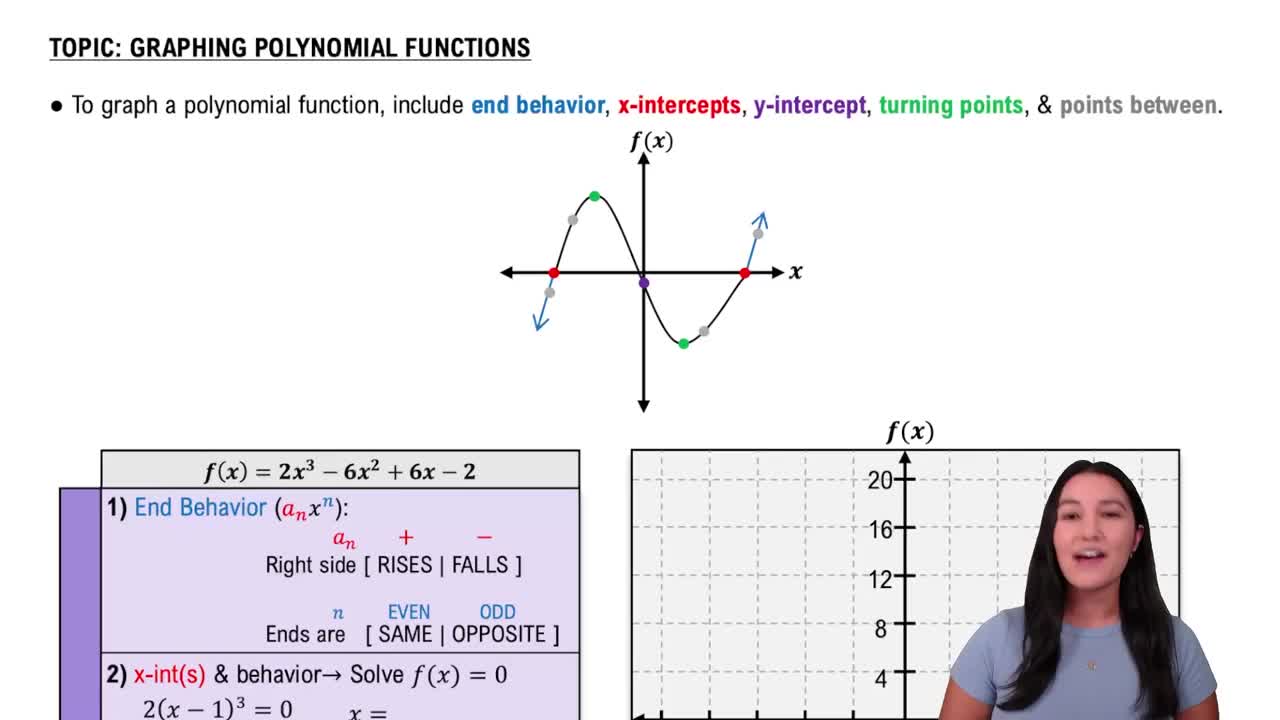
Graphing a polynomial function using a graphing utility visually reveals approximate locations of zeros and the behavior of the function. This aids in identifying initial roots and understanding multiplicity and end behavior, which supports algebraic methods in solving the equation.
Recommended video:
05:25
Graphing Polynomial Functions