Find all zeros of the polynomial function or solve the given polynomial equation. Use the Rational Zero Theorem, Descartes's Rule of Signs, and possibly the graph of the polynomial function shown by a graphing utility as an aid in obtaining the first zero or the first root. f(x)=3x4−11x3−x2+19x+6
Ch. 3 - Polynomial and Rational Functions

Chapter 4, Problem 47
Use transformations of f(x)=1/x or f(x)=1/x2 to graph each rational function. h(x)=(1/x) + 2
Verified step by step guidance1
Identify the base function given, which is \( f(x) = \frac{1}{x} \). This is a rational function with a vertical asymptote at \( x = 0 \) and a horizontal asymptote at \( y = 0 \).
Look at the given function \( h(x) = \frac{1}{x} + 2 \). Notice that it is the base function \( \frac{1}{x} \) plus 2, which means the graph of \( f(x) \) is shifted vertically.
Understand that adding 2 to the function shifts the entire graph up by 2 units. This means the horizontal asymptote, originally at \( y = 0 \), will move to \( y = 2 \).
The vertical asymptote remains unchanged at \( x = 0 \) because the transformation does not affect the denominator.
To sketch the graph, start with the graph of \( f(x) = \frac{1}{x} \), then shift every point up by 2 units, and draw the new horizontal asymptote at \( y = 2 \) while keeping the vertical asymptote at \( x = 0 \).

Verified video answer for a similar problem:
This video solution was recommended by our tutors as helpful for the problem above.
Video duration:
5mWas this helpful?
Key Concepts
Here are the essential concepts you must grasp in order to answer the question correctly.
Parent Rational Functions
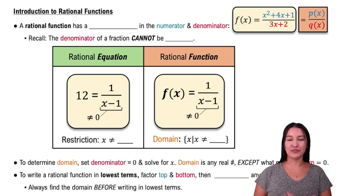
The parent functions f(x) = 1/x and f(x) = 1/x² are basic rational functions with distinct shapes and asymptotes. Understanding their graphs, including vertical and horizontal asymptotes, is essential as they serve as the starting point for transformations.
Recommended video:
Intro to Rational Functions
Transformations of Functions
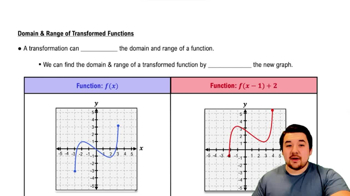
Transformations involve shifting, stretching, compressing, or reflecting the graph of a function. For h(x) = 1/x + 2, the '+ 2' indicates a vertical shift upward by 2 units, moving the entire graph and its horizontal asymptote accordingly.
Recommended video:
Domain & Range of Transformed Functions
Asymptotes of Rational Functions
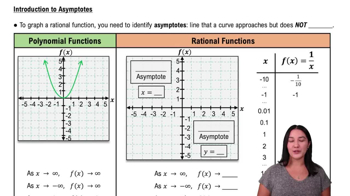
Asymptotes are lines that the graph approaches but never touches. For rational functions like 1/x, vertical asymptotes occur where the denominator is zero, and horizontal asymptotes describe end behavior. Transformations affect the position of these asymptotes.
Recommended video:
Introduction to Asymptotes
Related Practice
Textbook Question
1073
views
Textbook Question
In Exercises 45–46, describe in words the variation shown by the given equation. z = kx^2 √y
534
views
Textbook Question
Give the domain and the range of each quadratic function whose graph is described. Maximum = -6 at x = 10
1089
views
Textbook Question
Solve each rational inequality in Exercises 43–60 and graph the solution set on a real number line. Express each solution set in interval notation. (−x+2)/(x−4)≥0
537
views
Textbook Question
In Exercises 47–48, find an nth-degree polynomial function with real coefficients satisfying the given conditions. Verify the real zeros and the given function value. n = 3; 2 and 2 - 3i are zeros; f(1) = -10
1172
views
Textbook Question
Solve each rational inequality in Exercises 43–60 and graph the solution set on a real number line. Express each solution set in interval notation. (−x−3)/(x+2)≤0
489
views
