Solve each rational inequality in Exercises 43–60 and graph the solution set on a real number line. Express each solution set in interval notation. (4−2x)/(3x+4)≤0
Ch. 3 - Polynomial and Rational Functions

Chapter 4, Problem 51
Use transformations of f(x)=1/x or f(x)=1/x2 to graph each rational function. g(x)=1/(x+2)2
Verified step by step guidance1
Identify the base function given, which is \( f(x) = \frac{1}{x^2} \). This function has a vertical asymptote at \( x=0 \) and a horizontal asymptote at \( y=0 \).
Recognize that the function \( g(x) = \frac{1}{(x+2)^2} \) is a transformation of \( f(x) = \frac{1}{x^2} \) involving a horizontal shift.
Determine the horizontal shift by setting the inside of the denominator equal to zero: \( x + 2 = 0 \) which gives \( x = -2 \). This means the graph of \( f(x) \) shifts 2 units to the left.
Update the vertical asymptote from \( x=0 \) to \( x = -2 \) because the denominator is zero at \( x = -2 \). The horizontal asymptote remains \( y=0 \) since the degree of the numerator is less than the degree of the denominator.
Sketch the graph by shifting the original \( f(x) = \frac{1}{x^2} \) curve 2 units to the left, keeping the shape the same, with the vertical asymptote at \( x = -2 \) and the horizontal asymptote at \( y=0 \).

Verified video answer for a similar problem:
This video solution was recommended by our tutors as helpful for the problem above.
Video duration:
6mWas this helpful?
Key Concepts
Here are the essential concepts you must grasp in order to answer the question correctly.
Parent Rational Functions
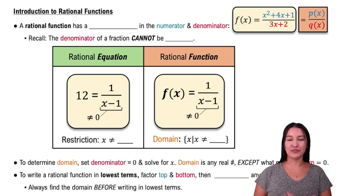
Parent rational functions like f(x) = 1/x and f(x) = 1/x² serve as the basic models for more complex rational functions. Understanding their graphs, including asymptotes and general shape, is essential before applying transformations. For example, f(x) = 1/x has vertical and horizontal asymptotes at x=0 and y=0, respectively.
Recommended video:
Intro to Rational Functions
Transformations of Functions
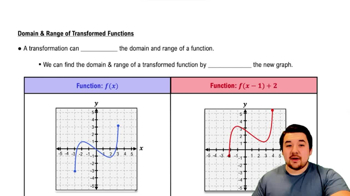
Transformations involve shifting, stretching, compressing, or reflecting the graph of a function. For g(x) = 1/(x+2)², the '+2' inside the denominator shifts the graph horizontally left by 2 units. Recognizing how changes inside the function affect the graph helps in sketching the transformed function accurately.
Recommended video:
Domain & Range of Transformed Functions
Asymptotes of Rational Functions
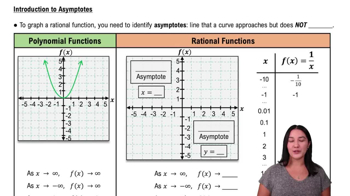
Asymptotes are lines that the graph approaches but never touches. Vertical asymptotes occur where the denominator is zero, indicating undefined points, while horizontal asymptotes describe end behavior as x approaches infinity. For g(x) = 1/(x+2)², the vertical asymptote is at x = -2, and the horizontal asymptote is y = 0.
Recommended video:
Introduction to Asymptotes
Related Practice
Textbook Question
458
views
Textbook Question
Solve each rational inequality in Exercises 43–60 and graph the solution set on a real number line. Express each solution set in interval notation. (3x+5)/(6−2x)≥0
502
views
Textbook Question
In Exercises 49–50, find all the zeros of each polynomial function and write the polynomial as a product of linear factors. g(x) = x^4 - 6x^3 + x^2 + 24x + 16
732
views
Textbook Question
In Exercises 51–54, graphs of fifth-degree polynomial functions are shown. In each case, specify the number of real zeros and the number of imaginary zeros. Indicate whether there are any real zeros with multiplicity other than 1.
704
views
Textbook Question
Write an equation in vertex form of the parabola that has the same shape as the graph of f(x) = 2x2 but with the given point as the vertex. (−10, −5)
1031
views
Textbook Question
Solve each rational inequality in Exercises 43–60 and graph the solution set on a real number line. Express each solution set in interval notation. x/(x−3)>0
557
views