Ch. 3 - Polynomial and Rational Functions
Blitzer - College Algebra 8th Edition
Blitzer8th EditionCollege AlgebraISBN: 9780136970514Not the one you use?Change textbook
Chapter 4, Problem 87

In Exercises 81–88, a. Find the slant asymptote of the graph of each rational function and b. Follow the seven-step strategy and use the slant asymptote to graph each rational function. f(x)=(x3+1)/(x2+2x)

Verified step by step guidance
1
Step 1: Identify the degrees of the numerator and denominator. The numerator is \(x^{3} + 1\) (degree 3) and the denominator is \(x^{2} + 2x\) (degree 2). Since the degree of the numerator is exactly one more than the degree of the denominator, a slant (oblique) asymptote exists.
Step 2: Perform polynomial long division to divide the numerator \(x^{3} + 1\) by the denominator \(x^{2} + 2x\). This will give you a quotient (which represents the slant asymptote) and a remainder.
Step 3: Write the quotient from the division as the equation of the slant asymptote. The slant asymptote will be of the form \(y = \) (quotient polynomial).
Step 4: Use the seven-step strategy to analyze the function: (1) Find the domain by identifying values that make the denominator zero, (2) Find intercepts by setting numerator and denominator equal to zero appropriately, (3) Determine vertical asymptotes from the denominator zeros, (4) Find the slant asymptote from the division, (5) Analyze end behavior using the slant asymptote, (6) Plot key points and asymptotes, (7) Sketch the graph using all gathered information.
Step 5: Use the slant asymptote as a guide for the end behavior of the graph, noting that as \(x\) approaches infinity or negative infinity, the graph of \(f(x)\) will approach the slant asymptote line.

Verified video answer for a similar problem:

This video solution was recommended by our tutors as helpful for the problem above.
Video duration:
25m
Was this helpful?

Key Concepts

Here are the essential concepts you must grasp in order to answer the question correctly.

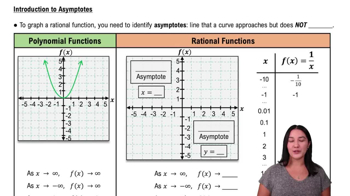
Slant (Oblique) Asymptotes

A slant asymptote occurs when the degree of the numerator is exactly one more than the degree of the denominator in a rational function. It represents the line that the graph approaches as x approaches infinity or negative infinity. Finding the slant asymptote involves polynomial division to express the function as a linear term plus a remainder over the denominator.
Recommended video:
6:24
Introduction to Asymptotes

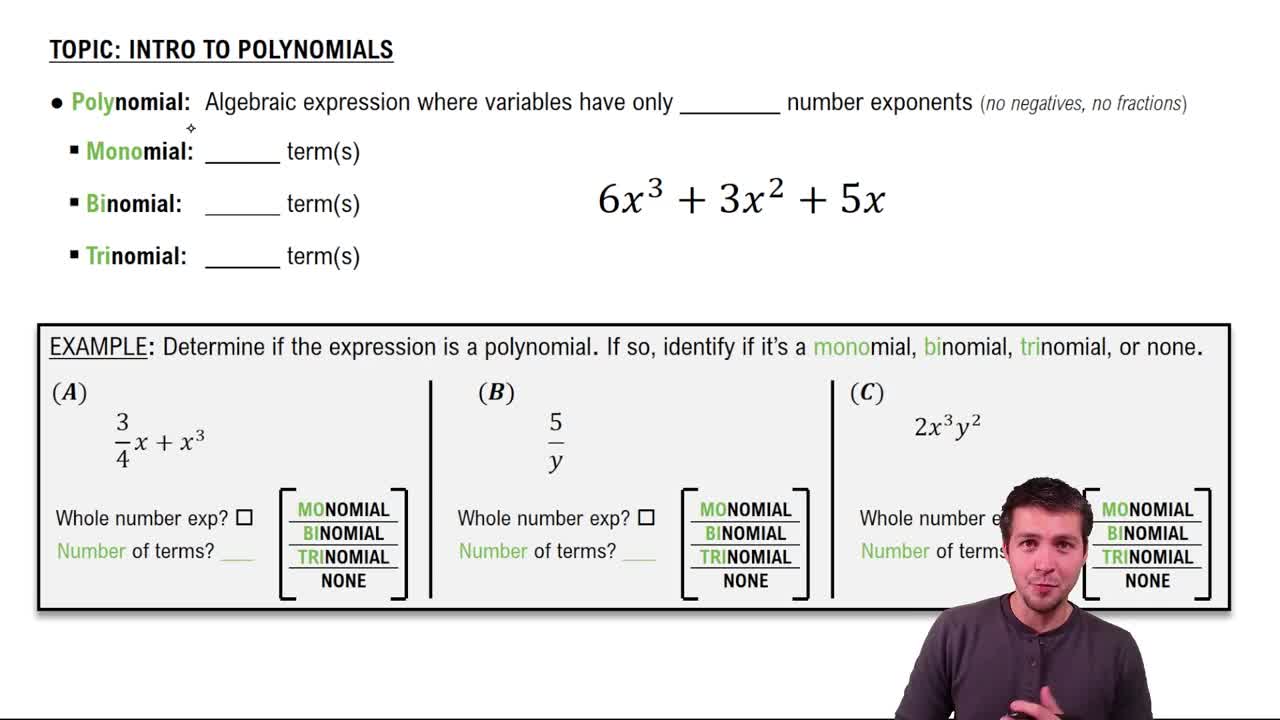
Polynomial Long Division

Polynomial long division is a method used to divide one polynomial by another, similar to numerical long division. It helps rewrite a rational function into a quotient plus a remainder, which is essential for identifying slant asymptotes. The quotient gives the equation of the slant asymptote when the numerator's degree is one higher than the denominator's.
Recommended video:
Guided course
05:13
Introduction to Polynomials

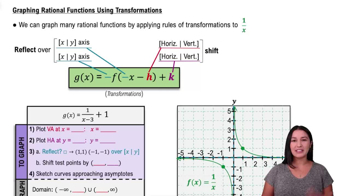
Graphing Rational Functions Using Asymptotes

Graphing rational functions involves understanding their asymptotes, intercepts, and behavior near undefined points. The slant asymptote guides the end behavior of the graph, showing how the function behaves for large values of x. Following a step-by-step strategy ensures accurate plotting by considering intercepts, asymptotes, and test points.
Recommended video:
5:31
Graphing Rational Functions Using Transformations