
Textbook Question
Use long division to rewrite the equation for g in the form quotient + remainder/divisor. Then use this form of the function's equation and transformations of f(x) = 1/x to graph g. g(x) = (2x+7)/(x+3)
1110
views

 Verified step by step guidance
 05:07
05:07
 02:58
02:58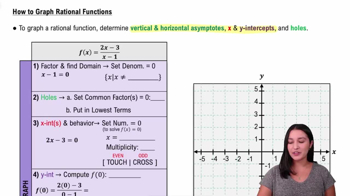 8:19
8:19Use long division to rewrite the equation for g in the form quotient + remainder/divisor. Then use this form of the function's equation and transformations of f(x) = 1/x to graph g. g(x) = (2x+7)/(x+3)
Solve each inequality in Exercises 86–91 using a graphing utility. (x - 4)/(x - 1) ≤ 0
In Exercises 89–94, the equation for f is given by the simplified expression that results after performing the indicated operation. Write the equation for f and then graph the function. (1 − 3/(x+2)) / (1 + 1/(x−2))
Solve each inequality in Exercises 86–91 using a graphing utility. 1/(x + 1) ≤ 2/(x + 4)
Solve each inequality in Exercises 86–91 using a graphing utility. x3 + x2 - 4x - 4 > 0
In Exercises 89–94, the equation for f is given by the simplified expression that results after performing the indicated operation. Write the equation for f and then graph the function. 5x2/(x2−4) ⋅ (x2+4x+4)/(10x3)